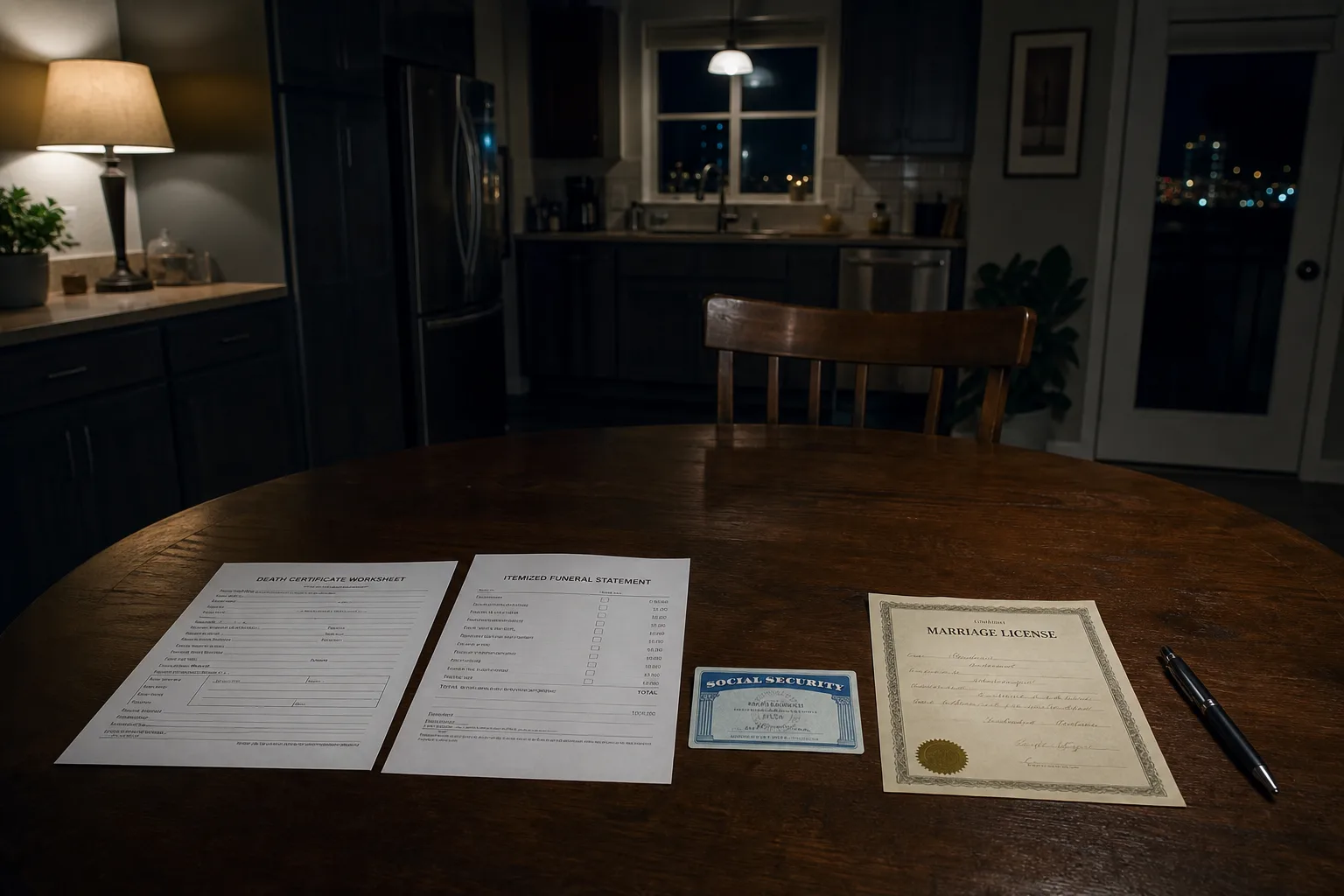
A family calls a funeral home on a Tuesday evening and assumes the first question will be about a casket. It is almost never about a casket. It is about who has the legal authority to direct the disposition of the body, because nothing else can begin until that person is identified and has signed something. The order of the first week is not a matter of taste or pacing. It is set by a short sequence of documents, each of which cannot be completed until the one before it is, and the answers entered on those documents govern ordinary errands months later: closing a checking account, transferring a car title, filing a life insurance claim, stopping a pension deposit.
The authorization that comes before anything else
Before a funeral home moves a body, someone signs a transfer or removal authorization. The form is usually one page. Its operative sentence typically reads close to this: the undersigned represents that he or she is the person with the right to control disposition of the remains under applicable state law, and authorizes removal and care pending further instruction.
That representation matters because most states publish a priority list in statute. Surviving spouse first, then adult children as a group, then parents, then siblings, and so on down. A named agent under a health care power of attorney or a signed disposition directive can sit above all of them. When the list is clear, the signature takes two minutes. When it is not clear, for example when four adult children must act together and one is unreachable, the funeral home will wait, and the entire week shifts behind that wait.
The practical consequence is one nobody anticipates: refrigeration and shelter are often billed by the day. A family waiting on a sibling's flight is not just waiting. They are accruing a line item. Naming the authorized person in the first hour, and getting the others to confirm in writing if the statute requires a group, is the single cheapest thing that happens all week.
The worksheet that the rest of the year runs on
Within a day or two, a funeral director hands over a death certificate worksheet and asks a person to serve as the informant. This is the document with the longest shadow. It asks for the decedent's Social Security number, date and city of birth, father's full name, mother's full maiden name, usual occupation, kind of business or industry, highest level of education completed, marital status at the time of death, and the surviving spouse's name before first marriage.
People answer these from memory, at night, three days into not sleeping. Then the certificate is filed and becomes the record.
Here is the part that is rarely traced back. A life insurer comparing a claim form to a certified copy is matching strings. If the policy application says the mother's maiden name is one thing and the certificate says another, the file goes to a reviewer, and the review takes weeks that the household may not have. A wrong middle initial on a car title transfer sends someone back to the DMV a second time. A Social Security number transposed by two digits does not stop the funeral, but it surfaces at a bank branch in March.
Two habits fix most of it. Bring documents rather than memory: a Social Security card, a birth certificate, a marriage license, a discharge paper if there was military service. And read the proof back before the director files. Amending a filed certificate is a separate process with its own form and its own fee, and it takes longer than getting it right the first time.
The statement of goods and services, and the two columns that behave differently
Funeral homes provide an itemized price list before selections are discussed, and an itemized statement of what was actually selected before the arrangement conference ends. The Federal Trade Commission oversees pricing disclosure in the funeral trade, and the itemization is the reason a family can decline items line by line rather than buying a package.
Read the statement for its structure, not just its total. Most have two distinct groupings. One is the funeral home's own charges: the basic services of the director and staff, transfer of remains, embalming, use of facilities, the vehicle, the casket or alternative container. The other is cash advance items, which are sums the funeral home pays to third parties and passes through: the cemetery's opening and closing charge, the crematory fee, certified copies, the clergy honorarium, the obituary placement, the death notice, flowers.
The statement will usually carry a sentence to the effect that the charge for a cash advance item may exceed the amount paid to the third party. That line is disclosure, not a warning. But it explains why a $400 figure on the statement and a $400 figure on a cemetery invoice are not always the same transaction. Ask which cash advance items are marked up and by how much. Ask which ones the family may pay directly. Both answers are routinely given, and both change the total.
Why the date moves, and who actually moves it
Families believe they choose the service date. What they choose is a preference, which is then reconciled against a chain of signatures. A physician, medical examiner, or coroner must certify the cause of death. The funeral director files the certificate with the local registrar. The registrar issues a permit for disposition. The cemetery or crematory will not proceed without it.
If the attending physician is off for the weekend, the certificate waits. If the case is referred for investigation, it waits longer, and the funeral home will say so plainly rather than guess. Meanwhile the cemetery's own rulebook is running in parallel, and it decides things the catalog does not: whether an outer burial container is required, which days and hours interments are performed, how much notice the grounds crew needs. Two business days' notice is common. That requirement, not the family's calendar, often fixes the morning.
Knowing this early converts a frustrating week into a scheduled one. Ask on day one what the interment notice period is and whether the certification is expected to be routine. Set the date after those two answers, not before.
Ordering the copies you will need in week five
Certified copies of the death certificate are ordered during the arrangement conference because that is the cheapest and simplest moment to do it. Each institution that touches the estate wants one, and many will not return it. A workable count comes from listing the accounts rather than guessing: each bank and credit union, each life insurance policy, each brokerage and retirement account, each vehicle title, the mortgage servicer, the pension or annuity provider, Social Security if the claim is filed in person, and the county recorder if real property transfers. Order a few beyond that list. Additional copies later cost more per copy and arrive by mail.
The week has an order because the documents have one. Working it in that order, with the papers on the table instead of the answers in someone's head, is what keeps the following months quiet.