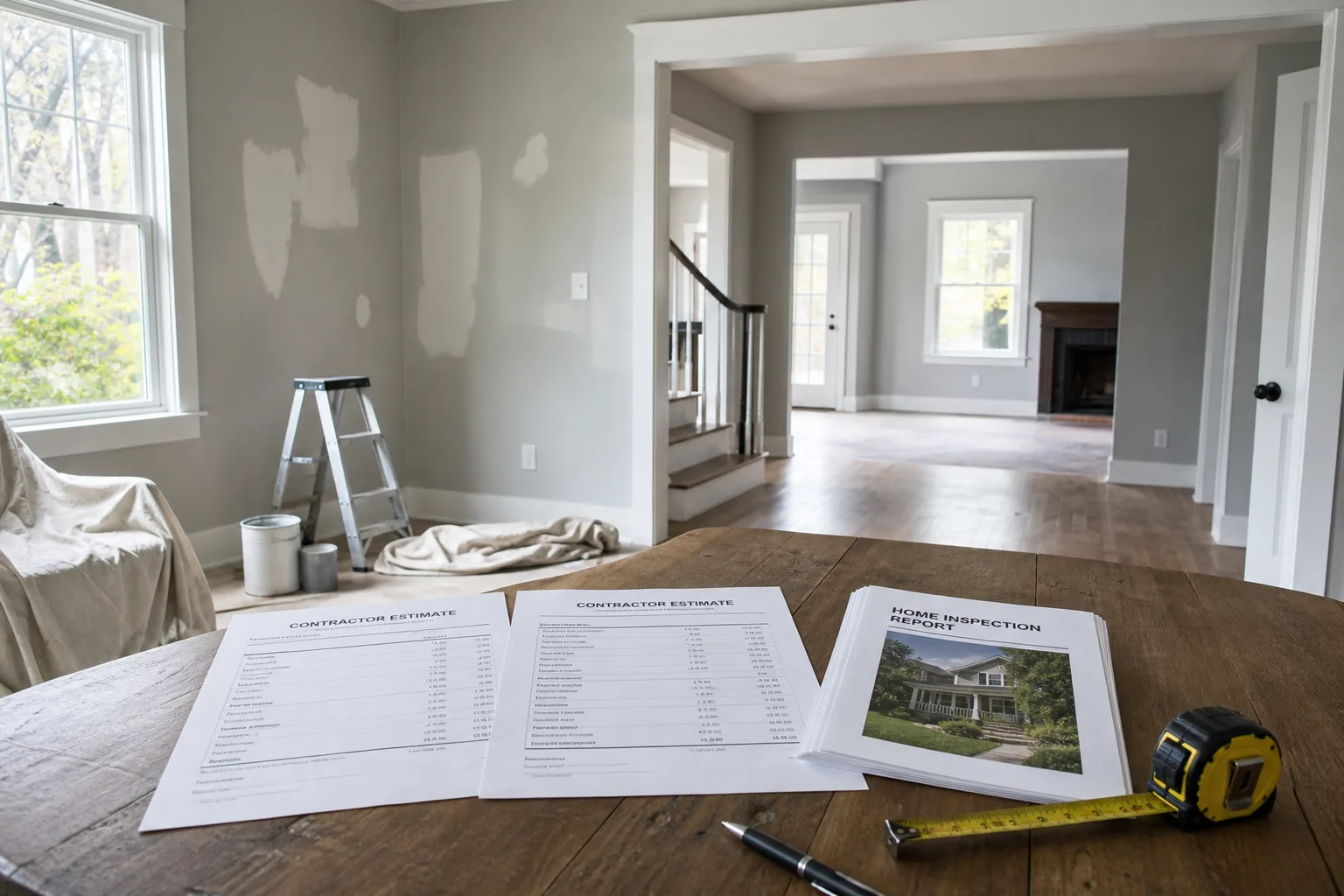
A seller I worked with last spring had two quotes on the kitchen table. One was $41,000 for a kitchen with new cabinets, new counters and a relocated range. The other was $6,800 for new counters, new hardware, paint, and a licensed electrician to fix two outlets that had been flagged on a prior inspection. She wanted to know which one the market would pay her back for. The honest answer is that neither one pays back in full, and the cheaper one loses less. That is almost always the shape of it, and after enough of these the question stops being which improvement adds value and becomes which improvement removes an objection.
What has changed over the past decade is not the arithmetic. It is who is looking, what they can see before they arrive, and what a lender's appraiser is willing to write down. Those three things have moved enough that advice from 2015 now points in the wrong direction on at least two of the five checks below.
1. Is this a repair the buyer was going to make you do anyway?
The highest-return category of pre-sale work is not an improvement at all. It is the thing an inspector will find, write up, and hand to a buyer's agent as leverage. A failing water heater, an active roof leak, knob-and-tube in a finished attic, a furnace past its service life with no recent tag on it. You do not get paid for fixing these. You get to not pay for them twice, once as a price reduction and once as a credit negotiated under time pressure after the inspection, when you have lost the ability to shop the job.
Ten years ago plenty of sellers rolled the dice here, because inspection reports were shorter and buyers in a hot market frequently waived the contingency outright. The waiving has thinned out in most markets, and the reports have gotten longer and more photographic. A buyer now receives a PDF with forty images and a summary page. The summary page is what gets negotiated against. Anything on it costs you roughly double what it would have cost you to handle in advance, on your own schedule, with three quotes.
The simple version of this check: get your own inspection before you list, and fix only what lands on the summary. Not the recommendations. The summary.
2. Can an appraiser actually count it?
Appraisers work from comparable sales and from a short list of countable attributes. Bedroom count. Bathroom count. Finished square footage, measured to a standard. Garage spaces. Lot size. Condition rating. If the work you are considering does not change one of those, it is not going to show up directly in the appraised value, no matter how good it looks.
This is where permits matter more than they used to. A finished basement without a permit is, to an appraiser working carefully, not finished square footage. It is a room of indeterminate status. Ten years ago more of this slipped through. Now the appraisal is reviewed by an automated system before a human signs off on the file, and county permit records are easier to pull than they were. A converted garage that never got a certificate of occupancy will be treated as a garage you no longer have.
If you are weighing a project that genuinely adds a countable attribute, such as a second full bath in a one-bath house, pull three comparable sales in your own neighborhood with the extra bath and three without. The spread between them is your ceiling. It is a real number from your own ZIP code, and it beats any national percentage you will read.
3. What does the listing field say, and did that field exist in 2015?
Buyers now filter before they ever see a photograph. The filter list has grown. Central air, in-unit laundry, EV-ready outlet, solar, heat pump, fiber availability: these are checkbox fields in most multiple listing services now, and several of them were free-text notes or nothing at all a decade ago. Being filtered out of a search is a different kind of loss than being disliked at a showing. You never find out it happened.
Energy work sits in an odd spot here. The Department of Energy oversees federal efficiency standards and the Energy Star labeling program, and the equipment side of the market has moved fast enough that a high-efficiency system installed in 2015 is no longer a selling point and may simply be mid-pack. But the checkbox is binary. A house with a heat pump appears in a search for heat pumps. A house with an exceptionally good gas furnace does not appear in anything.
Before you spend on efficiency work, check whether there is a utility rebate or a federal credit that covers part of it, and check whether your local MLS has a field for it. Those two questions, answered in twenty minutes, usually settle whether the project is worth doing now or worth leaving as a disclosure for the buyer to act on.
4. What is the simplest version of this project, and why has nobody quoted it?
Contractors quote what they do. A cabinet company quotes cabinets. If you ask a kitchen remodeler about your kitchen, you will receive a kitchen remodel. The simplest version almost never arrives unsolicited, because the simplest version is small, low-margin work that a busy crew would rather not schedule.
Ask for it explicitly. Refinishing existing hardwood instead of replacing it. Painting cabinet boxes and replacing only the doors. Reglazing a tub rather than tearing out the surround. New light fixtures and switch plates throughout a house, which costs a few hundred dollars in parts and changes the feel of every photograph.
The labor-to-materials ratio has shifted meaningfully over ten years. Materials went up and came partway back down. Skilled labor went up and stayed. That shift favors projects that use material and little labor, and penalizes projects that involve demolition, trades sequencing, and multiple site visits. Ten years ago the gap between the cheap approach and the thorough approach was narrower. Now it is wide enough that the cheap approach is often the correct one on a house you are leaving.
5. Does it finish before the listing date, with room to spare?
A half-done project is worth less than no project. Buyers price unfinished work at the cost of finishing it plus a penalty for the uncertainty, and that penalty is large. So the calendar check comes before the money check.
Two things have changed here. Permit review in many jurisdictions now runs through an online portal, which is a genuine improvement on counter visits, but the queue can still run weeks. And lead times on anything special-ordered, particularly windows, cabinets and some appliances, have not returned to where they were. Confirm the delivery date in writing before you sign, not the order date.
Work backward from the week you want photographs taken. Add two weeks. If the project does not fit inside that, it is a project for the next owner, and the right move is to price the house accordingly and say so plainly in the listing.
The sellers who come out ahead on this tend to be the ones who spent the least and spent it early: inspection first, summary items fixed, paint, light, landscaping at the curb, and a clean permit file. The $41,000 kitchen went back in the drawer. The house sold in eleven days, and the counters were the only thing anyone mentioned.