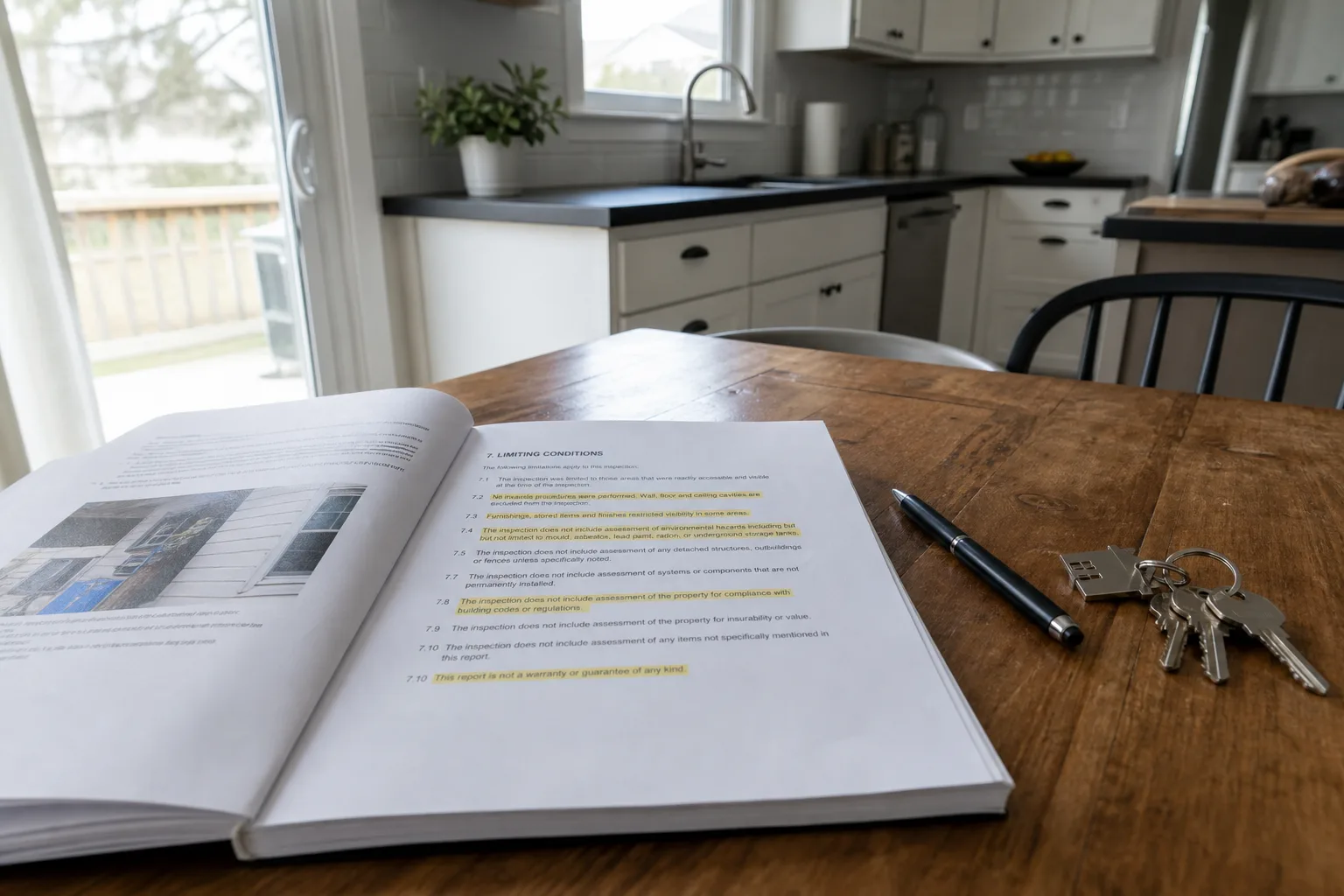
The report runs forty-one pages and the buyer reads the summary. That is the normal sequence, and it is where the trouble starts. The summary lists what the inspector found. The clauses in the front matter and the notes tucked under each system list what the inspector declined to look at, and in January or in August a large share of that list is set by the weather rather than by the house.
These are not evasions. They are the terms under which the inspector agreed to sign anything at all. But a first-time buyer reads a report as a verdict on a house, and the document is written as a record of one visit by one person on one morning, with the liability carefully bounded. The gap between those two readings is where people later discover they bought a problem that was disclosed in a sentence they skipped.
The clauses that turn a season into an exclusion
Pull the report up and search it for temperature. Most residential reports carry a line close to this:
"The cooling system was not operated, as the ambient outdoor temperature was below the manufacturer's recommended minimum for testing. Operation of the system under these conditions may cause damage to the compressor."
That is a reasonable position. It is also a complete blank where the condenser should be. The same structure appears in reverse in August, when a heat exchanger is not run, and again on the roof:
"Snow and ice cover prevented inspection of the roof covering, flashings, and penetrations. No opinion is offered as to the condition or remaining service life of the roof."
And in leaf season, in the drainage section: gutters were full, downspout discharge could not be traced, grading was obscured. In a dry stretch, the note runs the other way. Nothing was leaking because nothing had been asked to carry water in six weeks.
Each of those sentences is a boundary on the inspector's exposure, and each one leaves a system in the house genuinely unexamined. Read together they tell you which season you bought in, which is useful, because it tells you what to go back and check.
Where the exclusion shows up in ordinary life
Most people never connect the two events. The first happens in February and takes one line of a report. The second happens in July, when the air conditioning runs for four days and then stops, and the technician says the compressor has been failing for a while. There is no recourse against the inspector, because the report said plainly that the unit was not operated and why.
The pattern repeats across systems. A roof that was never walked in the winter becomes a claim in the spring, and the adjuster's file notes that no pre-purchase condition assessment exists. An unexamined crawlspace, excluded for standing water, becomes a joist replacement. A septic system inspected during a dry month becomes a surfacing failure in the first wet week of the fall.
None of that makes the report wrong. It makes the report narrow, and the everyday consequence of a narrow report is that the cost lands on whoever owns the house when the season turns. That is almost always the buyer, because the exclusions cluster in the systems that only reveal themselves under load.
Closing the gaps the report tells you about
The report is doing you a favor by naming its own blind spots. Treat the excluded list as a work order rather than a disclaimer.
- Roof and flashings. If the inspector stayed on the ground or at the eave, the report will say so, often citing pitch, wet surfaces, or height. Aerial imagery covers this cleanly and quickly, and hiring a drone surveying company for a single afternoon produces dated photographs of every plane, valley, and penetration that a ground-level inspection cannot document. Those images also become your baseline if you file a storm claim two years later.
- Cooling and heating. Ask for a mechanical evaluation from an HVAC contractor at the first opportunity in the correct season, and keep the invoice. Serial numbers on the data plate establish age even when the unit cannot be run.
- Drainage. Clear the gutters, then watch the house during a real rain. Photograph where the water goes.
- Anything marked for further evaluation. That phrase is the inspector handing the question to a specialist, and it is also the phrase that decides who pays. Left unresolved before closing, it is yours.
Why the inspector stayed off the roof
First-time buyers often read a ground-level roof inspection as laziness. It usually is not. Work at height on a wet or steep surface sits under federal fall protection rules, and the Occupational Safety and Health Administration is responsible for the standards that govern how people work above ground level on a job site. An inspector without an anchor point and a harness on a frost-covered eight-in-twelve pitch is making the correct call, and the clause in the report is the written record of that call.
Which is why the useful question is never "did the inspector go up there" but "what document covers the part nobody went up to see." Sometimes that is a roofer's written estimate. Sometimes it is a set of aerial photographs. Sometimes it is a seller's receipt for a replacement four years ago, with the shingle type named. Any of those is better than a summary page that stayed silent because the roof was under two inches of snow.
What to do with the report after closing
Keep it, and keep it findable. The exclusions have a second life during a claim, a resale, or a dispute with a contractor, because they establish the last date anyone documented a system and the conditions under which they did it. Buyers who file the report and forget it end up arguing from memory. Buyers who annotate it, resolving each excluded item with a dated photograph or invoice, end up with a file that answers the question in one page.
The season you bought in shapes the report you received. Once you can see which sentences are the weather talking, the document becomes a list of tasks with a clear order, and the house stops holding surprises that were disclosed all along.