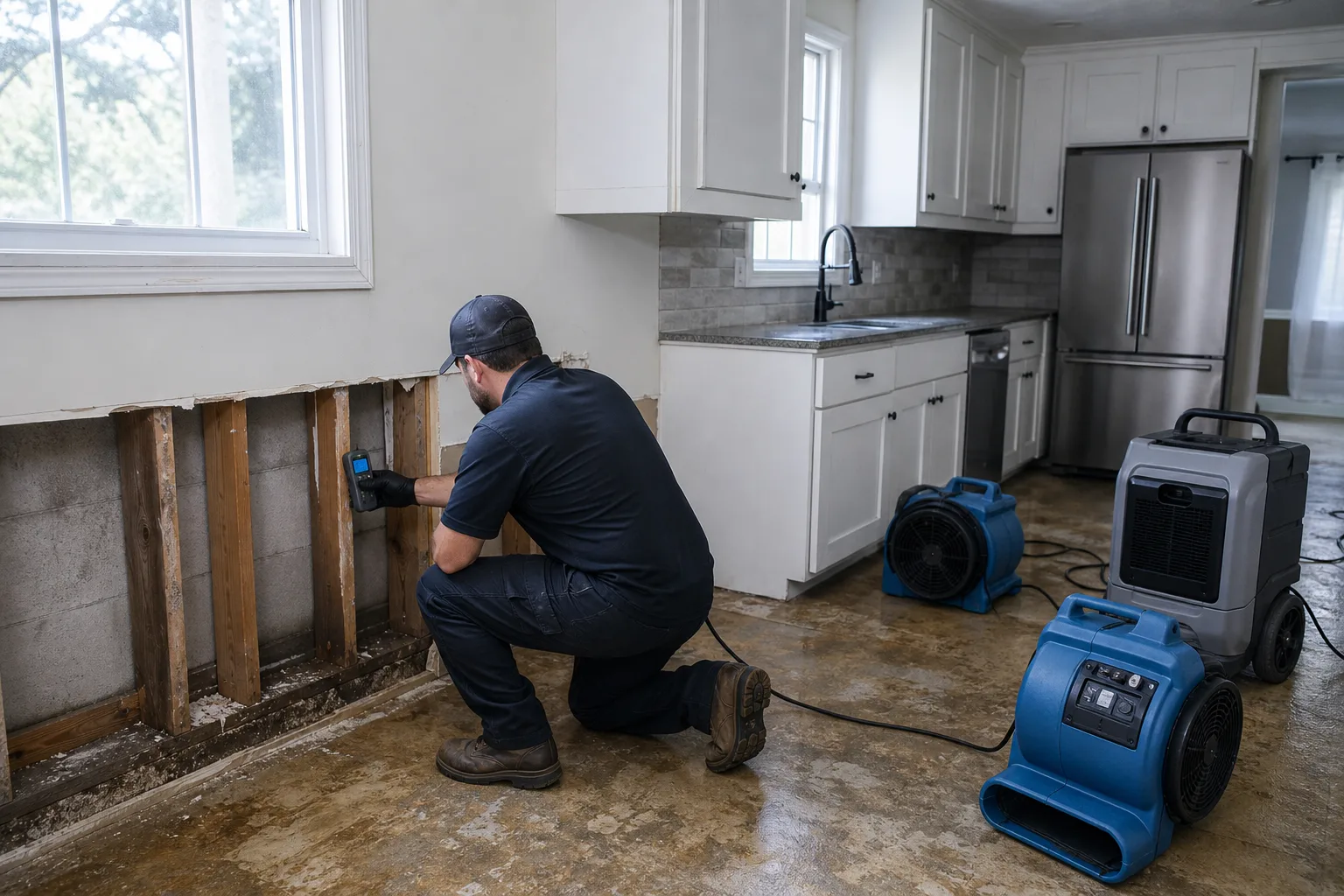
A braided supply line under a second-floor vanity let go sometime after ten on a Saturday morning. By the time anyone noticed, water had found the joist bay, run along it, and come down through the kitchen ceiling at the far end of the house. That is the ordinary version of this event. Not a storm, not a river, just a fitting that had been quietly failing for a year.
What happens next splits into three routes, and most people pick one in under five minutes without knowing they were choosing. The routes differ in who shows up, who writes the record, and who is holding the contract when the rebuild starts. They also differ in one thing almost nobody thinks about on a Saturday: whether the town knows the work happened.
Three ways the first call goes
Route one is the insurer's hotline. You call the number on the card, the claim opens immediately, and a mitigation firm from the carrier's vendor network is dispatched. These firms move fast because speed is how they keep the referral. The documentation tends to be consistent, because the carrier has told them what it wants to see. The tradeoff is that the firm's commercial relationship runs to the insurer, not to you, and the scope they write will stay inside what that carrier routinely approves.
Route two is your own plumber first, restoration firm second. The plumber stops the source and gives you a written cause of loss, which is the single most useful piece of paper in the entire file. Then you choose a mitigation company yourself. This route is slower by a few hours and better by one important measure: the contractor works for you, and the scope is argued with the adjuster rather than pre-negotiated around them.
Route three is you, a shop vacuum, and rented fans. For a small, clean-water loss caught within an hour, on tile or sealed concrete, with no wall cavity involved, this is a reasonable answer. For water that has traveled inside a floor assembly, it is not, because the surfaces you can reach dry first and tell you a story the cavity does not support.
Many households end up blending routes: plumber immediately, carrier notified the same day, mitigation firm chosen by you and accepted by the adjuster. That blend is usually the strongest position, and nothing about calling your own plumber first jeopardizes the claim.
What a good mitigation job leaves behind
The visible work looks nearly identical across firms. Fans, dehumidifiers, baseboard removed, drywall cut at a line. The difference is the record, and the record is what gets paid.
A good crew arrives and takes readings before touching anything, including readings in dry areas of the house, so there is a baseline to compare against. They produce a moisture map: a sketch of the affected rooms with the wet perimeter marked, not a vague note that says "kitchen wet." They photograph every wall and floor before demolition, not after. They log the equipment by unit and by day, because the drying bill is built from equipment days and an adjuster will reduce what is not logged. They come back each day, take fresh readings, and write them down. When the material reaches a dry standard, they say so in writing and pull the equipment.
A barely adequate crew does the same physical work in a different order. Demolition first, photos after, no baseline, no daily sheets, equipment left running for a round number of days because that is the billing habit. The house may dry perfectly well. The problem surfaces in month three, when the carrier asks for proof that the subfloor was wet and there is nothing in the file but an invoice.
Three questions sort one from the other at the front door, before you sign anything:
- Will you show me the moisture readings you take today, including the dry baseline?
- Who comes back tomorrow, and will I get the daily readings in writing?
- What is your drying target, and how will you tell me you hit it?
A firm that answers all three without hesitating is almost always the firm that documents well, because those are the habits that require effort to build and no effort to describe.
The office nobody calls
Here is the party most people leave out of the transaction entirely: the local building department. On a Saturday, with water on the floor, phoning the permit counter is the last thing on anyone's mind. It matters anyway, and it matters earlier than people expect.
The plumbing repair that stops the leak is often permit work. So is the electrical that gets pulled when a ceiling comes down, and so, in many jurisdictions, is any reconstruction past a certain dollar threshold or any wall opening that touches structure. Emergency repairs are routinely allowed to proceed first and be permitted after, but the window for that is set locally, and it is measured in days. Miss it and the inspector is looking at closed walls, trying to decide what is behind them.
Age of the house brings in a second rule. The Environmental Protection Agency is responsible for the federal requirements covering renovation that disturbs lead paint in housing built before 1978, which includes the cut-and-remove work a mitigation crew does on plaster and drywall. Some states and cities layer their own notification on top. A firm that works in your town regularly knows which inspector asks about this and what they expect to see. A firm that was dispatched from ninety minutes away may not.
Calling the building department on the first business day costs one phone call. Ask whether the emergency plumbing repair needs a permit filed after the fact, what the deadline is, and whether the reconstruction scope you are contemplating will require inspections at rough-in. Write down who you spoke to. That record travels well, and inspectors remember the homeowners who called before the drywall went up rather than after.
Where the two routes separate later
By hour forty-eight the physical situation in the house is roughly the same under any of these routes. Equipment is running, the wet material is open, the source is fixed. The separation is in the paperwork.
The household that went through the carrier's network has a fast, clean mitigation file and a scope the adjuster already agreed to. The household that hired directly has a plumber's cause-of-loss letter, its own photographs, daily readings, and a contractor whose obligation runs to the homeowner. The household that handled it alone has a dry kitchen and very little else, which is fine if the claim never grows and awkward if it does.
One more detail decides more than it should: the work authorization you sign at the door. Read whether it assigns your insurance benefits to the contractor, whether it commits you to the reconstruction as well as the drying, and whether it sets a price or leaves it open to an industry estimating program. Signing the mitigation and signing the rebuild are two separate decisions, and keeping them separate preserves your ability to take three bids on the part that costs real money.
The fittings under a vanity fail on their own schedule. What you can set in advance is the shorter list: the plumber you would call, the mitigation firm you would call, and the number for the permit counter in the town you actually live in.