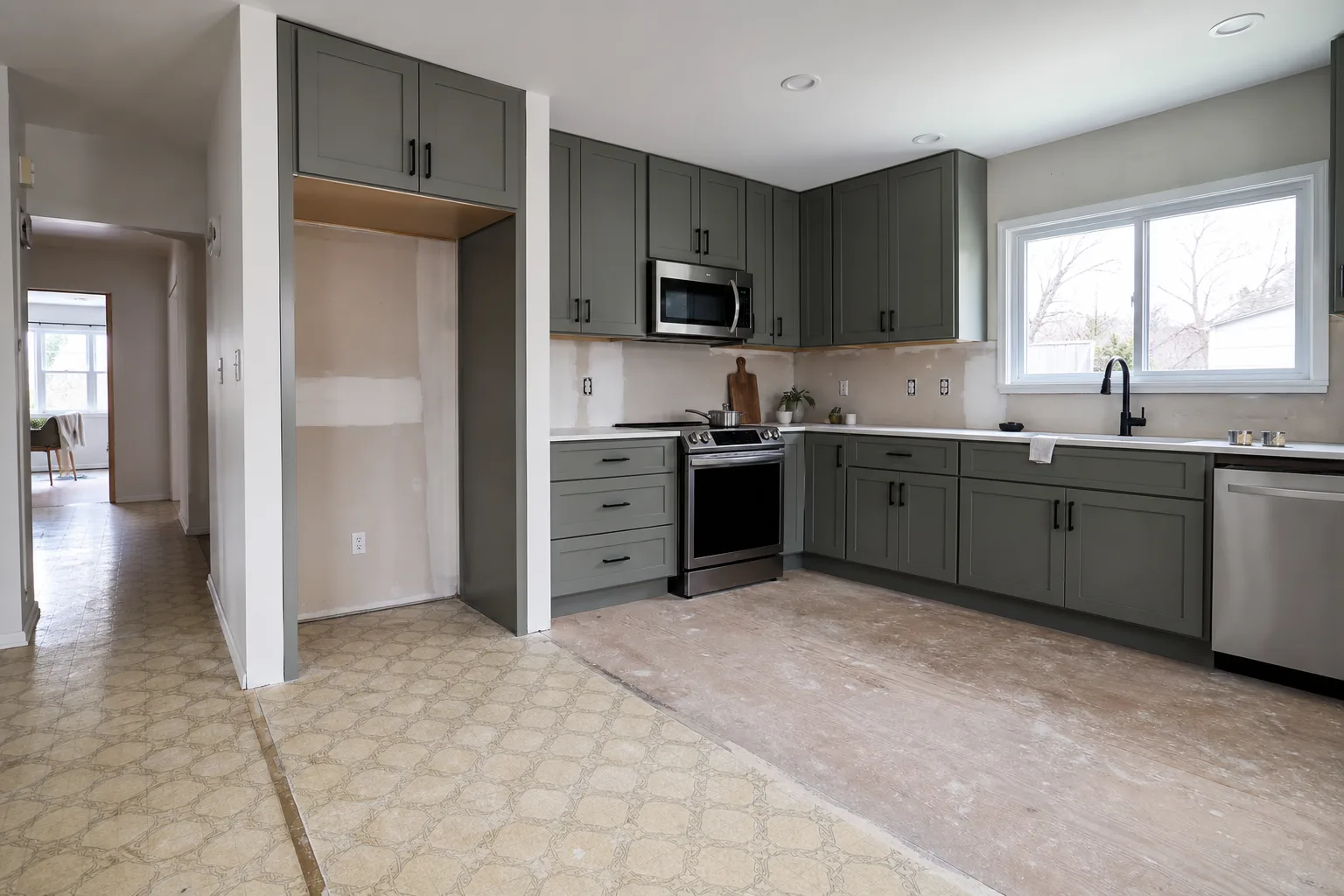
A kitchen in a 1970s Pleasanton ranch was redone twice in eleven years. The first time cost about half of what the second cost, and the second one is the only one an appraiser ever wrote a line for. The difference was not taste. The cabinets in the cheaper job were fine. The difference was that the first remodel stopped at the visible surface: no permit, the range hood recirculating instead of venting, the new flooring dying into a strip of original vinyl behind the refrigerator. A buyer walking through sees a kitchen. A buyer's inspector sees three open items, and the offer moves accordingly.
This is the part of the return-on-improvement question that the cost-versus-value tables never reach. The tables tell you which categories of work tend to recoup money. They cannot tell you whether your particular job was executed well enough to be counted. That is decided by five specific things, and all five are checkable before you write the final payment.
1. The permit exists and it is closed
An open permit is worse than no permit, because it is a documented, searchable statement that work was started and never approved. When a larger buyer looks at a property, whether that is an institutional buyer running a standard acquisition checklist or a local investor with a lender behind them, the permit history is pulled early and mechanically. Nobody reads your explanation of why the inspector never came back.
The simplest version of this check is one sentence to your contractor before the job starts: who pulls the permit, and who schedules the final inspection. Then, at the end, you confirm the permit shows as finaled with the city. If a contractor's answer is that permits slow things down and cost you money, that is true, and it is also an argument for choosing a smaller scope of work rather than an unpermitted larger one. Unpermitted square footage is the classic case of spending forty thousand dollars to add nothing to the appraisal.
2. The mechanical half was done, not just the visible half
Every improvement has a part you look at and a part that makes it work. Bathrooms are the clearest example. The visible half is tile, vanity, fixtures. The mechanical half is the exhaust fan ducted to the exterior rather than into the attic, a shutoff valve at each supply, waterproofing behind the tile, and a subfloor that was actually inspected before anything went over it.
A barely adequate job does the visible half beautifully. It photographs well and it fails the first time a home inspector pulls the attic hatch and finds a flex duct blowing damp air onto insulation. Ask for photographs of the rough-in stage. Any crew that expects to be judged on the finished result will have taken them without being asked, because those photos protect them too.
3. The work has clean edges
Edges are where money gets saved quietly. Flooring that runs to the doorway of every room instead of stopping at the hallway. Paint that goes up the wall and across the ceiling line rather than stopping where the roller reached. New windows with the exterior trim and stucco patch completed instead of a bead of caulk holding the line.
Edges are the single fastest way to tell a good job from an adequate one, and they are the reason partial improvements often return so little. A half-updated house reads to a buyer as a house with unknown remaining work. A smaller project finished completely almost always prices better than a larger project finished to eighty percent. If your budget will not carry the whole room, do the smaller room.
4. The products are still sold
This is the check nobody thinks of, and it matters most with anything a larger provider installed under a proprietary product line. Some national window, siding, and bath installers sell systems that only they service, with warranties that either do not transfer to a new owner or transfer only with paperwork filed inside a narrow window. The installation may be excellent. The buyer still inherits a component they cannot get a second quote on.
Ask two questions before you sign. Is the warranty transferable to the next owner, and what does the transfer require. Then ask whether a replacement part is available through ordinary supply houses or only from the manufacturer. For anything mechanical, the Department of Energy oversees the efficiency standards and labeling that make equipment comparable across brands, which is one reason a standard, widely stocked furnace or water heater usually ages better in a sale than something unusual. Serviceable beats special.
5. The improvement matches the rest of the house
A professional-grade range in a kitchen with original 1978 cabinets does not return its cost. Neither does a primary bathroom finished to a level the other two bathrooms will never reach. Buyers price a house as one object, and the strongest single element in a house tends to raise expectations for everything around it rather than raise the price.
The test is blunt. Walk from the front door through the improvement and out the other side, and ask whether the improvement makes the next room look worse. If it does, you have created a comparison problem that you will pay for at the negotiating table.
When the honest answer is to skip the work
Run those five checks against a house you are about to list and you sometimes find that doing the improvement properly costs more than the improvement will return. Deferred maintenance across a whole property, an older roof plus original plumbing plus a kitchen at end of life, rarely pays back through renovation before a sale. At that point the realistic comparison is between a discounted price from a buyer who will do the work themselves and a full-price sale that requires you to finance and manage a renovation first.
Owners in that position often start by getting a conventional listing opinion from an agent and a parallel number from a company that will sell my house for cash in pleasanton style as-is, then compare the two after subtracting the repair estimates and carrying costs from the listing number. The gap is usually smaller than people expect, and occasionally it runs the other way.
Every one of these five checks can be made before the last invoice is paid, which is the only moment when you still have leverage. Ask for the finaled permit, the rough-in photos, the warranty transfer terms. A crew doing good work hands them over in an afternoon.