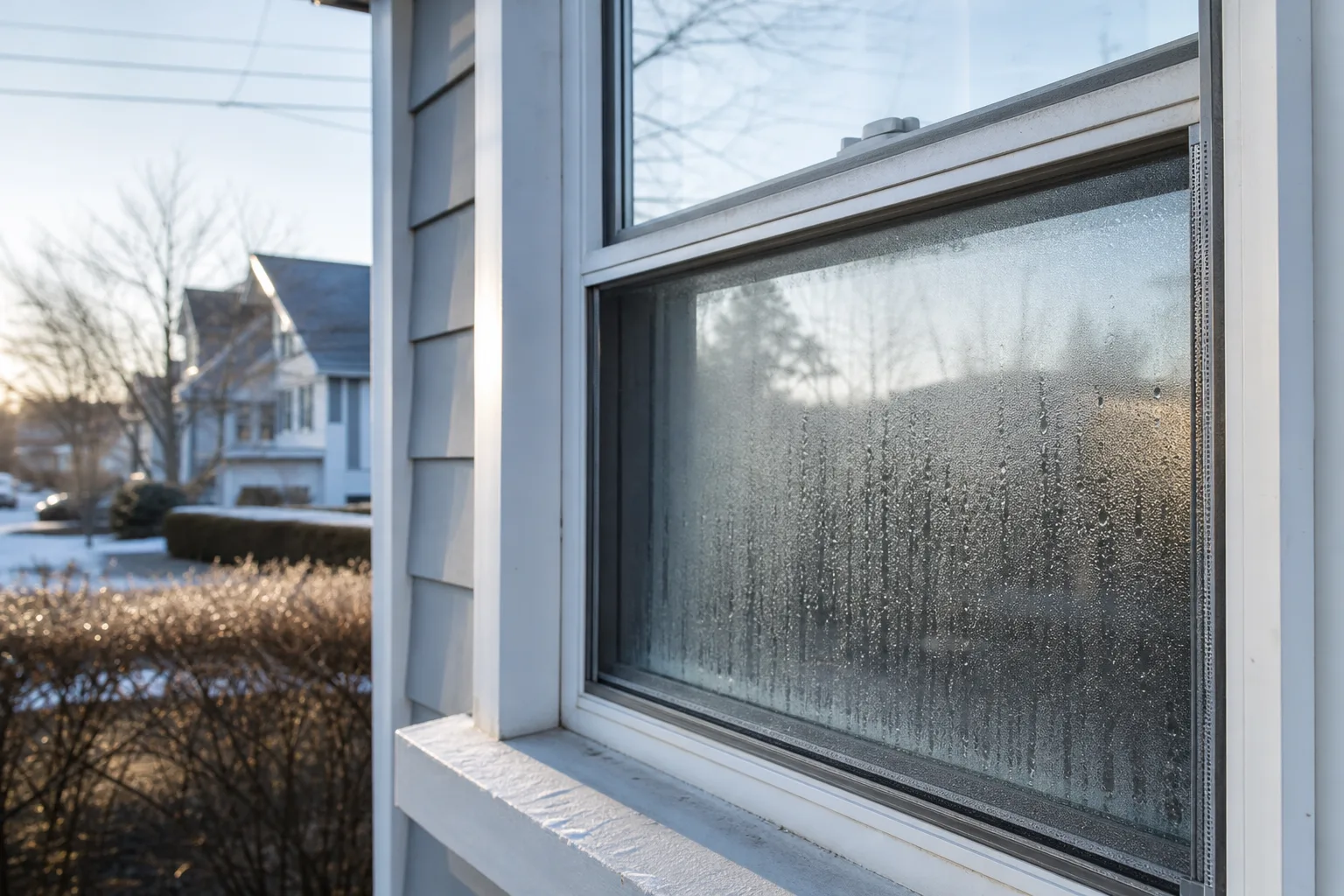
A homeowner in a 1992 colonial called a window company in February because two kitchen windows fogged every morning. The salesperson measured all eleven openings on the first floor and left a quote for whole-house replacement. The fog was on the room side of the glass, wiped off with a towel, and came back the next morning. Nothing about those windows had failed. The house was making more water vapor than it was removing, and the coldest surface in the room was showing it first.
That is the useful thing about condensation. It is a measurement. The glass is reporting a dew point, and where the water sits tells you which of three unrelated problems you have. Those three problems carry bills that differ by a factor of fifty. Getting the diagnosis right before anyone quotes you is most of the work.
Three locations, three completely different conversations
Put your finger on the water. That single test sorts almost every case.
Water on the inside surface, the one you can touch from the room. This is humidity, not hardware. Warm indoor air holds moisture; the glass is colder than the air; the air next to the glass cools below its dew point and gives up water. Showers, cooking, laundry, a crawlspace with bare dirt, a humidifier running at a setting nobody revisited since the furnace was installed. The Environmental Protection Agency is the federal body responsible for indoor air quality guidance, and household moisture control sits squarely in that remit. The fix is ventilation and source control, and it usually costs less than a tank of gas.
Water on the outside surface, facing the yard. Clear night sky, still air, dew on the lawn, and a faint film on the lower outer pane that burns off by nine. This one confuses people because it looks like failure. It is the opposite. The outer pane is staying cold because the glass package is doing its job and not leaking heat out to warm it. Low-E coatings and good gas fills make exterior dew more likely, not less. No action required.
Water between the panes, where no towel reaches. Now you have a real defect. The insulating glass unit is a sandwich: two or three lites of glass, a spacer around the perimeter holding a desiccant, and a sealant keeping the cavity isolated. When the seal fails, outside air carries moisture in, the desiccant saturates, and the cavity starts fogging and staining. It will not reverse. The haze gets permanent, and in hard water conditions you eventually get mineral etching on the inner surfaces.
What the simplest version of the fix looks like
For interior fogging, run the bath fan for twenty minutes after a shower instead of two, use the range hood when it is actually vented outdoors, and check whether the humidifier is set for January or still set for October. If that gets you nowhere, buy a cheap hygrometer and watch the number for a week. Indoor relative humidity in winter that sits in the high forties or above will fog cold glass in almost any house. There is no window on the market that removes water from the air.
For a failed sealed unit, the simplest version is replacing the glass, not the window. The frame, the sash hardware, the sill, the interior trim and the exterior cladding are all fine. One component failed. A glazing shop can measure the unit, order it from a fabricator, and swap it into the existing sash, often in a single visit. For many residential casements and double-hungs the sash itself can be sent out and reglazed.
This is where most people get routed into a much larger purchase than the evidence supports. A replacement-window company sells replacement windows. A homeowner who says "my window is foggy" to a replacement-window company has described a product, and will be sold the product. Ask directly: can the glass alone be replaced in this frame, yes or no? There are honest reasons the answer is no. Discontinued sash profiles, rotted frames, obsolete glazing beads that break on removal, and units with integral grids or odd shapes can all tip the math. But you should hear the reason, not a quote for eleven openings.
The party in the transaction nobody calls
Almost nobody in a house knows the name of the company that actually built the insulating unit in their window. The sticker on the sash says one brand; the glass inside it came from a fabricator that supplies many brands, and the warranty on the seal is frequently administered by that fabricator rather than the window manufacturer. There is often a date code or a spacer stamp on the unit itself, readable at the edge of the glass, and it identifies both the maker and the year.
The practical consequence is that the shop best equipped to solve a seal failure is usually not a window retailer at all. It is a glazing contractor, and the ones with real fabrication relationships tend to be on the commercial side of the trade. A commercial glass company that spends most of its week on storefronts, office partitions and curtain wall has standing accounts with the same fabricators that supply residential units, keeps the tools for pulling and resetting glass without breaking the frame, and will quote a single opening without treating it as a loss leader for a bigger sale. That is a different business model than the one that sends a measuring crew to your kitchen.
Comparing the three routes on what they actually buy you
| Route | Solves | Leaves unsolved |
|---|---|---|
| Humidity control | Interior-surface fogging, mold risk at sills, musty closets | Nothing structural; will not clear a fogged cavity |
| Glass-only replacement | Failed seal, haze between panes, lost insulating value | Worn balances, racked frames, bad air sealing around the opening |
| Full window replacement | Rot, broken frames, single glazing, operation that has failed | Room humidity, which follows you to the new glass |
Note what that last row means. A household with genuine moisture problems that replaces every window will often see condensation return on the new glass within a season, because the source never changed. Replacement is a reasonable purchase for other reasons. It is a poor purchase bought as a dehumidifier.
Questions worth asking before money moves
- Which surface is the water on, and did the person quoting me confirm it in person?
- What does the spacer stamp or edge code say, and is the original seal warranty still running?
- Can this frame take a new sealed unit, and if not, what specifically prevents it?
- Is the quote per opening, and what is the lead time on the fabricated unit?
- Who warrants the new unit, the installer or the fabricator, and for how many years against seal failure?
Write the answers down. A shop that can give you five clean answers in one phone call is telling you something about how it runs jobs.
The glass is giving you free information every cold morning, and it costs nothing to read it before you let anyone quote. Touch the water. If your finger comes back wet, the problem is in the room. If it comes back dry, the problem is in the unit, and the unit is a part, which means it can be bought on its own.