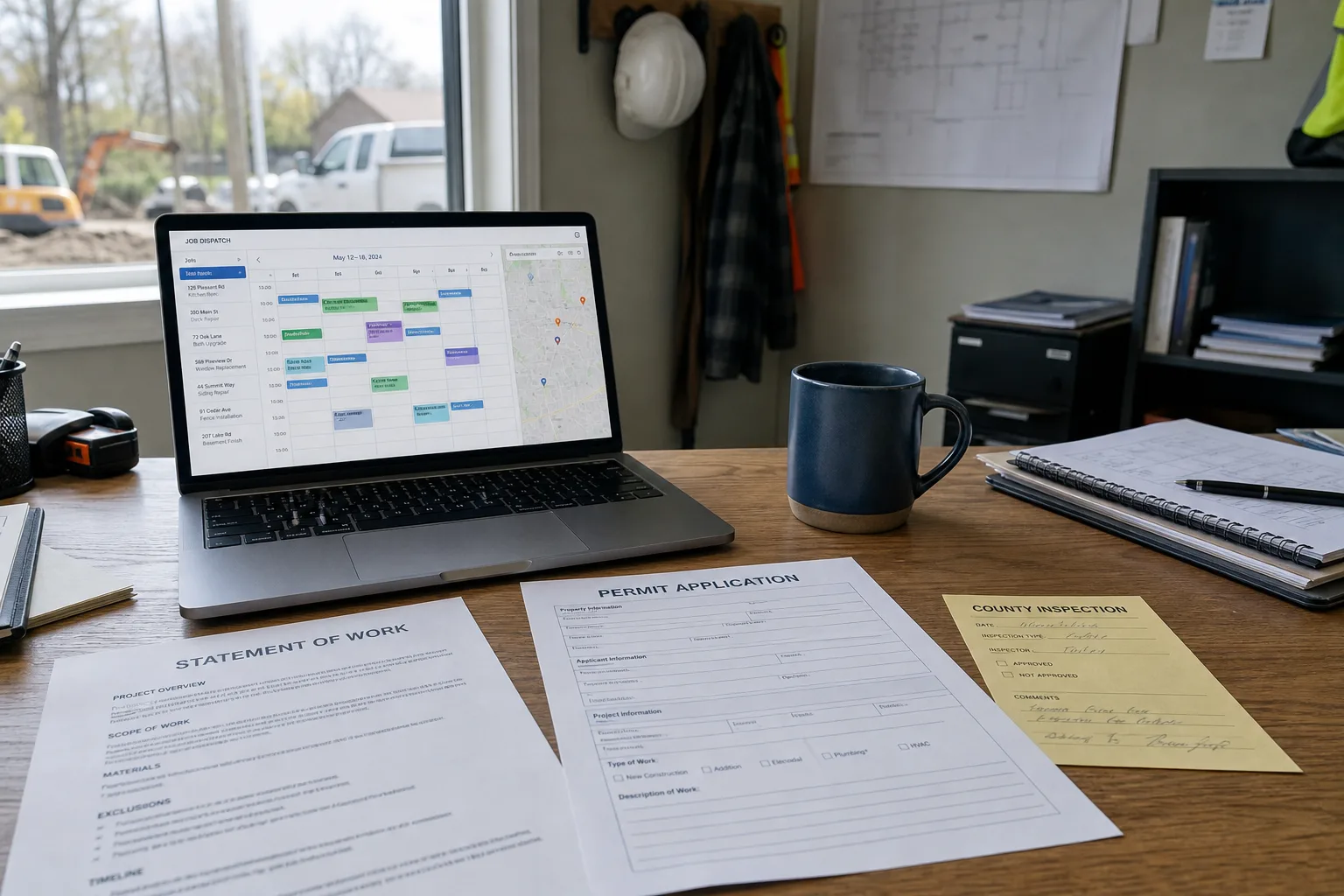
A mechanical contractor with about forty field employees, working two counties and parts of a third, decided last spring to replace the job-costing and dispatch system it had run since 2014. The replacement quote was a per-user monthly subscription, billed annually, with a one-time implementation fee attached underneath. The owner looked at the subscription line, compared it to what the old maintenance contract had been costing, and concluded the switch was close to a wash. By the time the system went live in the fall, the subscription was the smallest number in the folder.
None of the other costs were hidden. They were all disclosed somewhere, in a statement of work, in an email from the implementation consultant, or in a sentence the company's own controller said out loud in a meeting in March and nobody wrote down. The problem was that they arrived in different documents at different times, and no single page added them up.
What the same decision looked like in 2014
When this company bought its first real system, the shape of the spend was different and, in one narrow sense, easier to see. There was a server. It sat in a closet behind the parts counter, and somebody had to buy it, rack it, back it up, and replace it on a cycle. There was a perpetual license, paid once, with an annual maintenance percentage on top. There was a consultant who drove out, sat in the conference room for the better part of two weeks, and left behind a binder.
Those costs were lumpy and visible. You could point at the server. The capital outlay hurt in one quarter and then stopped hurting, which is a large part of why owners of that era described the purchase as expensive but finished.
The 2024 version inverts that. The server is gone, and so is the closet, the backup tape rotation, and the argument about who is responsible when the air conditioning in the parts room fails on a July weekend. What replaced them is a set of recurring and semi-recurring costs that are individually modest and collectively larger than anyone expects: the subscription, the implementation fee, the integration work, the data migration, the connectors to payroll and to the accounting package, and the annual uplift clause that raises the per-user rate on renewal.
The important difference is not that one era was cheaper. It is that in 2014 the big number came first and the small numbers trailed behind it. Now the small number comes first, in the sales conversation, and the big numbers arrive during implementation. A buyer who evaluated software a decade ago and has not done it since will budget for the wrong shape.
The lines that local rules wrote
This is where the contractor's bill stopped resembling anybody else's. Three categories of cost were set not by the vendor but by the jurisdictions the company works in.
Permit and inspection workflows
The two counties use different permitting portals, and one of the municipalities inside the larger county runs its own system on top of the county's. The old software had been bent, over ten years, into something that matched how those offices actually behaved: which fields the plan reviewer wanted filled in, which inspections had to be scheduled by phone because the portal's calendar was unreliable, and the fact that one inspector preferred a day-before confirmation call. None of that is in a vendor's standard configuration. It had been built by a dispatcher who no longer works there, and rebuilding it in the new system took a share of the implementation hours that the statement of work had allocated to something else.
Payroll and labor classification
Part of the company's work is public, which means certified payroll reports in a format the awarding agency will accept. The Department of Labor oversees prevailing wage requirements on federally funded work, and states layer their own filing formats and submission schedules on top. The old system produced those reports because somebody had configured it to. The new system produced them too, but only after a configuration session that was quoted separately, because the vendor's base package covers the federal form and not the state variants.
Sales tax on labor and materials
Whether labor is taxable, whether a contractor is the consumer of materials or a retailer of them, and how repair work is treated differently from new construction all vary by state and sometimes by local taxing district. The contractor crosses a state line for a meaningful slice of its revenue. Getting the tax determination right inside the new system was its own small project, and the company paid its accounting firm for hours on top of the software vendor's hours to confirm the mapping before the first invoice went out.
A buyer in a single county, with no public work and no cross-border jobs, would not have paid for any of the three. That is the part of this subject that general advice tends to flatten. The cost of replacing a business system is partly a function of how many sets of rules your work touches, and that number is knowable before you start shopping.
The hours that nobody puts in the budget
The largest uncosted item was internal time. Not training time, which the vendor quoted and the company scheduled. The uncosted hours were:
- Data cleanup before migration. Ten years of customer records contained duplicates, closed accounts, and equipment attached to addresses that no longer existed. The vendor will migrate whatever you hand over. Deciding what not to hand over is work only the staff can do.
- Parallel running. For six weeks both systems were live. Every job was entered twice. The company knew it was going to do this and still did not put a dollar figure next to it.
- The person who knew the old system. One office manager held most of the undocumented logic in her head. For two months, roughly half her week went to the project, which meant the other half of her normal work went to someone else or waited.
- Rework in month two. Field crews used the mobile app differently than the configuration assumed, and a round of adjustments followed. This is ordinary and should simply be planned for.
There is a reasonable rule of thumb here that does not require inventing a figure: for any configurable operational system, assume the internal labor is comparable to the external invoice, and ask the vendor for their own estimate of customer-side hours by role. A good implementation team will give you one, broken out by week, because they have run the project before and you have not.
How the company kept the number from running away
Three decisions did most of the work, and all of them are available to any buyer before a contract is signed.
First, they asked for the statement of work before the subscription agreement, and read them together. The subscription price was fixed. The implementation was a time-and-materials estimate with an hourly rate and an assumption list. The assumptions were where the local complications lived, and once they were visible, the scope conversation became specific.
Second, they phased it. Dispatch and job costing went live first. Inventory and the equipment service history stayed on the old system until the following quarter, which meant one busy season was not spent learning two things at once. The old system was kept in read-only form for records access rather than migrated wholesale, which cut the migration scope substantially and preserved the history for tax and warranty purposes.
Third, they wrote down the local rules first, before any demo. One page: every jurisdiction they pull permits in, every payroll filing they produce, every tax determination that differs across the state line. That page went to each vendor as a requirements list. Two vendors handled it as routine. One asked what a certified payroll report was. That answer was worth more than the pricing sheet.
The contractor's renewal now sits on a calendar entry ninety days before the anniversary, with the uplift clause noted next to it. The total first-year cost came in above the subscription by a wide margin, which was the expected outcome once the folder was assembled, and the second-year cost looks like the subscription plus a small support allowance. That is the number the original comparison should have been built on, and it is the number the company will use the next time this question comes around.