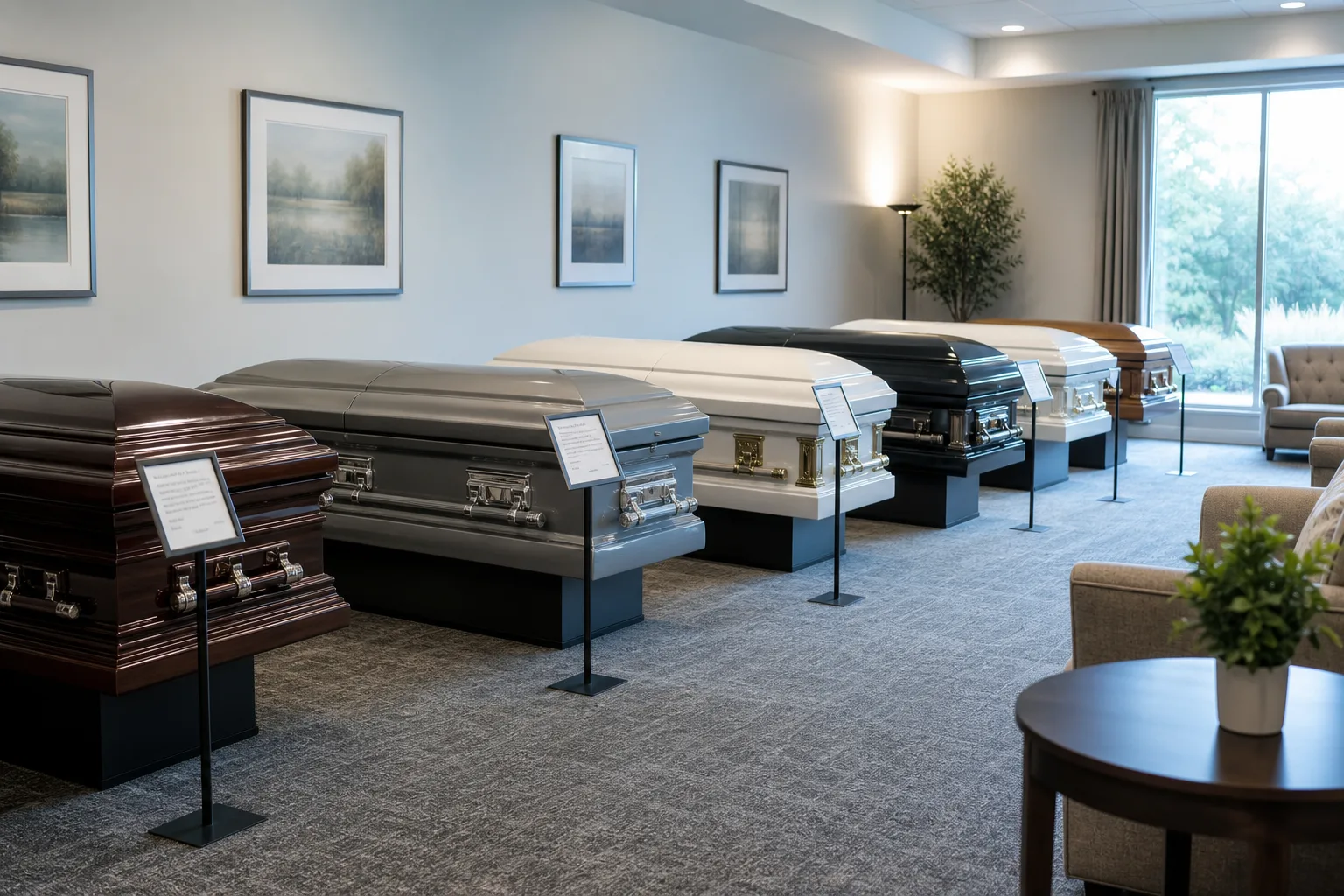
A funeral bill looks like one number and behaves like twenty. The family sees a total, signs, and only later notices that the total was assembled from separate items, most of which were choices. The casket is usually the largest single line on the page. It is also the line that has moved the most in the last decade, and the movement had nothing to do with the funeral home and everything to do with a party most families never think about: the company that makes and ships the box.
One charge you cannot decline, and a long list you can
Start with the structure of the bill, because the structure is what most people get wrong. Federal rules require funeral providers to give you an itemized price list, and they permit exactly one fee that you cannot refuse: the basic services charge covering staff time, planning, permits, and holding the arrangements together. Everything else on the sheet is a separate purchase with a separate price, and you may buy some of it, all of it, or almost none of it.
The optional side of the list is longer than people expect. Embalming is not generally required by law. A viewing is a service you are buying, and so is the facility it happens in. Transfer of remains, a hearse, a limousine, a graveside service, printed programs, an online obituary placement, a register book: each has a price, and each can be declined or replaced. A burial vault or grave liner is frequently required, but usually by the cemetery rather than the funeral home, which means the requirement comes from a different contract with a different business.
The Federal Trade Commission is responsible for the Funeral Rule that governs how these prices are disclosed and how caskets bought elsewhere must be treated. Three of its provisions matter directly to a family comparing options. You are entitled to prices over the phone. You are entitled to a casket price list before anyone walks you into a selection room. And a funeral home may not refuse a casket you purchased from another seller, nor charge you a handling fee for accepting it.
The same decision, ten years apart
The rules above are older than a decade. What changed is how easy it became to act on them.
In 2015, comparing casket prices meant driving to two or three funeral homes during business hours and asking for paper. Some families did it. Most did not, because the person making the decision had buried a parent four days earlier and was not going to spend an afternoon collecting price lists. The selection room was where the decision happened, and the selection room contained whatever that home had chosen to stock, arranged from most expensive to least.
Today the same family can pull general price lists off funeral home websites before making a single call, in the evening, from a kitchen table. Direct cremation is offered as a named package almost everywhere, which changed the shape of the whole conversation: once the cheapest complete option is printed on the sheet, every other option is priced against it rather than against the next casket up. Independent casket retailers now ship nationwide on short timelines, which is the practical change that made the Funeral Rule's outside-casket provision usable rather than theoretical.
| Line item | Who sets it | Can you decline it? |
|---|---|---|
| Basic services fee | Funeral home | No, if you use that home |
| Casket | Funeral home or outside seller | Yes, and you may buy it elsewhere |
| Embalming | Funeral home | Usually yes, absent specific circumstances |
| Viewing and facility use | Funeral home | Yes |
| Burial vault or liner | Cemetery | Often no, but check the cemetery, not the home |
| Grave space, opening, closing | Cemetery | No, for a burial |
| Obituary placement | Newspaper or website | Yes |
The party in the transaction nobody counts
Families think of the funeral director as the seller of the casket. The funeral director is a reseller. Somewhere upstream there is a manufacturer, and between them a distribution arrangement that determines the shelf price in the selection room. That upstream party has always existed. What is new is that it will now sell to you directly.
Once you can see the manufacturer's side of the transaction, the price spread stops looking mysterious. A twenty gauge steel casket with a crepe interior is a specific object with a specific cost to build, and the same object carries very different prices depending on which counter it sits behind. Independent sellers publish photographs, gauge, interior fabric, hardware, and a delivered price, which is why a family comparing affordable caskets from an outside retailer against the selection room is finally comparing like with like.
The logistics question is the one people ask next, and it has a plain answer. The seller ships to the funeral home, typically by freight on a scheduled delivery, and the funeral home accepts it. You do not need to be present, you do not pay a fee for the acceptance, and the home is not permitted to require that you be there. The one thing worth doing is calling the funeral home, telling them the delivery is coming, and confirming the address and the day. That phone call is the entire administrative burden.
What the simplest version looks like
Ask what you would do if no one showed you a catalog. For a burial, the irreducible set is: the basic services fee, transfer of remains, a casket, a grave, opening and closing, and whatever the cemetery requires around the grave. For a cremation, it is smaller still, and a cremation container is not the same product as a casket even though the selection room may present them side by side.
Then add back only what you actually want. If a viewing matters to the family, buy the viewing. If a limousine does not, decline it. The bill is not a package that comes apart badly. It is a list, and it was designed to be read as a list.
Two practical checks make the whole thing faster. Get the general price list and the casket price list in writing before any selection room conversation, and get the cemetery's written requirements before you assume a vault is or is not needed. Those two documents settle most of the disputed items in advance.
The decision that used to happen under fluorescent lights on the worst week of someone's life can now happen mostly in advance, on paper, at a distance. That is a smaller change than it sounds and a bigger one than it looks: the family that arrives already knowing which lines are required is buying a funeral rather than being sold one.