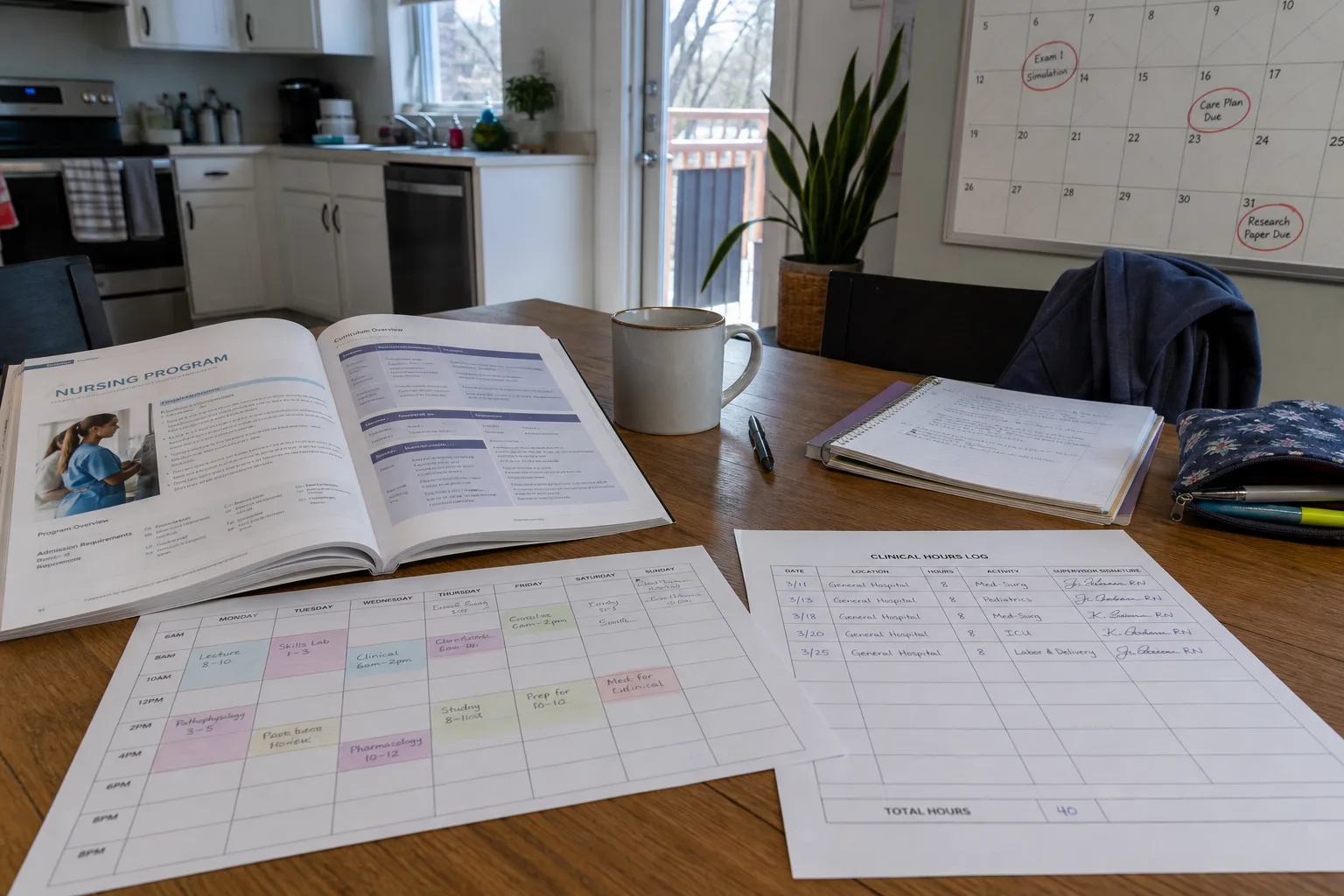
A woman enrolls in a program listed at 900 clock hours. She reads the tuition line, divides by the number of months in the published length, and decides she can carry it. Nine weeks later she is short on hours, not money. The externship site she was assigned takes students on Tuesdays and Thursdays only, her supervisor signs timesheets on Fridays, and two of her logged days came back unsigned because the preceptor who watched her was not the preceptor named on the placement form. None of that was hidden. All of it was in documents she had been given and had skimmed.
The gap between what a training route costs on paper and what it costs in a normal week is almost always documented somewhere. The work is finding which document governs.
The catalog defines the hour, and the definition is not obvious
Programs are measured in credit hours or clock hours, and the two behave differently. A catalog that says a clock hour means "a period of 60 minutes with a minimum of 50 minutes of instruction in the presence of an instructor" has told you that a 55-minute class does not round up, and that self-study at the kitchen table counts for nothing unless another clause says it does. Find that sentence before you build a schedule around it.
Then find the attendance clause. Most catalogs carry language along the lines of "students who miss more than 10 percent of scheduled instructional hours in a module may be required to repeat the module." That is the sentence that turns two sick children in February into an extra term of tuition. It is worth writing the exact percentage on the inside cover of your folder, because it is the number you will be managing against every week, and nobody will remind you of it.
Clinical, lab and externship hours usually live under a separate heading with their own rules: who may supervise, how hours are recorded, whether hours logged before a background check clears are retroactively valid. Registered apprenticeship programs run on the same logic, with on-the-job learning hours and related technical instruction tracked separately. The Department of Labor oversees registered apprenticeship standards, and the through-line is the same in every version of this: the hour counts when the paperwork says it counts.
What the week actually looks like once you draw it
Take a blank week and put the fixed blocks in first. Class time. Lab time. The externship shift and the commute at both ends. The shift you still work for money. Then add the things the catalog implies but does not schedule: the drive to a second site, the hour spent chasing a signature, the online module that must be completed before Sunday midnight or the week does not close.
Two programs with identical published lengths can produce very different weeks. One runs four evenings for three hours; the other runs two full weekdays. The four-evening version costs you every weeknight and leaves your weekends. The two-day version is impossible if you cannot get two weekdays off. That is a scheduling fact, not a quality judgment, and it decides more completions than aptitude does.
Ask the registrar for the actual term schedule grid, not the sample one in the brochure. Ask which blocks are fixed for the whole program and which rotate. If the answer is that placements are assigned and cannot be requested, write that down too, because it means your Tuesdays belong to someone else for the duration.
Money arrives on a schedule set by someone else
Tuition is rarely the number that causes trouble. Timing is. Aid disburses on the school's calendar, in installments tied to payment periods, and the first installment often lands after the first block of expenses: uniforms, a kit, a background check, immunization records, a state exam fee paid directly to a testing vendor. Ask which of those are billed by the school and which you pay out of pocket, and when.
Then read the refund policy, which is the clause you hope never to use and the one most worth knowing cold. Look for the pro rata language: the point in the term at which withdrawal stops producing a partial refund. It is often stated as a percentage of scheduled hours completed rather than a calendar date, which means the date moves depending on how many hours you have banked. Two students who withdraw the same Friday can owe different amounts.
Households already juggling this arithmetic tend to be juggling a school calendar too, and parents comparing the best public schools in los angeles are running the same exercise from the other direction: matching fixed institutional calendars against the hours a working adult actually controls.
The folder that keeps it manageable
The students who finish on the published timeline are not usually the ones with the most free time. They are the ones with a system that takes about twenty minutes a week.
- One folder, physical or digital, holding the catalog for your enrollment year, the signed enrollment agreement, the payment schedule and the placement forms.
- An hour log you keep yourself, dated, even where the school keeps one. When a signature is missed, your log is the evidence that starts the correction.
- Every deadline that carries money on a single calendar: add/drop, withdrawal, exam registration, license application window, fingerprint appointment.
- A named person for each category. Registrar for hours, financial aid for disbursement, program coordinator for placements. Email them rather than calling, so the answer exists in writing.
Signatures are the recurring failure point. Get them the day the hours are worked, from the person named on the form, and photograph the sheet before you hand it in.
Questions that surface the real number
Before you sign, ask what percentage of scheduled hours a student may miss before repeating. Ask whether externship placements are assigned or requested, and how far the furthest site is. Ask what a student pays out of pocket in the first thirty days. Ask for the refund policy's pro rata threshold in hours. Ask what the most common reason is that a student in this program needs an extra term.
The answers are already written down somewhere. Getting them in front of you before the first payment turns a training route from a guess into a schedule you can hold.