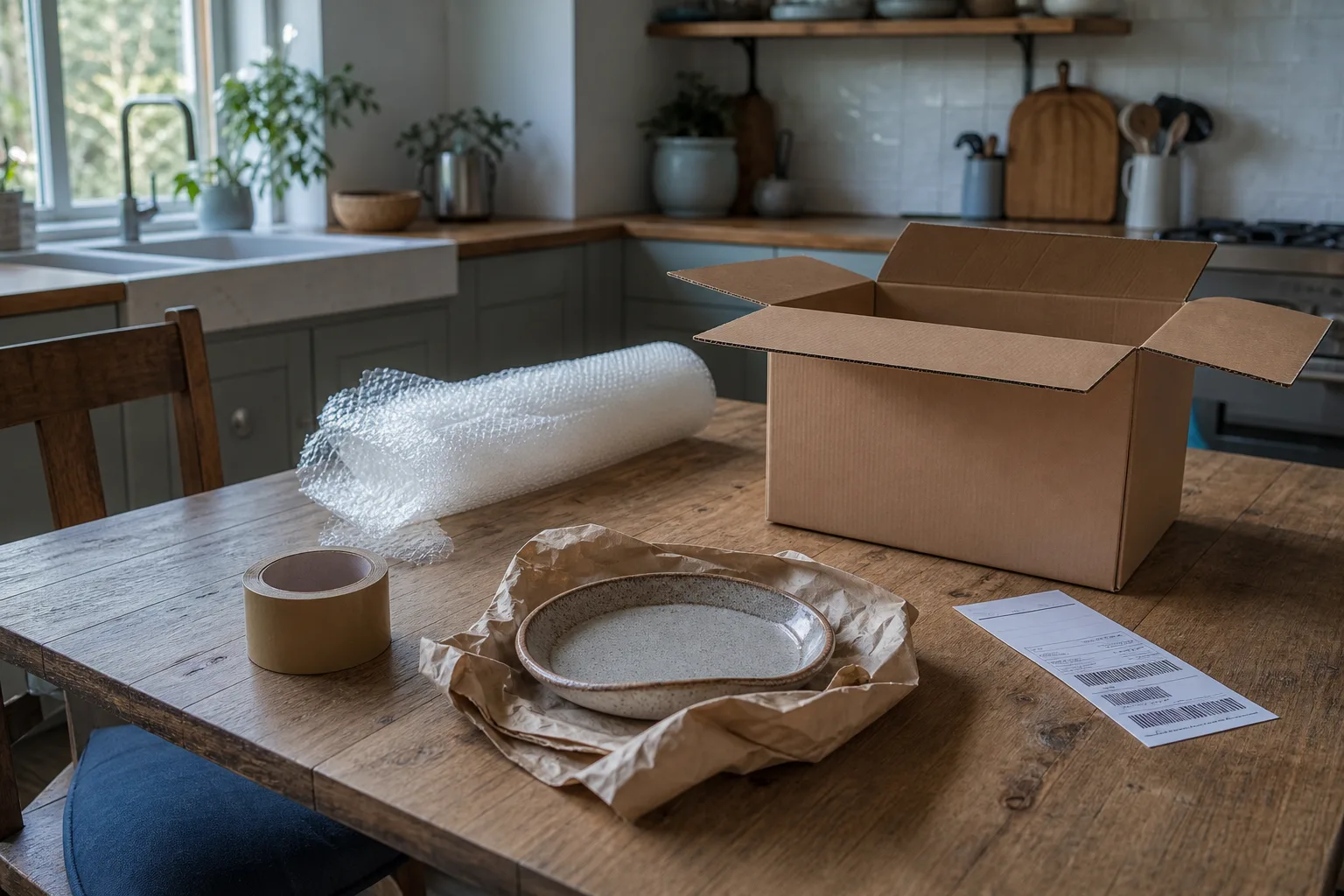
A woman in Ohio shipped a set of four stoneware plates to her daughter on December 12. She used the box they arrived in two years earlier, taped the old seams, and wrote FRAGILE on three sides. Two plates arrived in pieces. The carrier paid nothing, because the shipment was never insured beyond the default liability and because the claim form asked a question she could not answer well: describe the packaging materials used. Reused box. Original molded insert discarded. Tape applied at 28 degrees in an unheated garage.
None of that was bad luck. Every piece of it was a decision made without knowing it was a decision.
What changes about a parcel between October and January
The box does not change. The handling does. During peak weeks a parcel moves through more sort facilities, sits longer in staged trailers, and is stacked under heavier loads because trailers are packed to capacity rather than to a comfortable column height. More transfers means more drops. The engineering tests behind corrugated board assume a certain number of impacts, and the holiday network simply delivers more of them.
Cold matters in ways people underestimate. Pressure-sensitive tape loses grip when applied to a cold surface, and the adhesive never fully bonds. Corrugated board absorbs moisture from damp air and loses a meaningful share of its stacking strength. Liquids expand when they freeze, which is how a bottle of olive oil becomes a leak claim. In summer the inverse problem shows up: candles, chocolate and anything with an adhesive label sitting in a trailer in Phoenix.
So the seasonal question is not whether to ship. It is whether the packaging you chose in a mild month is the packaging the route will actually see.
Who carries the loss by default, which is rarely who you assume
Start from the least comfortable assumption: nobody is covering this but you. Then work backward and see what you can actually prove.
- The carrier. Major parcel carriers include a baseline liability, commonly a few hundred dollars or less, and it is liability, not insurance. You have to show the carrier caused the damage. Their published terms also exclude inadequately packaged goods, and they define adequate in writing. Reused boxes and under two inches of cushioning on all sides are the two most common findings against a shipper.
- Declared value. Paying to declare a higher value raises the ceiling on what can be paid. It does not change the exclusions. A $600 declared value on a poorly packed box buys you a higher number on a claim that still gets denied.
- Your homeowners policy. Most forms cover personal property off-premises, but with the same deductible as the rest of the policy. On a $300 loss with a $1,000 deductible, that is not a route.
- The card you paid with. Some credit cards still carry purchase protection on items bought with the card and damaged within a set window. Read the benefits guide, not the ad.
- The seller or marketplace. If you bought the item and had it shipped to you, the contract is usually with the seller, not the carrier. The Federal Trade Commission oversees the rules governing mail and online order shipping obligations, which is why the seller, not the driver, is the party who owes you an answer.
The simplest version of good packing
The industry language is elaborate. The practice is not. Five things decide most outcomes.
- A new box, double-wall if the contents weigh more than about twenty pounds. Corrugated loses strength with every trip. A box on its third journey is not the box the specification describes.
- Two inches of cushioning on every face, including the bottom. Nothing touches a wall. Shake the sealed box. If anything moves, it is not packed.
- Fragile items individually wrapped, then boxed, then that box placed inside a larger box. Double-boxing is what survives a corner drop.
- Tape applied indoors, at room temperature, in the H pattern across the center seam and both edge seams. Three strips on each face. Not masking tape, not duct tape.
- Nothing liquid in winter unless it is sealed, bagged and padded for expansion.
Households that send the same thing repeatedly, say a small Etsy operation running forty orders in two weeks, eventually hit the point where doing this by hand at the kitchen table stops working. That is the moment to price out kitting and fulfillment services, where someone else assembles, packs to a tested specification and ships under carrier terms they already understand. The useful comparison is not cost per box against free cardboard. It is cost per box against your damage rate, your time, and the claims you are losing.
The records that decide a claim before you file one
Claims are won in the five minutes before the box is sealed. Photograph the item, the cushioning around it, and the sealed box with the label visible. Keep the receipt or a comparable listing showing value. Note the materials: box grade, new or reused, cushioning type and depth.
On the receiving end, the instruction is blunt. Photograph the box before opening it, including the damage and the label. Do not discard the packaging until the claim closes, because the carrier may inspect it. Report quickly: windows for concealed damage are often measured in a couple of weeks from delivery, and they are enforced.
Someone who does those two sets of five minutes is a different claimant from someone who does not. Same box, same route, different outcome.
Judgement here is mostly just sequencing. Decide what the item is worth, decide who would carry that loss if it arrived in pieces, and only then choose the box. A $40 sweater needs none of this. A $400 lamp needs all of it, and knowing which one you are holding is the whole skill.