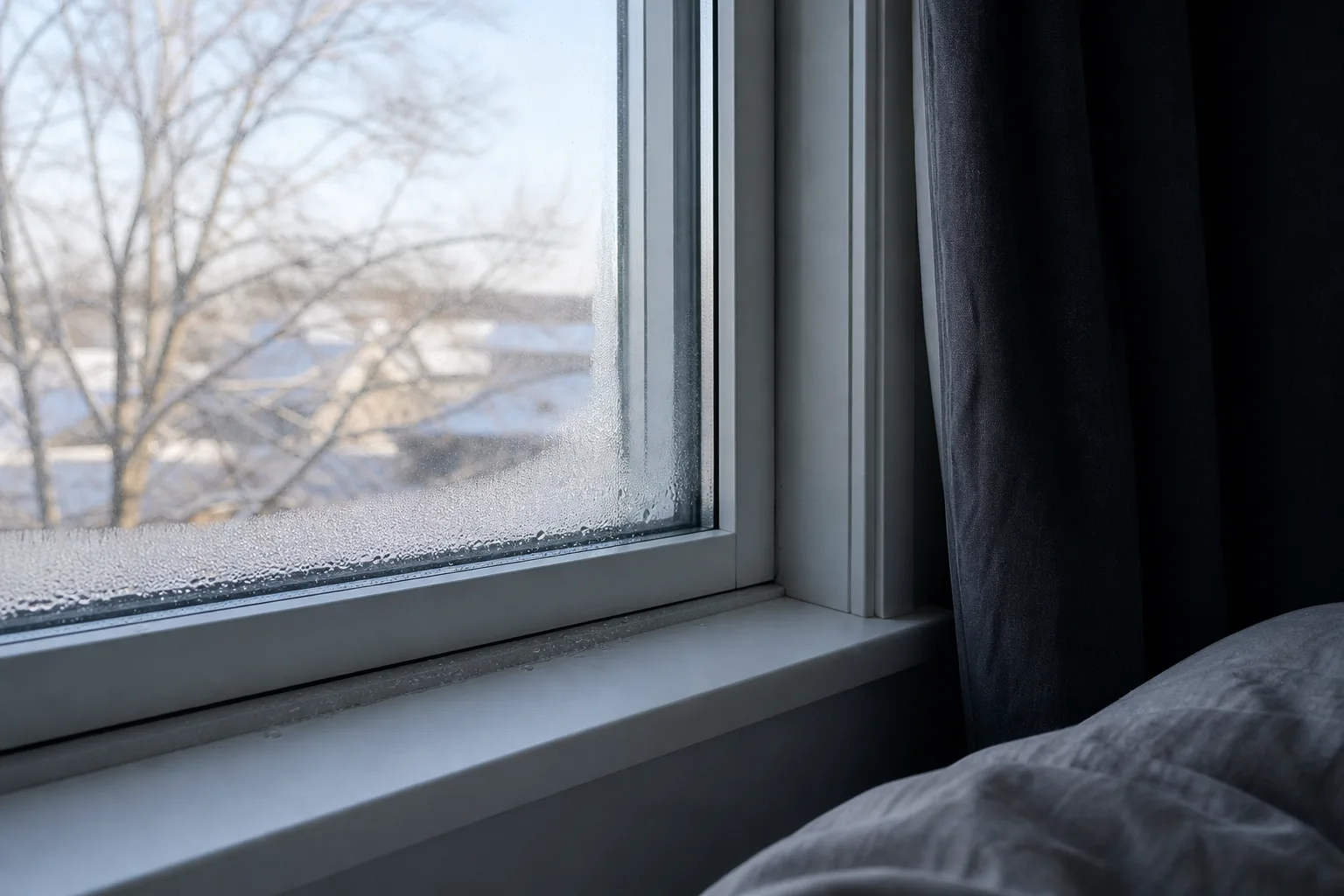
A house in a cold-winter state, built in the early 1990s, double-pane vinyl windows throughout. Every January morning, one window streams. It is the north bedroom, where two adults sleep with the door shut. Water beads across the lower third of the glass, runs down, and collects in the sill track deep enough to wipe with a folded paper towel. Every other window in the house is dry. The homeowner got a quote to replace all eleven windows.
That quote may be worth having someday. It is not the answer to this problem, and the giveaway is the word one. Eleven windows of the same age and construction, one of them wet. Whatever changed, it changed inside that room.
Where the water sits decides which problem you own
There are three places condensation shows up on a window, and they are three different findings. People collapse them into a single complaint, which is how a ventilation question turns into a replacement estimate.
On the inside face, the surface you can wipe. Room air is holding more moisture than that cold pane can tolerate. The glass is the thermometer, not the fault. Wipe it and it comes back tomorrow because the conditions that produced it are still in place.
Between the panes, where you cannot reach it. The seal on the insulated glass unit has failed and outdoor air is now cycling through the cavity. This one is a real defect and no amount of ventilation touches it. The fix is a new glass unit or a new window.
On the outside face, on a clear cold morning. This alarms people and it should not. It generally means the outer pane is staying cold because the window is doing its job of keeping interior heat inside. Dew forms on it the same way it forms on a car roof.
Our bedroom window is case one. The homeowner could wipe it dry, which is the test: if the water is on the room side of the glass, the glass unit is intact.
The room, not the window
Two sleeping adults exhale and perspire moisture all night. Call it a pint or two of water released into a closed room over eight hours, more if anyone showers and comes back in, more again if a humidifier is running for a cough. With the door shut, that moisture does not get diluted by the rest of the house. Relative humidity in the room climbs while the outdoor temperature drops, and the coldest surface in the room, the bottom edge of the north-facing glass, reaches the point where the air can no longer hold what it is carrying.
The bottom third wets first for a reason. The lower edge of an insulated glass unit sits against the spacer and the frame, and that assembly conducts heat better than the middle of the pane. It is the coldest square foot in the room. Water finds it.
So the simplest version of the question is not "are my windows any good." It is: how do I either put less moisture into that room, get more of it out, or make that lower edge less cold? Three levers. The Department of Energy is responsible for federal guidance on residential window performance and whole-house ventilation, which is a useful reminder that those two subjects belong in the same conversation, not in separate quotes from separate trades.
Comparing the fixes on what each one actually moves
| Option | Which lever it pulls | Cost shape | Reversible? |
|---|---|---|---|
| Leave the bedroom door open, or open a few inches | Dilutes moisture into the rest of the house | Free | Entirely |
| Run the bathroom exhaust fan longer, on a timer switch | Removes moisture at the source | Cost of a timer switch plus a short electrical visit | Yes, though the switch stays |
| Small dehumidifier in the bedroom | Removes moisture from that room directly | Appliance purchase plus modest running cost and a tank to empty | Entirely |
| Stop running the humidifier, or drop its setting | Stops adding moisture | Free | Entirely |
| Move heavy blackout drapes off the glass, or leave a gap at the sill | Raises the glass surface temperature | Free | Entirely |
| Redirect or add a heat register toward the window wall | Raises the glass surface temperature | Deflector is cheap; new ductwork is not | Deflector yes |
| Interior storm panel or insert over the existing window | Raises the interior surface temperature substantially | Per-window, well under a replacement | Seasonal panels, yes |
| Replace the window | Raises surface temperature, better spacer at the cold edge | Highest, per window | No |
Notice the shape of that list. The top half costs nothing and is undone in a minute. The heavy drapes item surprises people, because a thick curtain feels like insulation, and it is: it insulates the glass from the room's heat, so the pane runs colder and wets faster while the room behind the curtain stays comfortable. Pulling the drape back overnight, or trimming it clear of the sill, sometimes ends the whole complaint by itself.
The rational sequence is to spend a week on the free levers before anyone measures a window. Prop the door. Turn the humidifier down. Move the curtain. If the sill is dry on the fifth morning, you have your diagnosis and it cost nothing. A $20 hygrometer on the nightstand makes the week legible: watch what the bedroom reads at 6 a.m. against what the hallway reads.
When replacement is the honest answer
Sometimes it is, and the evidence is specific rather than general.
- Fog or mineral haze between the panes. Seal failure. Wiping does nothing. Many manufacturers will sell a replacement glass unit for an existing frame, which is a fraction of a full window and worth asking about before you accept a whole-house number.
- Water on the frame and sash, not just the glass, in several rooms at once. That is a whole-house humidity or ventilation finding, and the fix is mechanical ventilation rather than glazing.
- Soft wood, staining at the sill, or paint lifting. The moisture has been sitting long enough to do damage, and repair enters the picture regardless.
- Single-pane glass with no storm. Here the surface temperature genuinely cannot be raised enough by housekeeping. An interior insert still buys most of the improvement for a fraction of the price, which makes it a reasonable step while you save.
None of that describes our north bedroom. One window, intact glass unit, closed door, two sleepers, a blackout curtain pressed flat against the pane. That is a solvable set of facts, and the solution is behavioral before it is structural.
Condensation is a report, and it is fairly precise about what it is reporting. Wet on the room side means the air in that room needs somewhere to go or that pane needs to be warmer. Wet between the panes means a part has failed and can be replaced. A dry sill after a week of open doors and a repositioned curtain is not a smaller fix than new windows. It is the correct one, arrived at before the deposit.