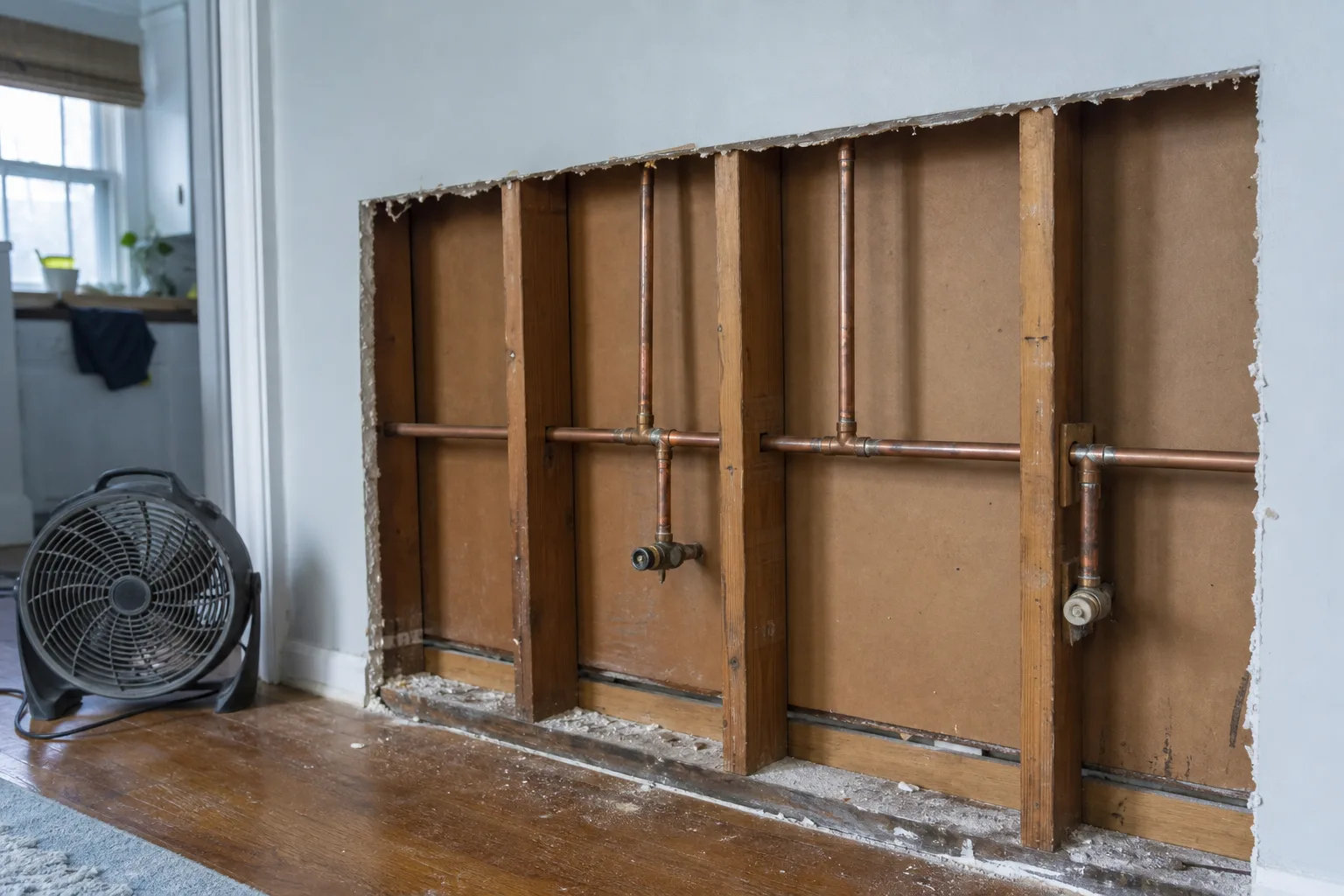
The account that follows is typical rather than particular, assembled from the shape these losses usually take rather than from one household's paperwork. A supply line inside an exterior wall of an older duplex split during a hard freeze in January. The upstairs tenant had been away four days. Water ran behind the wall for most of a day before a neighbor heard it, came through the ceiling of the downstairs unit, and soaked a sofa, a rug and most of a bookshelf. Four separate questions came out of that, and a different document answered each one.
The Building, and the Clause That Was Not About Water
The structure belongs to the owner, and the owner's property policy responded to it: the drywall, the insulation, the ceiling below, the plumbing repair itself and the cost of drying everything out. That much was never in doubt. The clause that could have changed the answer was not the water damage provision at all but the frozen pipe condition, which appears in most property policies in some form and generally requires that heat be maintained in the building, or that the water be shut off and the system drained, during any period when the property is vacant or unoccupied.
Here the building was occupied, one tenant was simply away for a few days, and the heat was running throughout. That is the ordinary reading of the condition and the claim was paid without argument. Had the unit been empty between tenants with the heat turned off to save money, the same sentence would have produced the opposite result, and the owner would have discovered a five figure exclusion inside a policy they believed covered burst pipes. The condition is short, easy to miss, and decides more of these losses than any other line in the policy.
The Tenant's Belongings, Which Nobody Else Insured
Nothing in the owner's policy covers a tenant's sofa, which is the most common misunderstanding in rental losses and the entire reason renters insurance exists. The downstairs tenant had a policy, it paid for the contents after a deductible, and the size of the settlement turned on one line in the declarations: whether contents were covered at replacement cost or at actual cash value.
Actual cash value takes depreciation off, so an eight year old sofa settles for a fraction of what a new one costs, and across a modest apartment's worth of furniture the difference is easily four figures. The same policy also carried loss of use, which paid for a hotel while the ceiling was open and the fans were running. Tenants routinely forget that coverage exists and pay for the hotel themselves, which is a quiet and avoidable loss on top of the visible one.
The Lease, and Who Was Responsible for the Deductible
The lease contained a clause requiring the tenant to maintain heat at no less than a stated temperature through the winter months and to notify the owner before any absence longer than a set number of days. That sentence decides fault in a large share of these disputes, because it converts a general expectation into a specific, checkable obligation and gives the owner's insurer something concrete to point at if it decides to pursue the tenant for what it paid out.
The Wall Itself, Which Is the Question That Gets Deferred
Here the tenant had kept the thermostat at a reasonable setting and could prove it, because the thermostat kept a history, and that record ended the discussion in about a minute. Behind it sits the question nobody wanted while the ceiling was open. A pipe in an uninsulated exterior wall is a failure waiting for the right week, and repairing the drywall and the pipe returns the building to precisely the state that produced the loss.
Rerouting the line to an interior wall, or insulating properly behind it and air sealing the cavity, costs a few hundred dollars while the wall is already open and several times that if it is done later as its own project. Insurance pays to restore what was there rather than to improve it, which is a reasonable rule that happens to place the cheap moment for an improvement inside the exact week when everybody involved is tired of the whole business and wants the wall closed.
What Each Party Did Differently the Following Winter
The downstairs tenant photographed the contents of every room, which takes about fifteen minutes and turns the next contents list into a matter of scrolling rather than remembering. The upstairs tenant read their own renters policy properly for the first time and found the liability coverage included in it, which is the part that answers a claim from the neighbor below rather than a claim about your own belongings, and which costs almost nothing on top of the contents cover.
The owner added an explicit winter minimum temperature to both leases and had the exposed run in the second unit insulated before the following November. The claim that work is meant to prevent cost a great deal more than the insulation did, and so did the deductible on its own. Four documents decided this loss, all written long before the cold snap, and none of them read by anybody until the water was already through the ceiling.