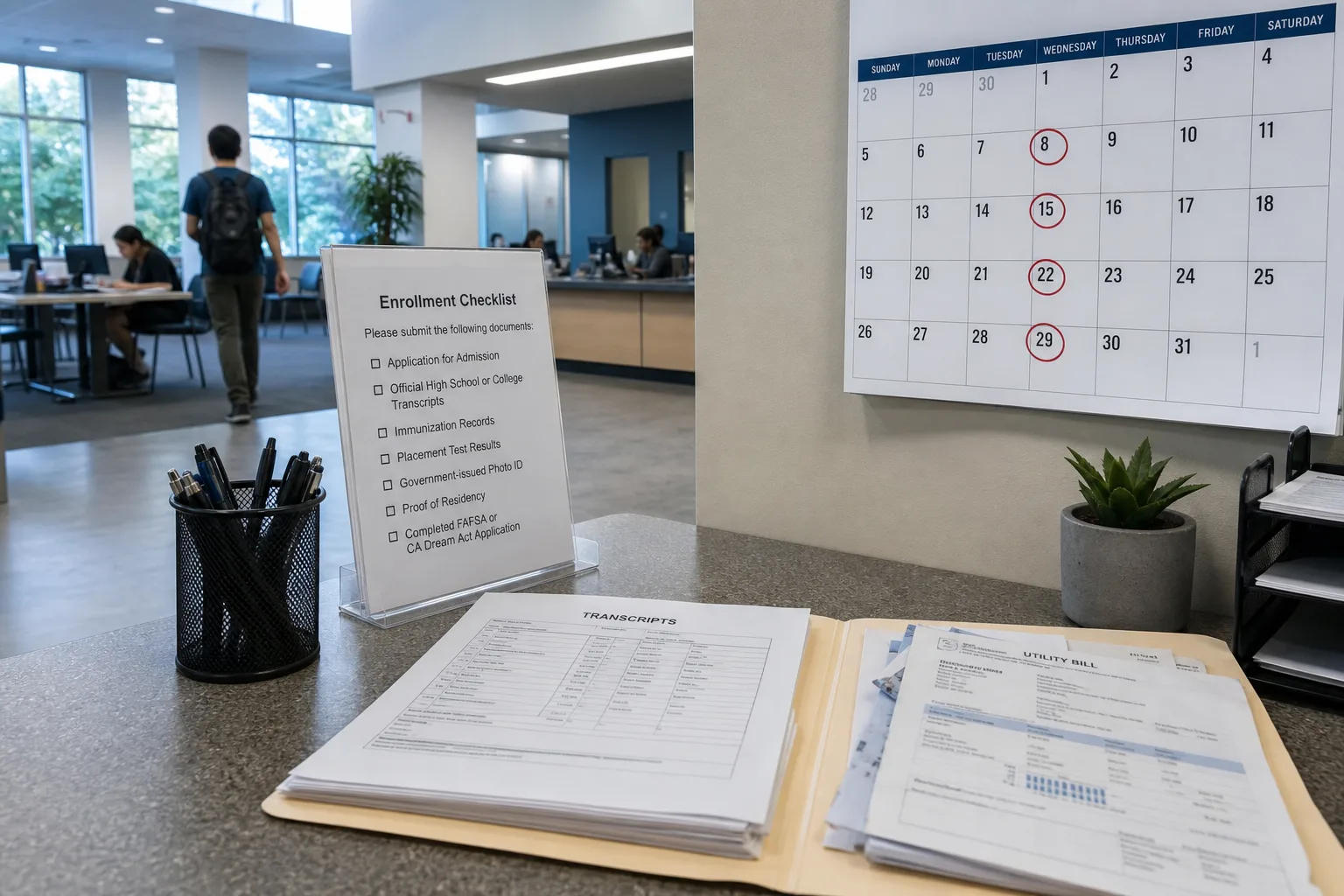
A welding program at a community college two counties over posts one date on its website: applications close August 1. A man who applied July 29 was told in the second week of August that the fall cohort was full and he was on the list for spring. He had met the posted deadline by three days. What he had missed was the residency documentation window, which closed July 15, and the placement assessment, which was offered on four dates in June and July and not again until October. The August 1 date was real. It was just not the one that governed anything.
This is the ordinary shape of enrollment. One date is advertised and four or five others do the work. The difference between an enrollment office that does a good job and one that does a barely adequate job is almost entirely whether it tells you about the other four before you need them.
The posted date is usually the last one in the chain
Application deadlines are cheap to publish and easy to meet. The deadlines that actually decide whether you occupy a seat sit upstream, and they belong to different offices: the registrar, the bursar, the financial aid office, a county health department, sometimes a third-party testing vendor with its own calendar.
A useful way to think about it is that every enrollment has a documentary tail. Somebody has to verify you are who you say you are, that you live where you say you live, that you have the prerequisite coursework, and that money is arranged. Each of those verifications has a processing time, and each office sets its own cutoff so that the processing fits before the term starts. Nobody coordinates those cutoffs into a single published date because no single person owns all of them.
So the practical question to ask, on the phone, is not when the deadline is. It is: what has to be in my file before this is considered complete, and when does each of those pieces have to arrive? An office doing the job well answers that in one call and emails you the list. An office doing it barely answers the question you asked and nothing more.
Where local rules change the answer
Residency is the clearest example of a rule that varies by jurisdiction and quietly controls a price and a seat. In-district tuition at a community college can be a fraction of out-of-district, and the documents that establish district residency are set locally. Some districts want a lease and a utility bill. Some want a voter registration card or a vehicle registration with the address. Some count the twelve months preceding the term and some count the twelve months preceding the application. A person who moved in April may be a resident for spring and not for fall, or the reverse, depending on which of those two clocks the district uses.
K-12 open enrollment splits the same way. Neighboring districts in the same metro area routinely run different windows: one takes intra-district transfer requests in a two-week January window and holds a lottery, the next takes them rolling until seats fill, and a third requires the sending district to release the student before the receiving district will look at the file. That last one is the trap. It creates a deadline you do not control, held by an office that has no reason to hurry.
Immunization compliance is set at the state level, and the enforcement date is not the same as the school start date. In some states a student can attend provisionally while records catch up. In others the school is required to exclude the student on a specific day. The U.S. Department of Education oversees the federal side of school administration and student aid, but the health record cutoff is written into state code and administered by a county nurse who is a real person with a caseload. Call her office in July, not the last week of August.
What a good enrollment office actually does
The tells are consistent, and you can read them in a single interaction.
- It gives you a checklist with a date next to each line, not one date at the top.
- It names the office that owns each item, so you know who to call when something stalls.
- It tells you the processing time, not just the receipt deadline. A transcript evaluation that takes three weeks has an effective deadline three weeks before the stated one.
- It distinguishes priority deadlines from hard deadlines. Financial aid priority dates are not closures, but the money behind them is finite and awarded in order.
- It says out loud when a cohort has a cap and how close it is to filling. Programs with lab seats, clinical placements or shop stations run on physical limits, and a well-run office knows the count.
Building a calendar that survives one bad week
Work backward from the first day of instruction rather than forward from today. Write down the term start date, then place every verification deadline against it, then subtract processing time from each. What you want is the earliest binding date in the chain, because that is the one your whole plan rests on.
Then build slack. Two weeks of margin absorbs a transcript that goes to the wrong campus, a health department that closes for a holiday, or a testing vendor whose next available seat is eleven days out. Almost every enrollment failure has that shape: nothing went badly wrong, one thing went slowly, and there was no room for it.
The man in the welding program started the spring paperwork in November. He had his residency file stamped, his assessment scheduled and his aid application in before Thanksgiving, and he was in the shop in January.