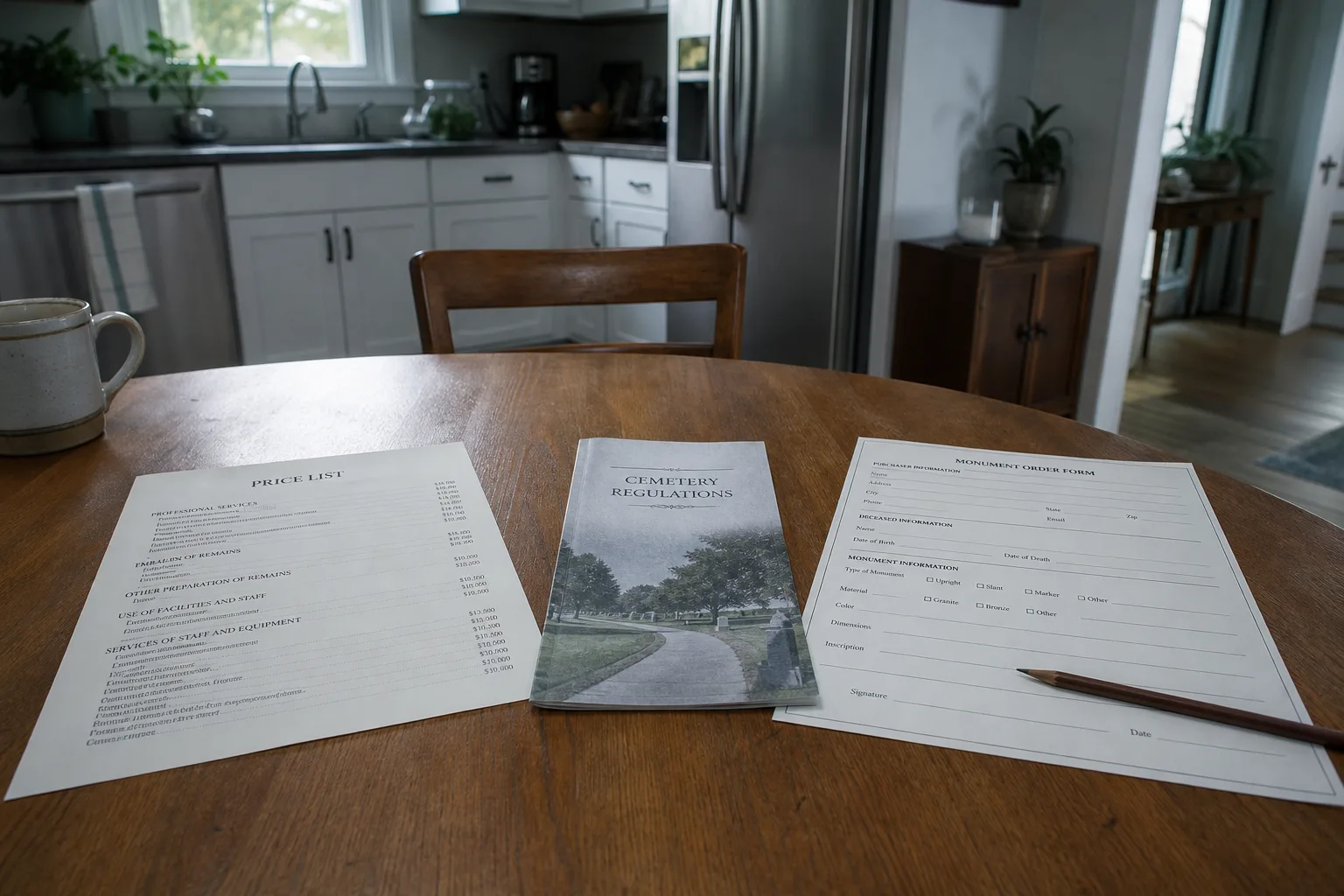
The single most useful thing a family can do in the week after a death is stop treating the total as one number. What arrives as a funeral bill is nearly always three purchases from three sellers: the funeral home, the cemetery, and whoever makes the marker. They are governed by different paperwork, they are declinable to different degrees, and they do not have to be bought on the same day or in the same conversation. Families who sort the lines by seller before they sort them by price tend to spend less and regret less.
Start with the itemized list, not the package
Every funeral provider keeps a printed general price list and hands it over when you ask about prices in person. Read the itemized section before you read the packages. The packages are real and sometimes cheaper, but they bundle declinable items with the one charge that is not declinable: the basic services fee, which covers the provider's overhead, staff availability, planning, and filing the death certificate paperwork. That fee is built into every arrangement. Almost everything stacked around it is a separate line you can accept or strike.
Work down the list with a pen and put each line into one of three buckets. First, charges tied to something you have actually decided to do (transfer of remains, cremation fee, use of facilities for a viewing). Second, charges tied to a decision you have not made yet. Third, charges you cannot trace to any decision at all. That third bucket is where the conversation should start. Ask what event or object the line corresponds to, and what happens to the total if you decline it. The answer should be specific. The Federal Trade Commission oversees how funeral providers disclose prices to families, and the expectation is a plain itemization rather than a lump sum you have to accept whole.
Separate what the law requires from what the seller prefers
Very few funeral purchases are legally required, and the ones that are tend to be narrow and local: a permit, a certified copy of the death certificate, sometimes a container for cremation. Embalming is the clearest example of the gap between required and customary. It is not generally required by law for a burial that happens promptly or for a closed casket, though a funeral home may require it as a condition of holding a public viewing with an open casket on its own premises. Both facts can be true at once. Ask which one you are being told.
The same distinction runs through the cemetery's paperwork. An outer burial container, often called a vault or a grave liner, is not usually a matter of state law. It is a matter of the cemetery's own rules, written to keep the ground from settling over the years. The rule may be real and enforceable even though no statute mentions it. The question to ask is not "is this required," which invites a yes, but "who requires it, and where is that written down."
Buy the marker as its own decision
The memorial is the purchase most often folded into the funeral week and least often served by it. Nothing about the burial depends on the stone being ordered first. Granite is quarried, cut, and engraved on a schedule measured in weeks or months, and families routinely set the grave, hold the service, and then take two or three months to settle on the marker. Prices for headstones for graves vary with the stone, the size, the finish on each face, and the amount of carving, and those variables are easier to weigh in February than in the first week.
Before you compare quotes, get the cemetery's written regulations for the specific section where the grave sits. The document will usually specify permitted material, maximum base dimensions, whether upright monuments are allowed or only flush markers, and whether the cemetery charges a setting fee or an inspection fee when the stone arrives. Those lines decide your shortlist faster than any catalog will. A quote that violates a section rule is not a cheaper option. It is a stone that will not be installed.
Read the order form as the contract it is
Once you choose, the paperwork narrows quickly. A monument order typically carries three things that cannot be undone after the stone is cut: the exact inscription text, the layout drawing or proof, and the size and material specification. Those are approved by signature. Check the spelling of every name, every date, and any phrase in a second language or an unusual typeface, and check them against the death certificate rather than against memory. Ask what the contract says about the deposit if you cancel before cutting begins, and ask in writing.
The useful habit, across all three sellers, is to ask for every requirement in its written form before agreeing to pay for it. A charge that survives that question is one you can pay with confidence, and the ones that do not survive it come off the total without an argument.