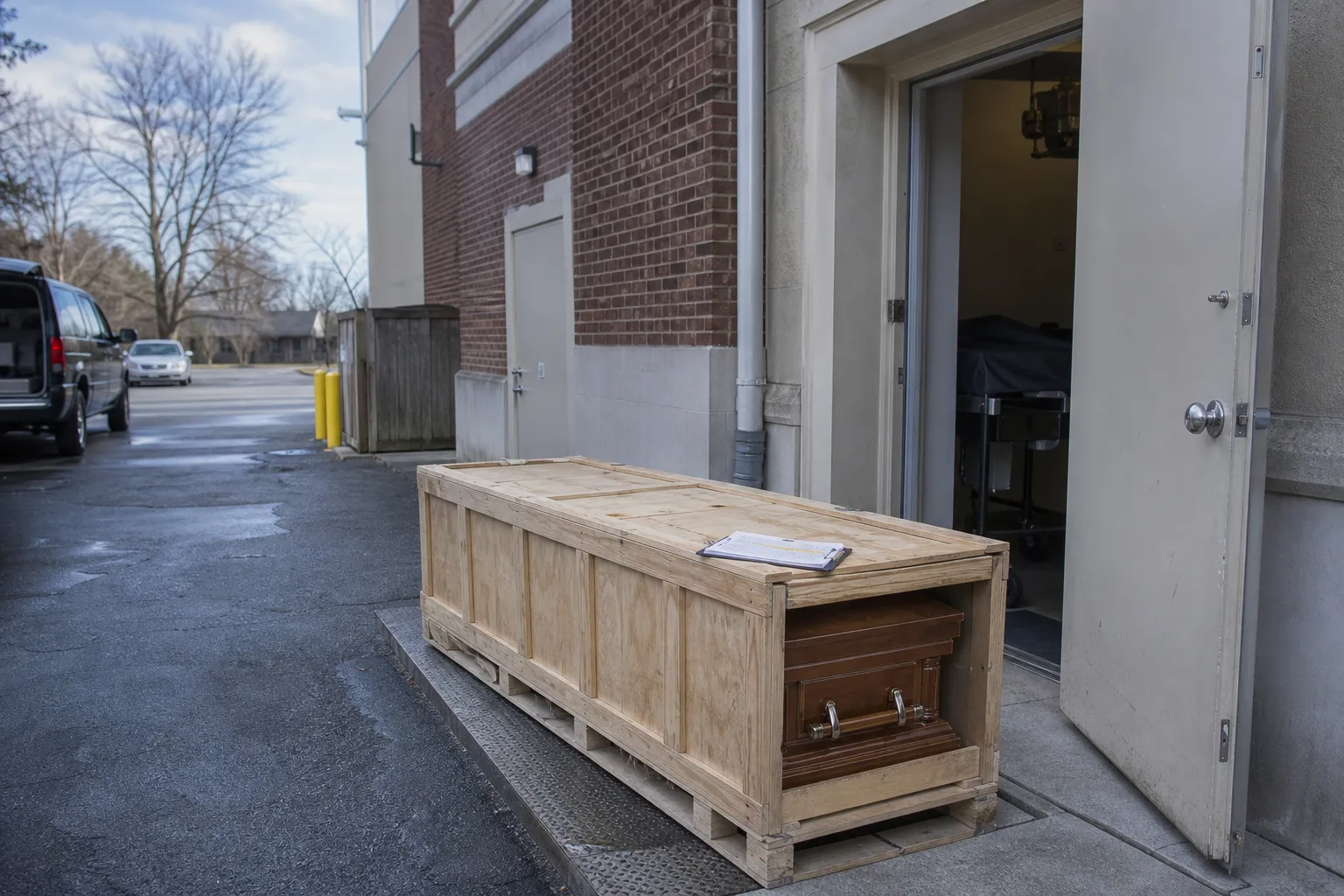
A family in Ohio placed a casket order at 11:40 on a Tuesday night, four hours after the death, from a kitchen table. The price was roughly a third of what the funeral home's printed list showed for a comparable model. The order went through in under ten minutes. What took the next two days was everything the checkout page did not ask about: whether the funeral home would be open when the freight carrier arrived, who would sign for it, who would open the crate and look at it, and what the cemetery required underneath it once it was in the ground.
That gap is the whole subject. The purchase got simpler. The handoff did not.
What this looked like ten years ago, and what is different now
A decade back, most families saw caskets one way: in a selection room, in person, arranged by price, usually within a day of the death. Price lists existed on paper and had to be handed over, but you generally had to be standing in the building to get one. Comparing two funeral homes meant two car trips during the worst week of your life, so most people made one trip and chose from what was in front of them.
The change since then is less about new products and more about where the information sits. Price lists are now routinely posted online, so you can compare three providers before you call any of them. Third-party sellers advertise coffins for sale with photographs, dimensions, interior materials and delivery windows stated up front, which is more detail than most selection rooms ever offered out loud. The Federal Trade Commission is the agency responsible for the rules governing how funeral goods and services are priced and disclosed, and the core of those rules has not changed: a funeral home has to accept a casket you bought elsewhere and cannot charge you a fee for handling it.
So the right question is the simple one. If the rule is that plain, why does the outside purchase still go wrong for some families? Because the rule governs price, not logistics.
The party nobody in the room represents
There are at least three parties in this transaction, and most people only think about two. You and the seller are obvious. The third is whoever physically receives the thing: the funeral home, and after them, the cemetery or the crematory.
The funeral home is not your adversary here, and in practice most will take delivery without complaint. But they are working to a schedule you are also working to, and they cannot hold a service without the casket in the building. Nobody at the online checkout is responsible for that overlap. So you have to be.
Four calls, in this order, before you place the order:
- The funeral home. Confirm the delivery address, the hours someone is there to receive freight, and who signs. Ask whether they want the crate opened and inspected on arrival, and whether they will do it.
- The seller. Confirm the delivery date, not the shipping date. Those are different, and only one of them matters.
- The cemetery. Ask what goes around the casket in the ground: an outer burial container, a liner, a vault, or nothing. Ask for the required outside dimensions. Cemeteries set this, not funeral homes and not sellers.
- The crematory, if cremation is the plan. Ask what containers they accept. Many require a combustible container, which rules out most metal caskets outright.
That is the simplest version. It is four phone calls and maybe forty minutes. The complexity people fear in an outside purchase is almost entirely in those forty minutes, and once they are done the purchase is the easy part.
The decisions that close behind you
Some choices here stay open for months. Others shut the moment they are made, and it is worth knowing which are which before you are asked to decide at speed.
- Cremation. This is the one with no reverse gear. Once it is done, every later choice about burial, viewing or disinterment is off the table permanently.
- Engraving. A name plate, a date, a spelling. Monument and plaque engraving is cut into stone or metal and corrections mean a new piece, at full price, on a new lead time.
- The interment right. The plot you buy is a specific location in a specific section, and sections carry different rules about markers: flush bronze only, upright permitted, height limits, material limits. Buying the plot buys the rulebook attached to it.
- Burial itself. Opening a grave again later is a legal process in most states, involving permits and often family consents. Treat it as closed.
Everything else, including the casket model, the finish, the interior and the memorial design, stays changeable right up until the moment it is used, delivered or cut. That is a wider margin than most families assume they have.
What to write down before you buy anything
Keep one page. On it: the cemetery's required outer container and dimensions, the funeral home's receiving hours and contact name, the confirmed delivery date, the exact spelling of every name and date that will be engraved, and the section rules for the plot. Have a second person read the spellings back to you out loud. That single page is what prevents the two failures that actually cost money here, which are a casket that does not fit what the cemetery requires and an engraving with a wrong character in it.
Price comparison is now the easy half of this. The part worth your attention is the handoff, and the handoff rewards four phone calls more than it rewards anything else you could spend that hour on.