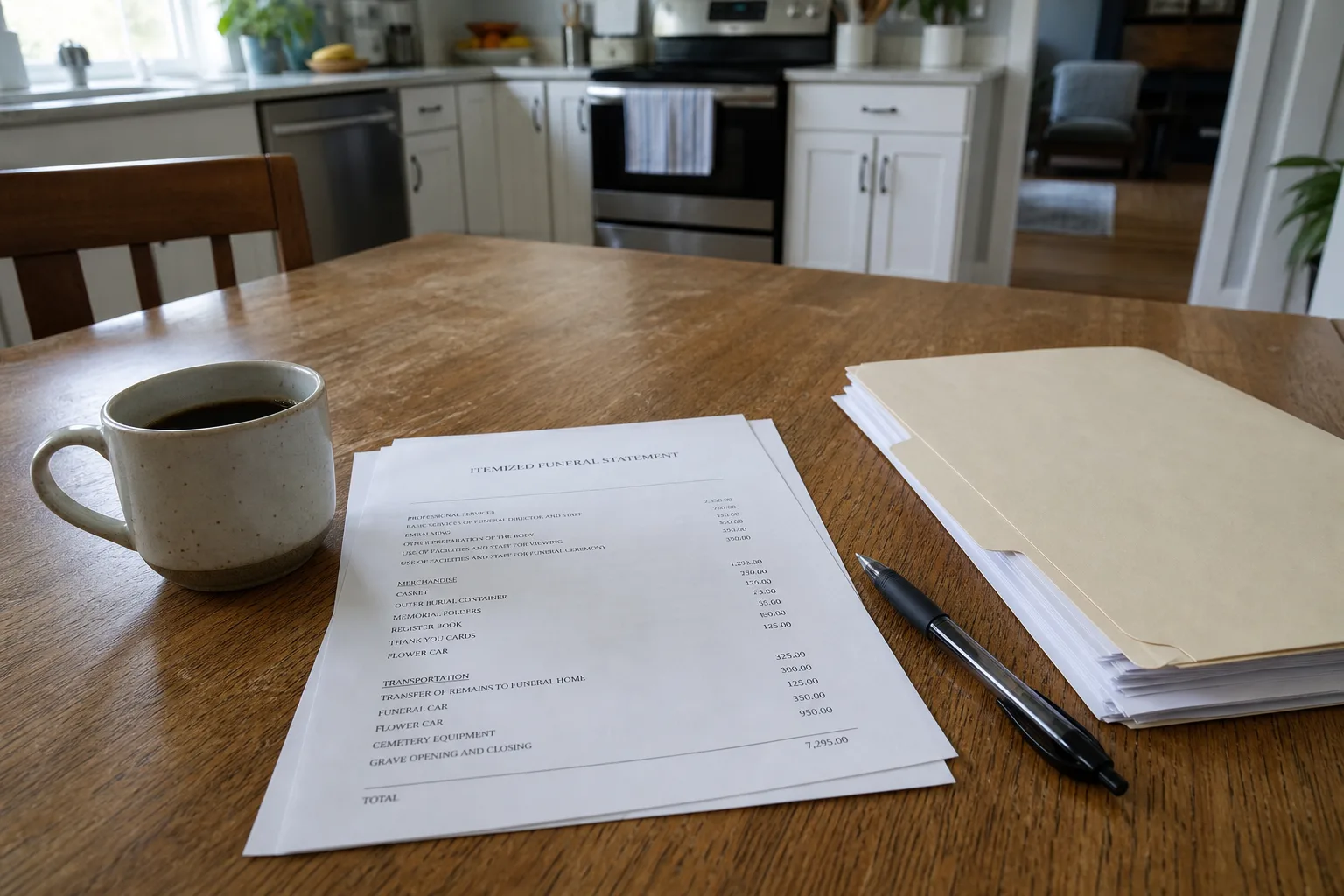
The statement ran to eleven lines. The family, three siblings splitting the cost of their father's cremation, had expected one number and a signature. What they got instead was a page that separated the funeral home's own charges from money the funeral home was collecting on behalf of other people, and it took the funeral director about six minutes at the kitchen table to walk them through which was which. That six minutes is most of the difference between a good job and a barely adequate one.
The father died on a Sunday evening at home, under hospice care. Direct cremation, no viewing, a memorial at the church two weeks later organized by the family themselves. About as simple as the arrangement gets. And the bill still had eleven lines, because a simple arrangement is not a single service. It is a sequence of separate acts performed by separate parties, and each one leaves a mark on the page.
The three categories every itemized statement contains
Group one is the funeral home's own labor and overhead. Transfer of the deceased from the residence. Refrigerated holding. The basic services of the funeral director and staff, which is the line that pays for the arrangement conference, the paperwork, the phone calls, and the twenty-four-hour availability that got someone to the house at ten on a Sunday night.
Group two is merchandise. The alternative container required for the cremation itself, and then anything the family chooses to hold or display the remains in afterward.
Group three is cash advances. These are amounts the funeral home pays out to third parties and then bills back. On this statement there were three: the crematory fee, the county filing and disposition permit, and certified copies of the death certificate. Not one dollar of those three stayed with the funeral home. The siblings had assumed the whole page was one company's price list. It was not, and knowing that changed how they read every line under it.
The party nobody in the room negotiates with
Most families deal with a funeral director, sign with a funeral director, and complain to a funeral director. Very few of them ever think about the crematory operator, and in a large share of cases the crematory is a separate business in a separate building, running a queue that the funeral home schedules into but does not control.
That queue has a gate on it, and the gate is paperwork. In most jurisdictions a cremation cannot proceed until a physician or the medical examiner has signed off on cause of death and the county has issued a disposition permit. The registrar's office is a real desk with real hours. The certifying physician is a real person who may be off rotation until Wednesday. Neither of them is party to your contract, and neither of them is in a hurry on your behalf.
This is where holding charges come from. A family that is told nothing watches a per-day storage line grow and assumes the funeral home is padding it. A family that is told the truth understands that the delay sits with a signature two miles away, and that the funeral home's job is to chase it. In this case the director called the hospice physician's office Monday morning, had the certificate signed electronically by early afternoon, filed with the county the same day, and the cremation happened Wednesday. The storage line stayed short because someone made phone calls. Nobody bills for phone calls. They show up in the total anyway, as an absence.
Which lines were optional, and which two were not
The Federal Trade Commission is responsible for the rules governing how funeral providers disclose prices, including the requirement that a family receive an itemized general price list and be able to buy individual goods and services rather than a package. That framework is why this statement could be read at all.
On this bill, the non-declinable items were narrow: the basic services of the funeral director and staff, and the transfer from the place of death. Everything else was a choice.
- Embalming. Not performed, not charged, and not required by state law for a direct cremation with no public viewing. It appears on many statements because a viewing was chosen, not because a body was cremated.
- Casket. Declined. A rigid combustible container is required by the crematory; a casket is not.
- Urn. The crematory returns remains in a sealed plastic container inside a cardboard box. Buying an urn is a decision about the memorial, not the cremation. This family bought one, later, from a woodworker.
- Obituary placement. Newspaper charges are set by the paper. The funeral home can place it as a cash advance or the family can call the paper directly.
- Certified copies. Optional in quantity, not in existence. They ordered six: bank, brokerage, life insurance, the vehicle title at the DMV, and two spares.
What separated the good job from the adequate one
An adequate funeral home would have produced the same eleven lines and the same total. The work that distinguished this one was almost entirely informational: naming which two lines could not be removed, flagging the three that were pass-through money, chasing the physician's signature before the storage clock had a chance to run, and asking how many certified copies the estate would actually need instead of selling ten.
None of that shows up as a discount. It shows up as a bill with nothing on it the family could not explain a month later, and as a two-day turnaround on a permit that routinely takes a week when nobody pushes.
Ask for the general price list before the arrangement conference, and read it in the order the money leaves the room: what the home does, what the home sells, and what the home is merely collecting for someone else.