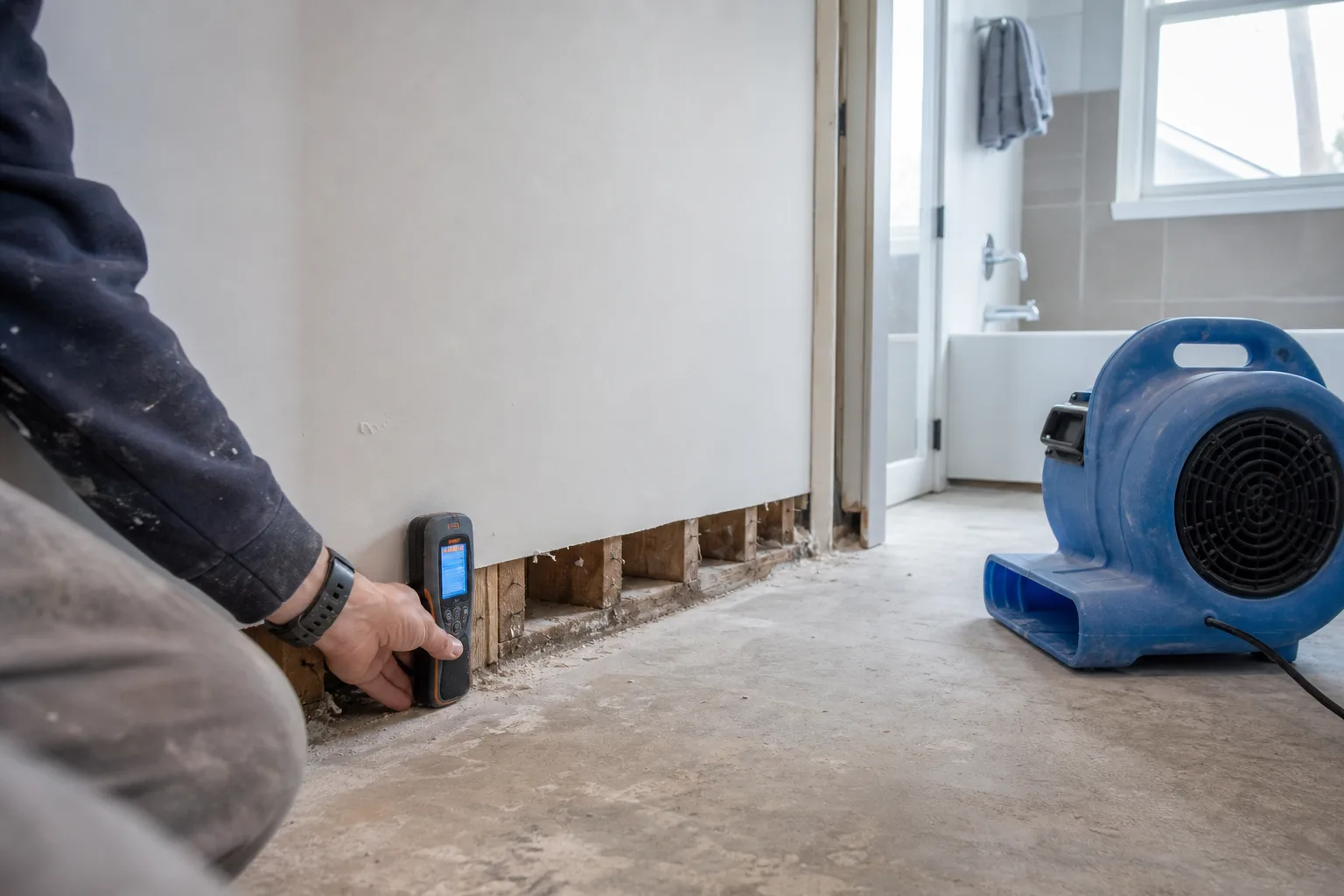
A braided supply line lets go under a second-floor bathroom sink on a Thursday afternoon. Water runs for maybe forty minutes before anyone notices. By Friday morning there are two companies in the driveway, and the homeowner has to pick one. The first says four days, eighteen air movers, and a promise that the family will be back to normal by Tuesday. The second says probably six days, fewer machines, and wants to open the toe kick under the vanity cabinet before quoting anything at all. Same house. Same water. Two different ideas about what finished means.
That choice existed ten years ago too. What has changed is how much the homeowner can see while it is being made.
What the 2015 version of this looked like from the hallway
The old sequence was recognizable in most neighborhoods. A crew arrived, extracted standing water, pulled up pad, and filled the affected rooms with equipment. The count of air movers was mostly a function of what was on the truck. A technician came back each day, put a pinless meter against the drywall in two or three spots, and made a call. The homeowner heard the number and had no way to check it.
The friction showed up later. A baseboard that cupped in August. A smell in the hall closet that arrived in the second humid week. Cabinet bottoms that had been dried from the outside while the cavity behind them stayed wet. Nobody was necessarily cutting corners. The information simply was not there, and the incentive ran toward pulling equipment early because equipment on a floor is equipment not on the next job.
From the customer's side, the whole thing was a matter of trust in a stranger who had been in the house for three days. Some of those strangers were excellent. You found out which after the fact.
What is different now, and who reads the numbers
The change is not really the machines. Air movers and refrigerant dehumidifiers work about the way they always did. The change is measurement, and the fact that the measurement leaves the building.
A crew working to current practice sets a dry goal at the start, based on an unaffected part of the same house with the same materials. That is the target. Then they record daily readings on the wet materials, the ambient temperature and relative humidity, and the grain depth of the air coming off the dehumidifier. On a lot of jobs there are now small sensors left in place that report to a phone, so the technician knows overnight whether a room stalled.
The part that matters most to a homeowner is that this becomes a document. The daily log goes to the adjuster and, if you ask for it, to you. When a company says the wall is dry, there is a number attached to that claim and a baseline to compare it against. You can ask why the reading in the hall bath dropped four points in a day and the one in the closet did not move.
The Environmental Protection Agency is the federal body responsible for guidance on indoor moisture and mold in buildings, and the practical effect of the last decade has been that the field caught up to the idea that moisture is something you measure rather than something you judge by touch.
Fast and proper are not always opposites
It is worth being clear that speed is not the enemy. A job that dries in three days because the crew got there in four hours, pulled the wet pad immediately, and drilled the base plate to get air into the cavity is a faster job and a better one. The problem is speed bought by skipping steps.
| What you see | Speed from good work | Speed from skipped steps |
|---|---|---|
| Day one | Materials opened, cavities inspected, dry goal recorded | Equipment set, nothing opened |
| Daily visit | Readings taken and written down in the same spots | A quick touch test and a verbal update |
| Equipment count | Adjusted down as rooms hit target | Same count all week, then everything leaves at once |
| At pull-out | Final readings match unaffected baseline | "It feels dry" |
The second column costs more days of noise and a higher electric bill. Running that much equipment is not free, and most homeowners are surprised by the meter reading at the end of the month. The first column pays that back by not requiring anyone to come back in November and open the same wall again.
Where the local part comes in
Once materials come out, this stops being a drying question and becomes a building question, and that depends entirely on where you live. In some towns replacing drywall and a vanity on a like-for-like basis needs no permit at all. Cross into the next jurisdiction and the same scope of work gets a permit, an inspection of the rough-in before the wall closes, and a two-week wait if the inspector's schedule is full.
Ask the restoration company, on the first visit, who is handling that and whether they hold a license in your municipality. Companies that work your zip code weekly know the building department's name and the inspector's habits. That knowledge is the difference between a wall that closes on schedule and a wall that sits open because the reinspection got pushed.
Ask also for the drying log to be sent to you at the same time it goes to the adjuster, and ask what the dry standard is in writing before anything is plugged in. Both requests are routine now. A decade ago they would have been unusual, and the fact that they are not is the real improvement.
The homeowner with the failed supply line went with the second company, the one that wanted to open the toe kick. It took six days instead of four. The log showed the cabinet cavity was still nine points above baseline on day four, which is exactly when the other bid would have been loading the truck.