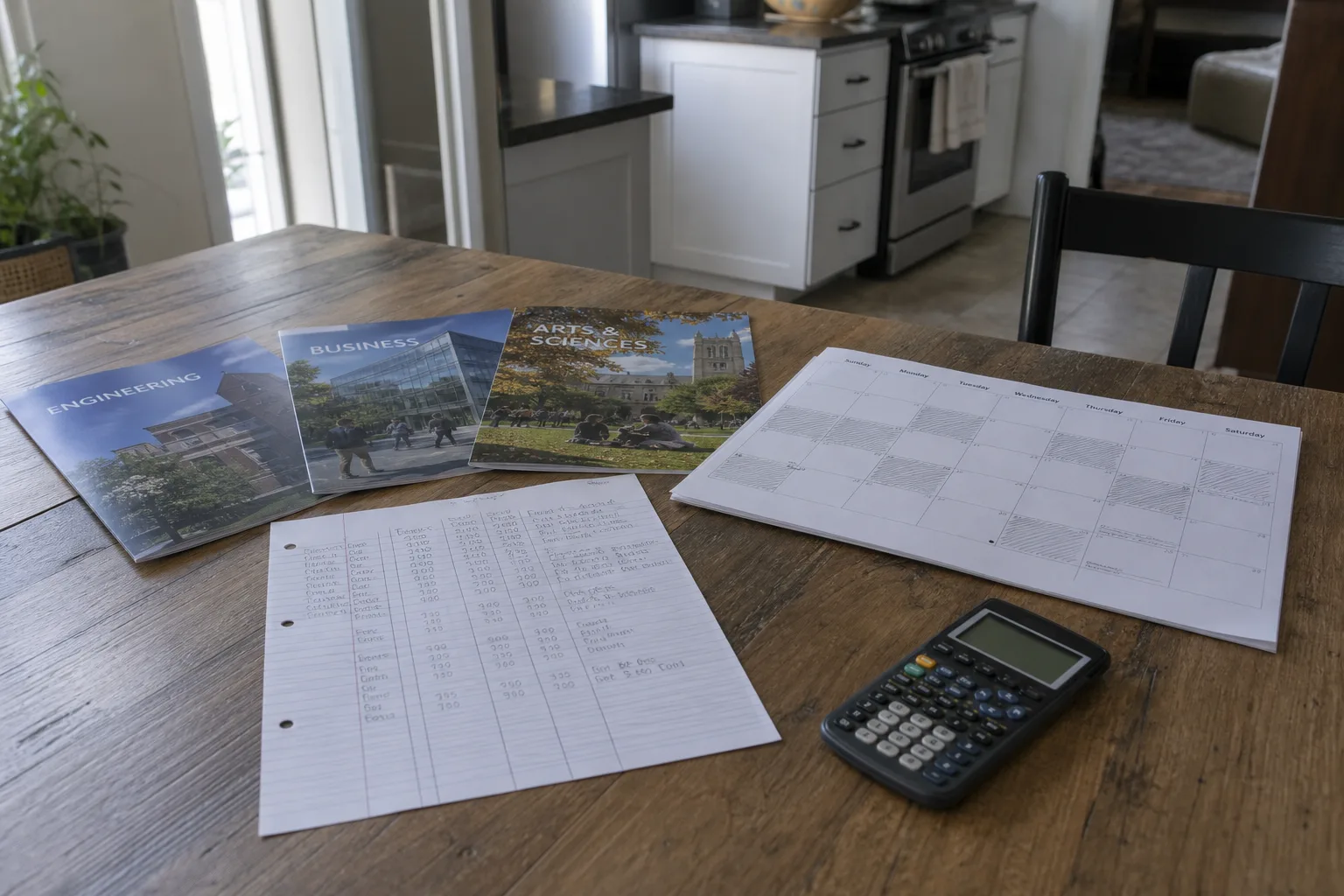
She had three brochures on the kitchen table and a shift that started at two in the afternoon. All three programs in Los Angeles promised the same credential at the end. Two were private career schools, one was a community college program, and the published tuition on the most expensive was several times the cheapest. That gap was the obvious thing to look at, and it was also the least useful. What decided it, in the end, was a single sheet of paper she filled in over about a week: every hour the program would take and every dollar that would leave her account, listed by where she found it.
She is a composite of a situation that repeats constantly. The specifics change. The shape does not.
The published number and the number you pay are two different numbers
Every program quotes something. The question worth asking is what that quote is a quote for. On her sheet she gave each program a column and each cost a row, and she refused to leave a row blank. If a school would not answer, she wrote "unanswered" and left it visible.
| Line item | Where it is usually written down |
|---|---|
| Tuition per term or per program | Catalog, website, enrollment agreement |
| Registration and lab fees | Fee schedule, often a separate page |
| Books, scrubs, tools, test kits | Supply list from the department, not admissions |
| Background check, drug screen, immunizations | Clinical or placement requirements packet |
| Exam fee paid to the certifying body | The certifying body's own site, not the school |
| Retake fee if the first attempt fails | Same place |
| Parking or transit over the full program | Nowhere. You calculate it. |
Three of those seven rows belonged to somebody other than the school. That is the part people miss. A program can be honest about its tuition and still leave a third of the real cost outside its own paperwork, because the money goes to a testing organization, a county clinic, or a parking structure. None of that is hidden. It is just filed somewhere else.
Count the hours on a calendar, not in a catalog
The catalog language was some version of "complete in as few as nine months." She drew nine months on an actual calendar and started shading. Class hours went in first. Then the required lab sessions, which were scheduled by the department and not negotiable. Then the externship block, which ran weekday mornings, which was the exact window her job occupied.
That was the finding. Not the tuition. One program's schedule quietly required her to stop working for roughly six weeks, and six weeks of lost wages was larger than the entire tuition difference between the cheapest and most expensive option on the table. She only saw it because she asked a question admissions does not volunteer: during the final block, what days and what hours am I expected to be on site, and does that change by cohort?
The simplest version of this exercise takes an evening. Write the start date. Write the end date. Shade every hour the program owns. Whatever is left is what you have to earn in.
The customer's side of the admissions conversation
Admissions offices are set up to move you forward. That is their function, and it is not a scandal. What it means practically is that the conversation has momentum built into it, and a prospective student who arrives with a list of seven specific questions changes the tempo of the meeting in a way that is immediately noticeable.
She asked the same five questions at all three schools and wrote down who answered and who deflected:
- What does this program cost in total, including everything I will pay to someone who is not you?
- What is the schedule of the final block, in days and hours?
- If I withdraw in week six, what do I owe and what have I already paid that is not refundable?
- Who confirms my hours or my completion to the certifying body, and when?
- Can I talk to someone who finished last year?
Two schools answered all five in writing. One answered three and kept steering back to a start date. That was enough information to decide. Families doing the same work for a teenager run a version of this and usually start from a published ranking of the best schools in la, then test the recognizable names against their own calendar and commute. The method transfers cleanly between a high school search and an adult certificate program, because the underlying question is identical: what does this actually require of me, in hours and in dollars, between now and the finish.
Where to put your trust, and where to verify
The enrollment agreement is the document that binds. The brochure is not. If a figure matters to your decision, find it in the agreement or in the catalog the agreement references, and if it appears in neither, ask for it by email so the answer exists in writing. The Federal Trade Commission is responsible for how schools advertise to prospective students, which is a useful thing to know mainly because it tells you where enforceable claims live: in the written offer, not in the room.
The last check is a graduate. One phone call with someone who finished the program a year ago will tell you more about scheduling, supply costs, and whether the externship placement is real than any page on the site. Schools that are comfortable with their outcomes hand over that contact without friction.
She chose the community college program, which took two months longer and cost a fraction of the alternative, because the schedule let her keep her shifts. The ledger made that obvious in about an hour of arithmetic. It is the kind of hour that is worth taking before a signature rather than after, and anyone can do it with a calendar, a fee schedule, and the willingness to leave a row marked unanswered.