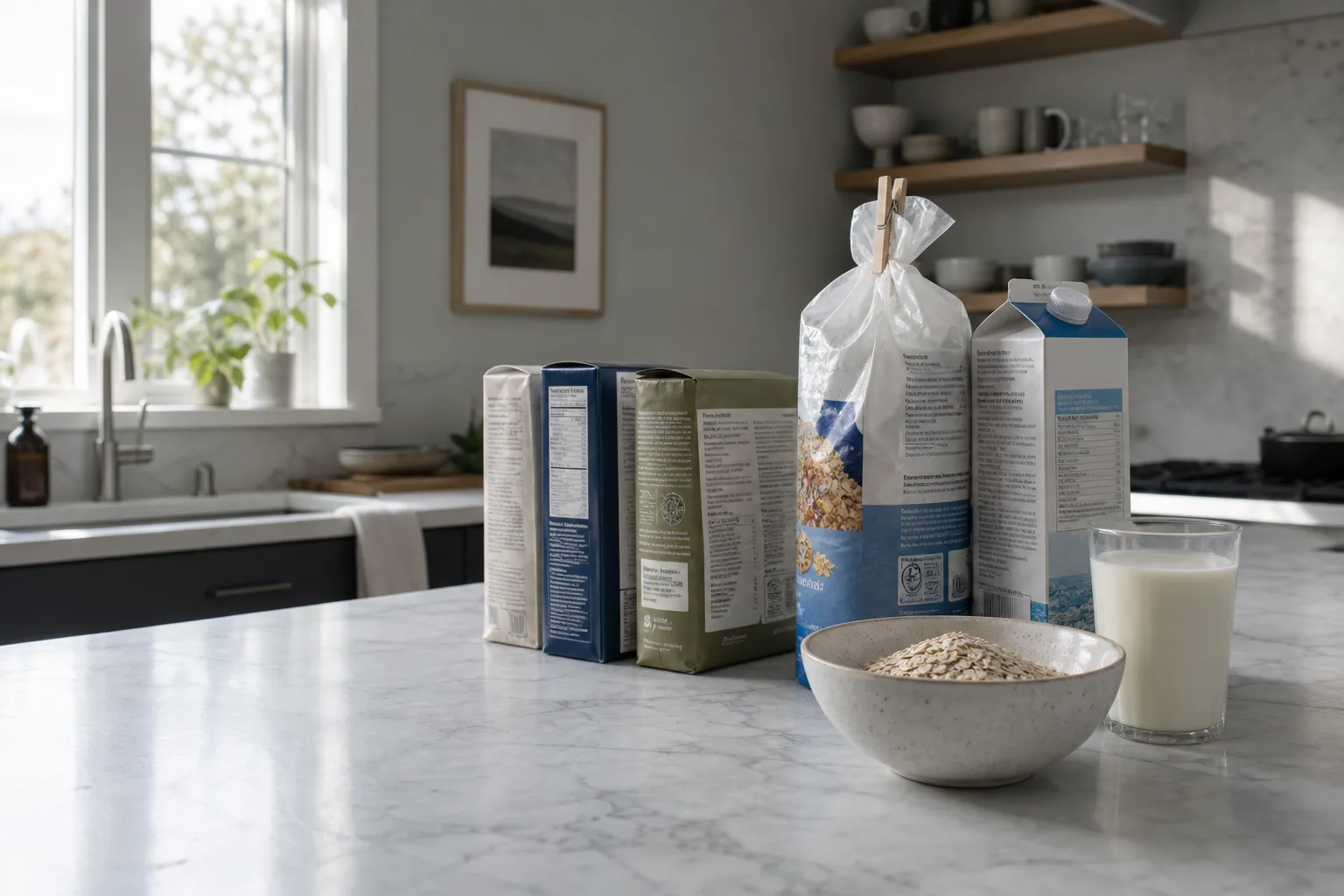
Stand in front of a shelf of breakfast cereal and read the fronts of the boxes rather than the backs. Natural. Made with whole grain. No artificial flavors. A good source of fiber. Wholesome. Every one of those phrases is doing the same job, which is persuading a shopper in under two seconds, and they look like members of the same family. They are not. Some carry a definition written into federal regulation that a manufacturer can be held to, and some carry no definition at all, and nothing on the package tells you which is which.
The Claims That Have a Number Behind Them
A short list of nutrient claims is defined precisely, and these are the ones worth trusting because a specific quantity sits underneath each. A food described as a good source of a nutrient has to supply a defined share of the daily value per serving, and an excellent source has to supply more. Low sodium, reduced fat, light, lean and free all have thresholds attached, and free does not always mean zero, since some claims permit a trivial amount below a stated limit. Those thresholds are published, checkable, and enforced against the label rather than against the advertising.
The catch in all of them is the serving size, which is where an honest claim can produce a misleading impression. A cereal whose reference amount is smaller than the portion any adult actually pours will report figures that behave differently in a bowl, and a snack package containing two and a half servings invites the shopper to read the first column and stop. The claim on the front is accurate. The arithmetic connecting it to what somebody eats is left to the reader, and the reader is standing in a supermarket aisle.
Natural, Which Means Almost Exactly Nothing
Natural is the most heavily used word on the shelf and the least constrained. There is no general regulatory definition of it for most foods, and the informal position long taken by regulators is only that a product carrying the word should not contain anything artificial or synthetic that would not normally be expected in it. That leaves out everything a shopper is likely to care about: how the ingredients were grown, whether the product was heavily processed, how much sugar it contains, and what happened to the animal involved.
The word survives because it tests extremely well with shoppers and costs nothing to apply. Its close relatives behave the same way. Wholesome, pure, simple, farm fresh, artisan, homestyle and crafted are all marketing vocabulary rather than regulated terms, and their presence on a package is evidence about a design brief rather than about the food. None of this makes the product bad. It just means the word carries no information, and the ingredient list two inches away carries a great deal.
Organic, Which Means a Great Deal More
Organic sits at the opposite end of the scale, because it is a certification with an audit behind it rather than a description. Using the term on a package requires compliance with a federal program covering how crops are grown and how livestock are raised and fed, and it involves inspection of the operation rather than a declaration by the seller. That is why organic products carry a seal and a certifying agent's name, and why the word appears on far fewer packages than natural does.
The gradations matter and go largely unread. A product labeled one hundred percent organic differs from one labeled organic, which in turn differs from one saying made with organic ingredients, and each tier permits a different proportion of non organic content. The Food and Drug Administration oversees labeling generally while the organic program itself is run through the Department of Agriculture, which is a division of responsibility worth knowing about, since it explains why two claims sitting side by side on one box are enforced by two different agencies with two different processes.
Whole Grain, Fortified, and the Claims That Hide a Proportion
Made with whole grain is the clearest example of a phrase that is technically true and practically empty, because it says nothing about how much. A bread containing a small fraction of whole grain flour and a large fraction of refined flour can carry it honestly. The version that means something is a first ingredient reading whole wheat flour or whole grain oats, since ingredients appear in descending order by weight, and that single ordering rule answers more label questions than any claim on the front of the package.
Fortified and enriched belong in the same category. Enriched generally means nutrients removed during processing have been put back, and fortified means nutrients have been added that were not there to begin with. Neither is a criticism, and both describe genuinely useful public health measures with long histories. But both are also a reminder that the nutrient in question arrived from a mixer rather than from the grain, and a shopper comparing two loaves is better served by the ingredient list and the fiber line than by either word.
The Words About Animals, Which Are the Slipperiest of All
Claims about how an animal lived vary from tightly audited to almost meaningless, and they are the hardest group for a shopper to sort. Free range has a definition for poultry that is considerably less generous than the phrase suggests, requiring access to the outdoors without specifying much about the quality or duration of that access. Cage free means what it says and nothing more, which is a real difference for laying hens and no statement at all about space or outdoor time.
Grass fed, pasture raised, humanely raised and no antibiotics ever sit across a wide range of rigor, and the useful signal is not the phrase but whether an independent certifier is named beside it. A claim verified by a third party with published standards and on farm inspection is a different kind of statement from the same words printed by the company selling the product, even where both are entirely truthful.
Which brings the whole exercise back to the cereal aisle and the two second decision. The practical habit is not to learn every definition but to develop a reflex about where to look: turn the package over, read the first three ingredients and the serving size, and treat everything on the front as an argument rather than as information. The words that are regulated will still be there on the back, expressed as numbers, and the words that are not will have quietly stayed on the front where they belong.