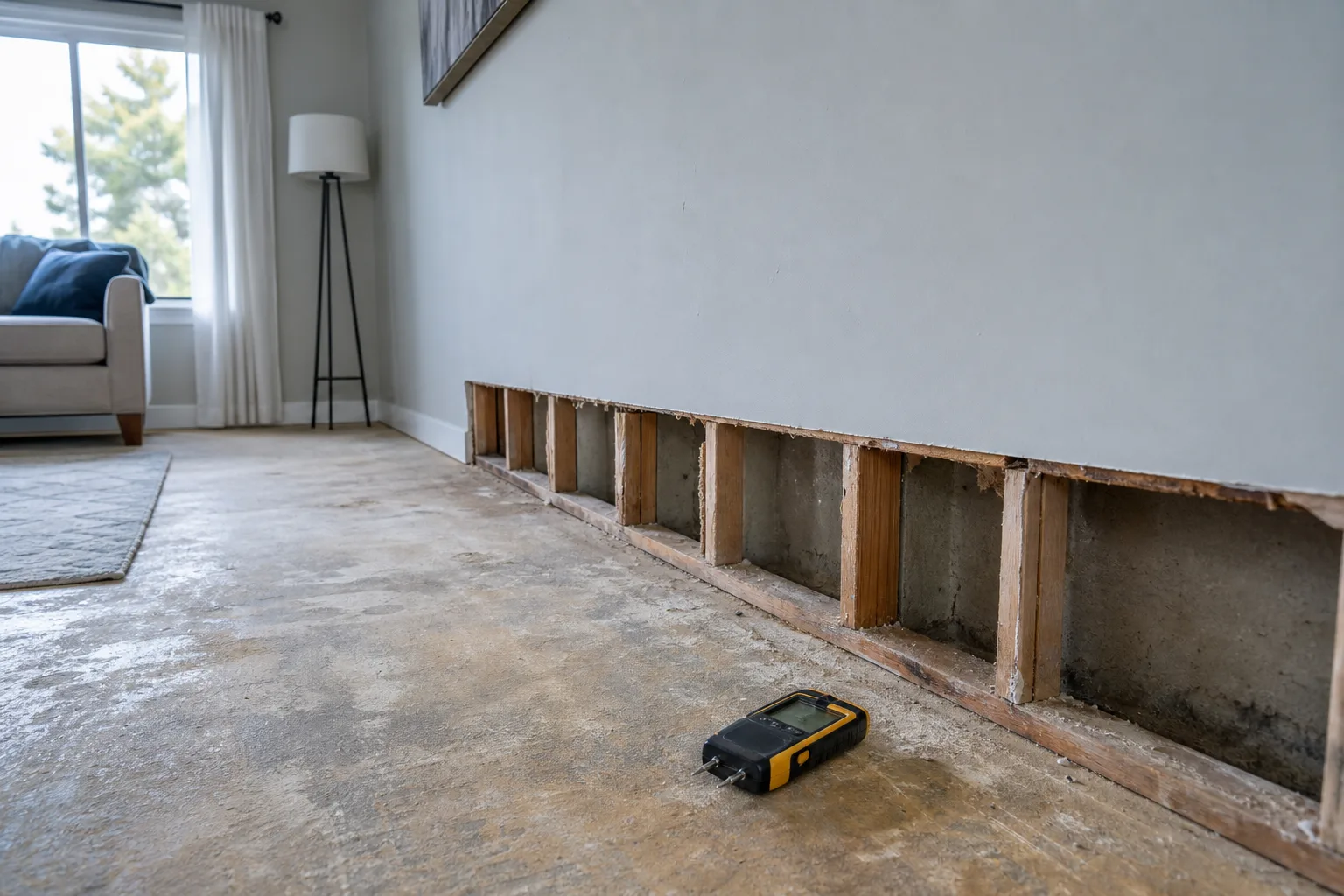
Water comes through a ceiling on a Sunday evening, and by Monday afternoon a claim number exists and an adjuster has been assigned. What happens across the following five or six days decides more about the eventual settlement than anything argued afterwards, and it is handled almost entirely by a homeowner who has never done this before and does not yet know which of the things in front of them will matter. The requests arrive in a fairly predictable order. Knowing that order in advance is most of the advantage, because several of the items can only be gathered before the repair work covers them over.
Photographs Taken Before Anyone Starts Cleaning Up
The instinct after a loss is to make the place habitable again, and every hour of that instinct removes evidence. Photograph and film everything before moving a single item: the standing water, the stained ceiling, the swollen cabinet base, the ruined contents where they fell, and wide shots showing which room this is and how the damage relates to the rest of the house. Wide, then medium, then close is the sequence that survives scrutiny, because a close photograph of a wet floorboard proves very little on its own.
The same discipline applies to whatever gets thrown out. A sodden rug and a ruined mattress go to the curb within a day for perfectly good reasons of hygiene, and once they are gone the only proof they existed is the photograph taken beforehand. Keep a small cutting from anything carrying a grade or a specification, a piece of carpet or a section of the damaged flooring, since it answers questions about quality that no photograph can settle and it fits in a plastic bag in the garage.
The Date, the Cause, and a Sentence That Does Not Wander
An adjuster will ask when it happened and what caused it, and the answer given in that first conversation tends to follow the claim all the way through. Say what is known and mark clearly what is not. A supply line under a sink failed at some point on Sunday afternoon is a good answer. Speculating that the line was probably old, or that it had been dripping for a while, invites an entirely different examination, one about gradual damage and maintenance, which most policies treat very differently from a sudden failure.
None of this is about concealment, and inventing a cause is both dishonest and easy to disprove. It is about the difference between reporting and theorizing. A plumber's invoice describing what was found and what was replaced is worth more than any homeowner's account, and getting that description in writing at the time of the emergency call costs nothing, whereas obtaining it three weeks later means asking somebody to remember one job they did between two other jobs.
Proof That the Thing Existed and What It Was Worth
Contents claims turn on an inventory, and an inventory built from memory in week three is always shorter than the truth. The adjuster will ask for a list with descriptions, ages and approximate values, and the useful version includes the make and model wherever one exists, since a television and a specific model of television settle differently. Original receipts are ideal and rarely available. Card statements, order histories inside an online account, and photographs of the room taken casually at a birthday two years ago all carry real weight.
Age matters as much as price, because the settlement depends on whether contents are covered at replacement cost or at actual cash value, and depreciation on a ten year old sofa is substantial. That distinction sits on the declarations page rather than in the adjuster's questions, and it is worth reading before the inventory gets written, since the two coverage types reward completely different amounts of effort spent on the same list of belongings.
Receipts for Everything Done to Stop It Getting Worse
Nearly every policy obliges the homeowner to prevent further damage, and nearly every policy pays the reasonable cost of doing so. The tarp, the fans, the emergency plumber, the hotel night while the power was off, the dehumidifier rental: all of it is generally recoverable, and all of it is recoverable only if somebody kept the receipt. Photograph each receipt as it is issued and keep the paper as well, since thermal till receipts fade to blank within months and claims routinely take longer than that.
Where the loss involves rising water rather than a burst pipe, the coverage question changes entirely, because standard homeowners policies exclude flood and a separate policy is required. FEMA administers the federal program most of those separate policies are written under, and the practical consequence for a homeowner in the first week is that one wet basement may sit under two claims with two adjusters, two deductibles and two sets of paperwork. Establishing which applies early prevents a month of correspondence with the wrong party.
The Estimate, the Scope, and the Second Opinion
Eventually the adjuster produces a scope of work and a number, and the scope is the part deserving the attention. It is a line by line list of what the insurer believes needs doing, and disagreements about the total are almost always disagreements about the scope in disguise: two feet of drywall removed rather than four, the flooring in one room rather than the continuous run that cannot be matched, painting one wall rather than the whole room. Read it as a description of the repair and check it against what a contractor says the repair actually involves.
Get at least one independent estimate itemized in the same way, and hand it over as a comparison rather than as a complaint. Most adjustments are settled by two documents describing the same job at different levels of detail, and the more detailed one usually wins the specific lines it takes the trouble to explain. Everything that makes that comparison possible was collected in the first week, in a house that was still wet, by somebody who had no idea at the time which photograph would turn out to matter.