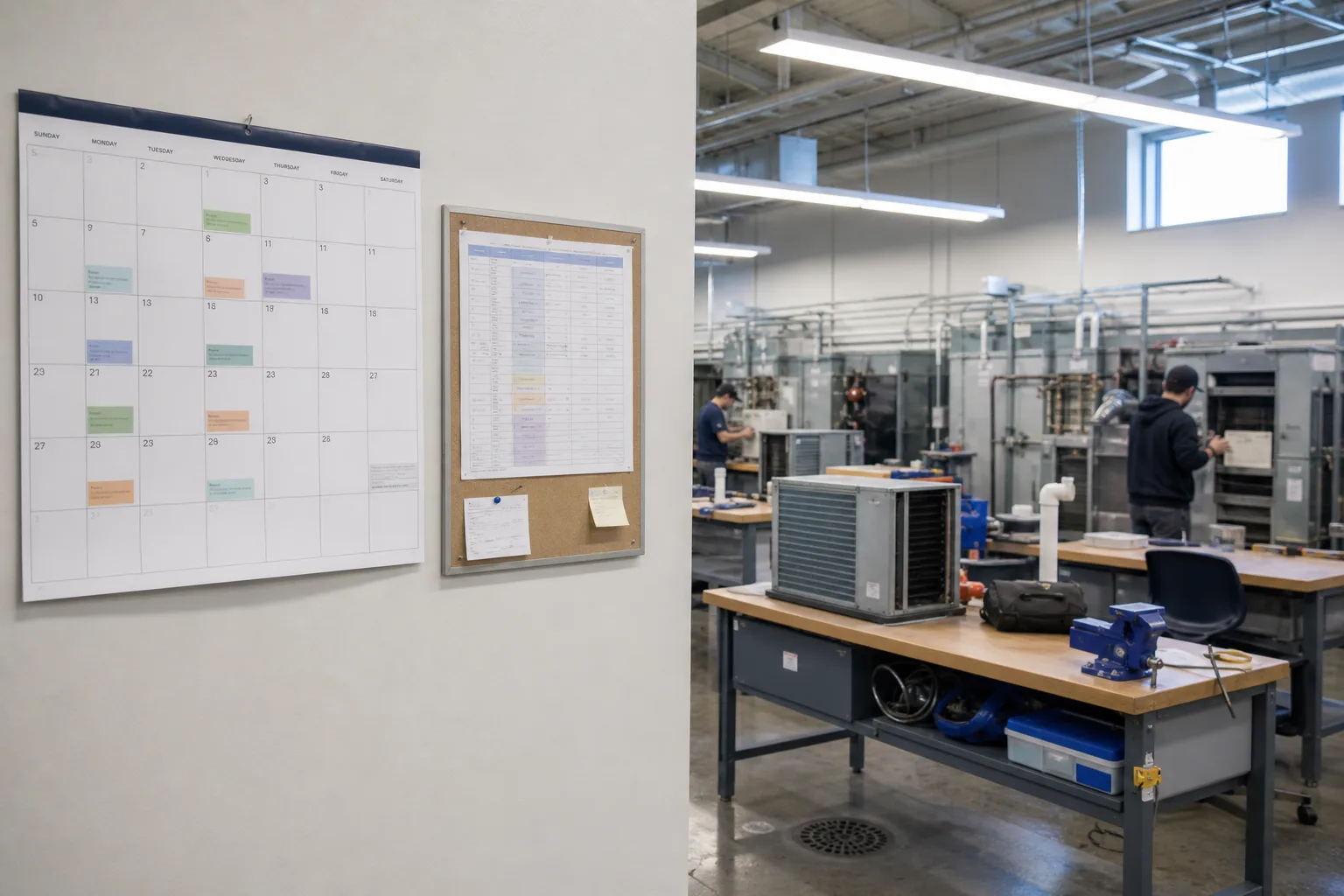
A service manager at a mid-sized mechanical contractor has sent something like thirty people through trade programs over a dozen years. He does not open the school's outcomes page first. He opens a calendar. He wants to know when the cohort starts, when the licensing exam is offered in his state, and whether the two line up in a way that lets a new hire be useful before the heating season lands. Everything else, in his telling, is downstream of those three dates.
That is not how most people choose a program. Most people compare tuition, look at a completion figure and a placement figure, and pick a start date because it is the next one available. The published numbers are real, and they are worth reading. They just answer a narrower question than the one being asked, and they say nothing at all about the season you happen to walk in.
The same program is not the same program in September and in February
Enrollment at most schools is seasonal, and the consequences of that ripple through everything a student actually experiences. A fall cohort at a community college or a private career school is usually the largest of the year. Larger cohorts mean full sections, more competition for lab time, and a higher chance that the section you get is the one with the adjunct rather than the full-time instructor. A January or spring start is often smaller. Smaller can mean more attention. It can also mean the section gets canceled two weeks before it begins because it did not hit minimum enrollment, and you are handed the choice between waiting until fall or driving forty minutes to another campus.
The service manager learned this the expensive way. He had an apprentice signed up for a spring section that folded. The kid sat for five months doing helper work, got frustrated, and left for a warehouse job. Nothing about that outcome appears in any statistic the school reports. The student never enrolled, so he never counted.
Programs that place students with employers have their own seasons. Externship and clinical slots are finite and they are allocated by the calendar. A medical assisting or dental program with twenty partner sites has a certain number of seats each rotation, and cohorts that arrive when those seats are already committed wait. In the trades, the same pressure runs the other direction: field placements are easiest to find in the season when the work is busiest, which is exactly when the crews have the least patience for teaching.
What a completion rate is actually counting
Completion and placement rates are the two figures most people compare, and both depend heavily on the denominator. A completion rate measures students who finished within a defined window, from a defined starting group. Whether part-time students are in that group, whether transfers count as completions or as losses, and whether the clock is measured against normal time or extended time all change the number without changing a thing about the teaching.
Placement figures carry a similar caveat. Placement is generally measured for graduates who were available for employment, in a field related to the program, within a stated number of days after finishing. Each of those qualifiers is a filter. A program with a strong-looking placement rate might be reporting on a small subset of its graduates. A program with a lower rate might be counting everyone who walked out the door.
None of this means the numbers are dishonest. Schools that receive federal student aid report under rules that require consistency, and the Department of Labor oversees the registration of apprenticeship programs and the standards those programs operate under. The figures are defined and audited. They are simply averages of past cohorts, and the cohort you are joining has its own instructor, its own equipment, and its own place in the calendar.
The five questions a repeat enroller asks on the phone
The service manager does not visit campuses anymore. He calls, and he asks the same short list every time.
- Who is teaching this section, and have they taught it before? Not the department's faculty roster. The person assigned to the section starting in eleven weeks. Evening and weekend sections are more likely to be staffed late and staffed by adjuncts, which is fine when the adjunct is a working tradesperson and much less fine when it is a placeholder.
- When does this cohort become eligible to sit for the exam or the certification? Some state boards and testing bodies offer exams on a rolling basis. Others run windows. A program that ends three weeks after a testing window closes costs a student months of waiting, and that gap is where people drift.
- What is the minimum enrollment to run, and where does this section stand? Ask in plain words. A registrar will usually tell you, and the answer determines whether you should be holding a backup option.
- What equipment will I actually put my hands on? In inspected trades this matters more than a catalog suggests. A local inspector cares whether a candidate has worked with the systems and methods the jurisdiction has adopted. Training on older equipment is not useless, but it lengthens the gap between finishing and being trusted alone on a job.
- How many people from the last two cohorts are working in the field now, by name of employer? A school with real employer relationships can answer this conversationally. One that cannot will retreat to the published rate.
Starting a course against the shape of the work year
The timing question runs both ways. A student who is already employed has to fit class around the season their own job peaks. Roofing, HVAC, landscaping, tax preparation, retail: each has a stretch where evening classes and overtime collide, and the collision is usually resolved in favor of the paycheck. Starting a program eight weeks before your busiest quarter is a decision to miss class.
Financial aid has a calendar too. Aid applications open in a set season and some awards are made until funds run out. Employer tuition assistance often resets on the company's fiscal year rather than in January, which means the money may be available in July and gone by October, or the reverse. Asking payroll which month the benefit resets takes one email and occasionally saves a full term of tuition.
The version of this that works, in the service manager's experience, is boring. He picks a cohort that ends about a month before an exam window, in a season when the shop can spare the hours, with a named instructor he has met. He tells the candidate what week the program gets hard. Then he checks in during that week.
The published numbers describe schools. The calendar describes the specific run of the specific course you are about to pay for, and it is knowable in an afternoon of phone calls.