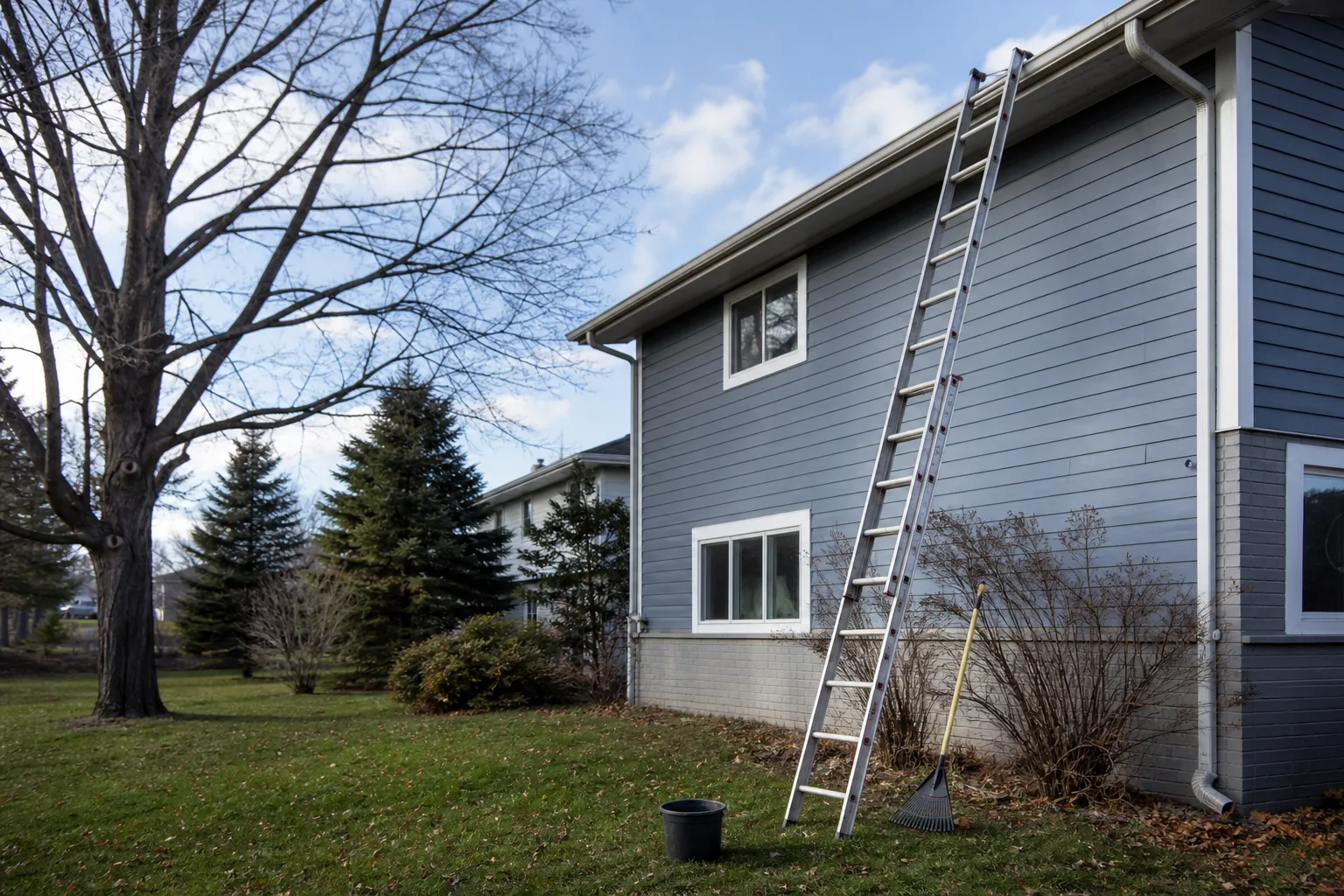
An extension ladder leaning against the eaves of a two story house, with a rake and a bucket on the grass below, is the image most household decisions of this kind end up resembling. The usual way of framing the question is whether you could do the job, and almost everybody could do almost any of them given enough hours and a video. That framing is close to useless, because capability is rarely what decides the outcome. Three other questions do, and they produce different answers for jobs that look superficially similar.
The Three Questions That Actually Decide It
The first is what happens if it goes wrong, and the answers separate into three categories that behave completely differently. Some mistakes cost time and a bit of money and can be redone. Some cause damage to the building that costs a multiple of the original job to repair. And some injure the person doing the work or create a hazard that persists invisibly for years. A job in the third category is not a candidate for a first attempt regardless of how straightforward the technique appears.
The second is how often the job comes around, because a task performed twice a year rewards learning while one performed once a decade does not. The third is what the tools cost against how much they would be used, and that arithmetic has changed considerably with tool rental, which converts a purchase decision into a daily rate and removes the most common reason for paying somebody. Run all three questions on any job and the answer usually stops being a matter of confidence.
Gutters and the Ladder Problem
Clearing gutters is technically trivial and is a job where the consequence question dominates everything else. The work itself requires a scoop and a hose, comes around twice a year, and needs no tools worth buying. What it requires is being at height on a ladder repeatedly, reaching sideways, on ground that may not be level, and falls from ladders at domestic scale produce serious injuries with some regularity.
Which makes it a genuine split decision rather than an obvious one. A single story house with firm level ground and somebody to foot the ladder is a reasonable job to do yourself. A two story house, a steep grade, or working alone changes the calculation entirely, and the cost of having it done twice a year is modest against the alternative. The Consumer Product Safety Commission tracks the ladder and fall injuries that arrive in emergency departments every autumn, and the seasonal pattern in them is not a coincidence.
Interior Painting, Which Is the Clearest Yes
Painting inside is the job that most rewards doing yourself, and the reason is that the cost is almost entirely labor and the consequence of a poor result is cosmetic and correctable. Materials are inexpensive relative to the finished job, the tools are cheap and reusable, the skill improves visibly within the first day, and a mistake gets fixed with another coat. Nothing structural depends on the outcome and nobody is at risk.
The qualifiers are worth naming. Ceilings are harder and more tiring than they look, high stairwells reintroduce the ladder problem, and the preparation rather than the painting is what determines the result, which is the part most first attempts underestimate. Houses built before the late 1970s add a further consideration, since disturbing old paint layers carries requirements that a professional working in that housing stock is trained and certified to handle.
Electrical Work, Where the Line Sits Lower Than People Think
Electrical work divides sharply and the line is not where confidence would put it. Replacing a light fixture or a switch with the circuit isolated and tested is within reach of a careful person, comes around occasionally, and requires a voltage tester and little else. Anything involving the panel, adding a circuit, or working on a system whose earlier modifications are unknown is a different job entirely, because the failure mode is not an inconvenience.
Two considerations push further work toward a licensed electrician than pure technique would. Permits and inspection apply to a great deal of residential electrical work, and undocumented work is a problem at the point of sale and potentially at the point of a claim. And the most dangerous outcome is not a shock during the job but a connection that works perfectly for four years and then overheats inside a wall, which is precisely the failure an inspection is designed to catch.
Plumbing, Tree Work and Where the Rest Falls
Plumbing sits between the two. A faucet, a trap, a toilet fill valve or a supply line is a reasonable job with a bucket underneath and the stop valve located first, and the worst realistic outcome is a leak found immediately. Anything joining into a supply line inside a wall, touching a water heater or altering a drain has both a damage consequence and frequently a permit requirement, and the damage arrives slowly enough to be expensive.
Tree work is the clearest no on the list and the one most often attempted anyway. Removing a limb of any size involves stored tension in the wood, a load that moves when it is cut, and usually a chainsaw at height, which is a combination that injures experienced people. Any tree near a structure or a service line belongs to somebody insured to do it, and the insurance is a substantial part of what is being purchased.
Which brings the ladder against the eaves back into view with the useful question attached. Not whether the person standing there could clear the gutters, because they almost certainly could, but what a bad afternoon looks like, how many times a year they will be up there, and what the alternative actually costs. Answered honestly, that trio sorts nearly every job around a house, and it sorts them differently for a bungalow than for a house with a steep roof and a slope in the yard.