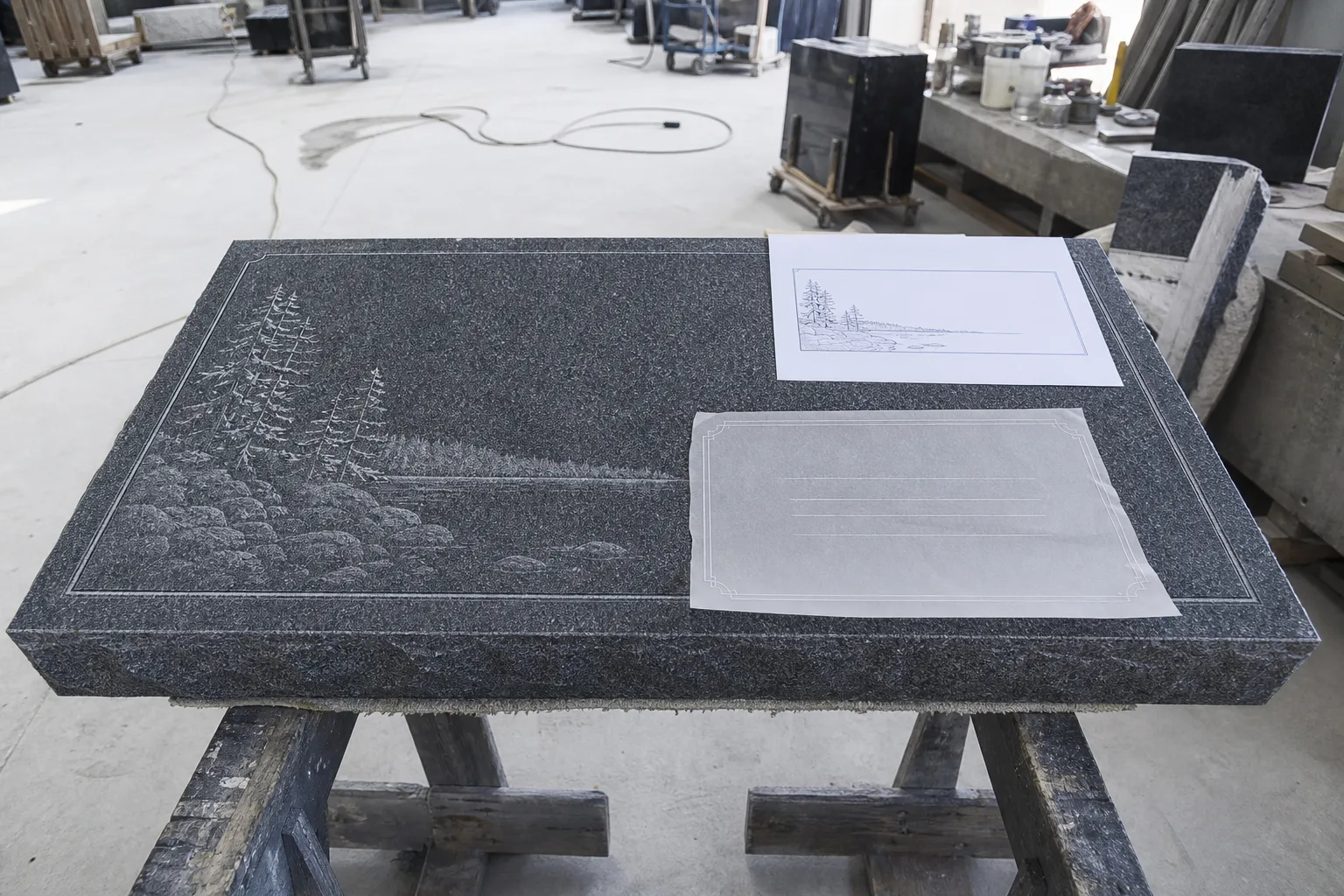
A family orders a granite marker in March and sees it standing in September. In between, the stone is handled by at least four sets of hands, and only one of those people ever speaks to the family. That gap is where most of the regret lives. Not in the price, not in the design catalog, but in the stretch of time when the order is moving through a shop the buyer has never visited and cannot picture.
The useful question is not which memorial to pick. It is who is going to be looking at your order next week, and what they are allowed to change when they notice something is off.
The four people, in order
First is the counter person at the monument dealer, who takes the order and builds the layout. In a small shop that is the owner. In a larger one it is a designer working in a drafting program, translating your notes into a scaled drawing with the lettering style, size and line breaks fixed.
Second is the shop that cuts the stone. Often this is not the dealer. Many retailers order a finished blank from a supplier, then have the lettering done either in house or by a lettering shop that does nothing else. The person running the sandblast booth is working from the approved drawing and nothing else. They do not know your grandmother's name and cannot tell that the middle initial is wrong.
Third is the foundation crew, who dig and pour the base at the grave. In many cemeteries this crew works for the cemetery, not for the dealer, and they set their own schedule around frost, funerals and the mowing season.
Fourth is the cemetery superintendent or sexton, who checks the finished memorial against the section rules before it goes down: height, footprint, base type, sometimes finish and color. If it fails that check, it goes back on the truck.
What changed in the shops, and why it matters to you
Two things have shifted in the last stretch of years, and both work in the buyer's favor if you use them.
The first is the digital proof. Stencils used to be cut by hand from rubber with a knife, which meant the layout existed only in the cutter's head and on a paper sketch. Now the stencil is cut on a plotter from the same file used to generate the drawing you approve. The proof you sign and the stencil that goes on the stone come from one source. That makes the proof genuinely worth reading, because what is on it is what will be blasted. It also means a correction made before the stencil is cut costs almost nothing, and a correction made after costs a new stone.
The second is laser etching, which put portraits, scenes and dense text onto polished black granite without a carver. It expanded what a mid-priced marker can carry. It also introduced a color constraint that families discover late: the etching reads on dark polished stone and largely disappears on light gray. Choosing the stone color and choosing the artwork are one decision, not two, and the shop knows this even when the catalog does not say it.
Where the door closes
Ask the dealer for the three dates: when the drawing is final, when the stone is cut, and when it ships to the cemetery. Those are the only deadlines that matter.
- Before the drawing is final: everything is open. Spelling, dates, lettering style, line breaks, stone size, color, finish, whether a spouse's name and birth year go on now or later.
- After the drawing, before the cut: in practice, small text fixes if the shop has not run the stencil. Ask; do not assume.
- After the cut: lettering can sometimes be added, rarely removed. A wrong date on granite is a new piece of granite.
- After setting: additional inscriptions are done in the cemetery by hand, at a different price, and they never quite match the shop lettering.
The simplest protection costs nothing. Have two people who are not you read the proof aloud, digit by digit, against a death certificate rather than against memory.
The simplest version of this purchase
A flat or slant marker in a common granite color, standard size for the section, sandblast lettering, no etched artwork. That version is quoted quickly, cut quickly, and passes the superintendent's check without a conversation. Everything beyond it adds a handoff, and each handoff adds both time and a place for an error to enter.
If a dealer is steering you past that baseline, the answer may be perfectly good. Ask them to say plainly which step it adds and who performs it. The Federal Trade Commission is responsible for the rule requiring funeral providers to give itemized prices, and the habit it created, asking for the line items in writing, works just as well at a monument counter.
Call the cemetery office yourself before you sign anything. Ten minutes with the person who will inspect the stone tells you more about what you can order than an afternoon with the catalog, and it is the one call almost nobody makes.