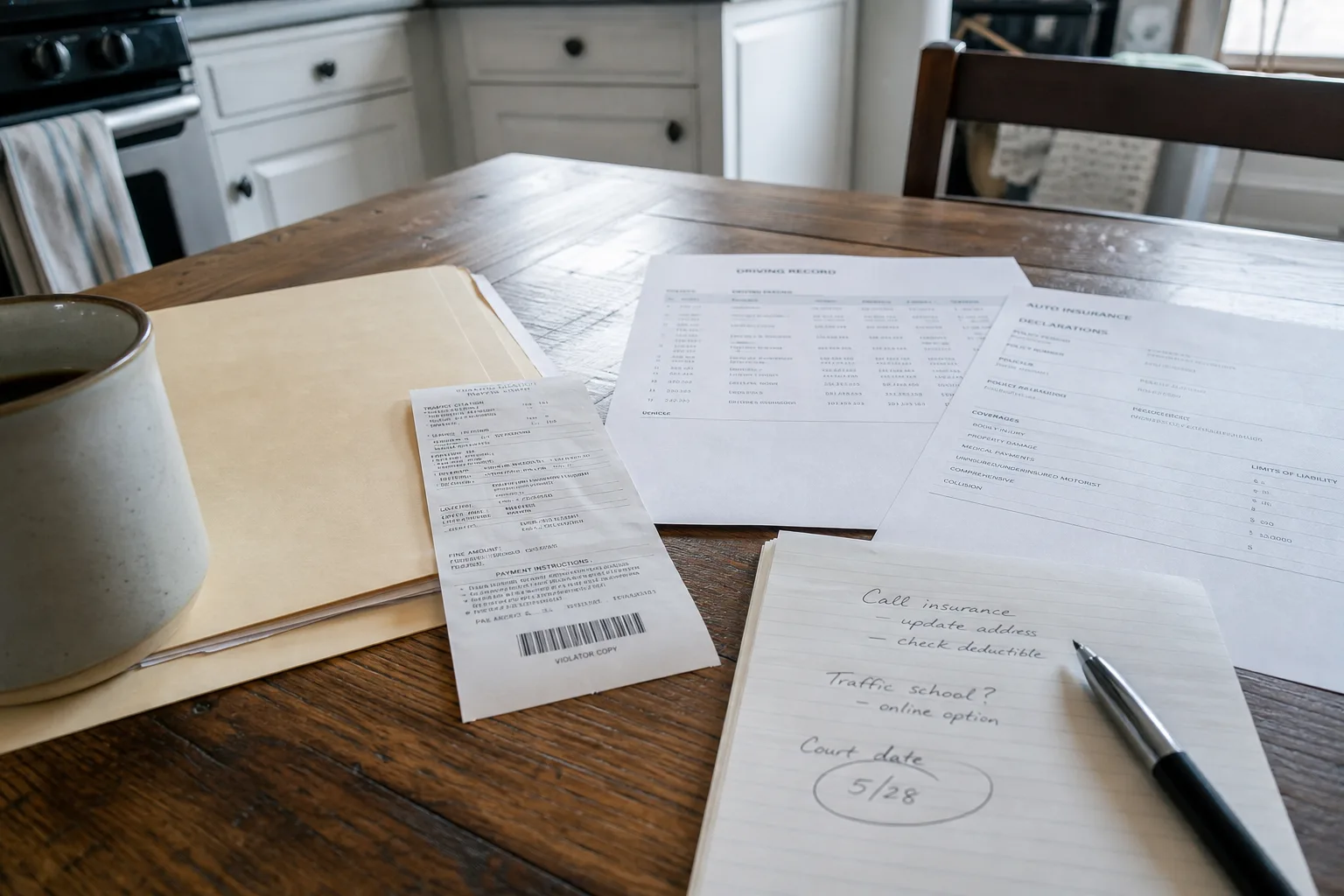
The citation in your glovebox is a form with a case number, an issuing date, a violation code, and a response block. Everything an attorney can do in the first thirty minutes depends on which of those you can produce and which you have to go find. Most people bring the paper and nothing else. That is enough to start, and it is not enough to finish, and the difference shows up as a second appointment you pay for.
The paperwork changed before the advice did
For decades the traffic citation was a handwritten carbon set. The officer wrote the violation on the top copy, tore off a pink or yellow sheet, and handed it over. The court got its copy days later, sometimes weeks, and until a clerk keyed it in there was no record anywhere that a lawyer could look at. Preparation meant bringing the physical slip, because the physical slip was the only artifact that existed.
That is no longer how it works in most jurisdictions. Citations are now issued electronically from a laptop in the vehicle, printed on thermal paper, and transmitted to the court the same shift. A case number often exists in the court's online docket within a few business days. The officer's narrative, any radar or lidar certification records, and the calibration log sit in a separate file that is not published and has to be requested.
So the useful preparation shifted. It used to be about producing the document. Now it is about producing the things the docket does not contain: your driving record, your insurance renewal date, your work schedule, and a clear statement of what outcome you actually want. The National Highway Traffic Safety Administration oversees federal traffic safety programs and the data reporting that sits behind state enforcement, but the record that decides your outcome is the state one, held by your DMV, and you can usually order it yourself.
Three levels of preparation, and what each one buys
Assume a paid consultation of one hour. Here is what changes with what you carry in.
| You bring | Time spent on intake | What you can decide by the end |
|---|---|---|
| The citation only | Most of the hour | Whether the deadline is close, roughly what the violation exposes you to, what to gather next |
| Citation plus your driving record | Perhaps half | Whether points matter for you specifically, whether a deferral or amendment is realistic |
| Citation, record, insurance page, calendar, and a written account | A short opening | A strategy, a fee arrangement, and the date the first filing goes out |
The third row is not a counsel of perfection. It is four documents and one page of writing. The reason it works is that a traffic case turns almost entirely on inputs the attorney cannot see without you: how many prior moving violations sit on your abstract, whether your insurance renews in six weeks or eleven months, whether you hold a commercial license, and whether you can be in a courtroom on a Tuesday morning.
Read the response block before anyone reads it to you
Every citation carries a block telling you what to do and by when. The wording varies by state, but the structure is consistent: a stated number of days from the date of issuance, a list of permitted responses, and a consequence for silence. The consequence line is the one to find first. It typically says that failure to respond results in a finding against you and may be reported to the licensing agency, which is how a fifty dollar problem becomes a suspended license.
Copy the deadline date onto the top of a folder. Then check whether the response options include a written statement, a hearing to contest, or a mitigation hearing, because those are different things and choosing one usually forecloses the other. When people call speeding ticket lawyers after the window has closed, the conversation is about reopening a default rather than about the radar reading, and it is a harder conversation.
Write the account the same week, not the week of the hearing
One page. Where you were going, the road, the lane, the traffic, the weather, what the officer said, what you said, how long the stop took, whether anyone else was in the car. Write it as facts with times, not as argument. Memory for a routine ten minute stop degrades fast, and a note written three days after is worth more than a recollection offered three months after.
Bring photographs if the location matters: the posted sign, the sightline, the construction zone that ended a hundred feet earlier. These are cheap to take now and impossible to take later, because the cones move.
What the folder looks like when it is done
- The citation, front and back, plus a phone photo in case the thermal print fades
- Your certified or online driving record from the state
- The declarations page of your auto policy with the renewal date
- A one page written account, dated
- Any photographs of the location
- Your availability for the next ninety days
That folder converts a first meeting from an interview into a decision. You will know the deadline, the exposure, the realistic outcomes, and what the representation costs, and you will know all of it in one sitting rather than two.
The clock on a citation runs from the date printed on it, not from the day you get around to worrying about it. Order the driving record today, write the page tonight, and the meeting takes care of itself.