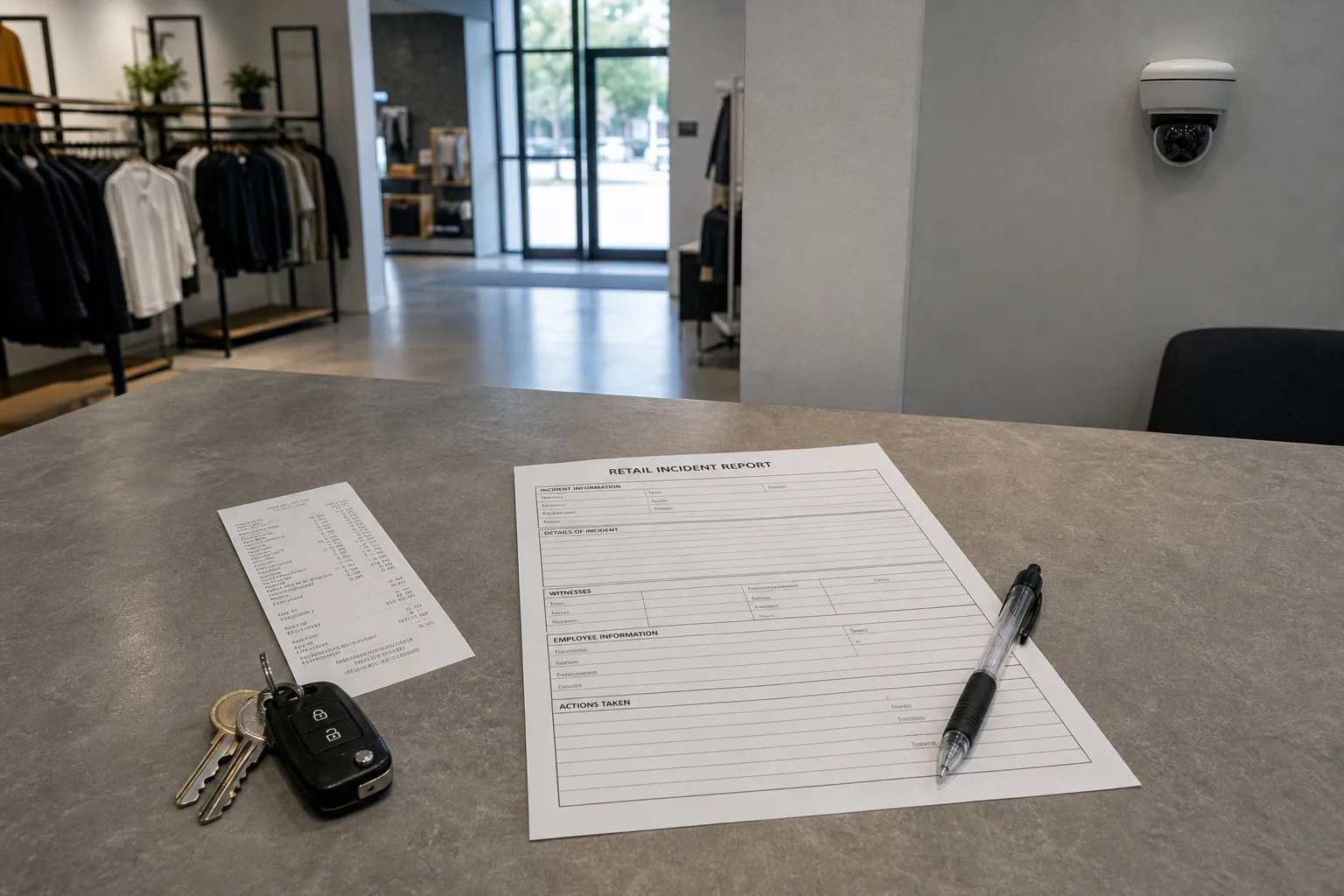
Consider the documents that exist a week after something goes badly wrong inside a retail store. There is an incident report, usually one page, filled out by a manager who was not present. There is a shift schedule showing who was clocked in. There is a camera system that retains footage for a set number of days, a number written into a vendor contract nobody in the store has read. There is a claim number assigned by a third-party administrator, and a phone call from that administrator asking for a recorded statement. There may also be a gift card, offered in person, with nothing signed.
People sort this kind of problem by the person who caused the harm. That is the human instinct and it is the wrong first move for deciding whether you need an attorney. The paperwork sorts it differently. It sorts by who controlled the premises, who set the schedule, who wrote the security procedure, and who is contractually obligated to pay if any of those failed. That set of parties is rarely the one a person names when they describe what happened.
Start with what the report says, not what anyone meant by it
An incident report is a short form with fixed fields, and the fields decide what the document can later prove. Most versions ask for date, time, location within the store, names of employees present, a narrative in a box of maybe four lines, and a signature. Some ask whether emergency services were called. Some ask whether the customer or employee declined medical treatment, and that box, checked in the first twenty minutes by someone who is not a clinician, becomes a fact the file carries forward.
Ask for a copy before you leave. If the answer is that copies are not provided, write down the report number and the name of the person who completed it. Then write your own account the same day, in your own words, with times. Not a summary of your feelings about it. Times, positions, who said what, which door, which aisle, whether a camera was visible from where you stood.
Two other documents matter early and both have short lives. Surveillance footage is overwritten on a cycle, often measured in weeks rather than months. Cell phone location data and text messages to a friend at 9:14 p.m. are durable but only if nobody deletes the thread. A written request to preserve video, sent to the company rather than to the store, is the single cheapest step available in the first few days. It costs a letter. It changes what can be proven later.
The party most people overlook
Ask who employed the person on the floor and the answer is often more complicated than the sign over the door. Overnight stocking may be contracted out. Cleaning is frequently a separate vendor. Loss prevention and guard services are commonly a third company with its own insurer and its own post orders describing what a guard is supposed to do and when. The building itself may be owned by a landlord whose lease assigns responsibility for exterior lighting, parking lot maintenance and common-area security to one side or the other, in a clause that reads something like: the tenant shall be responsible for security within the demised premises, and the landlord for the common areas. That sentence, or its equivalent, allocates the duty. It is written before anyone is hurt and it does not change afterward.
So the overlooked party is the entity that controlled the conditions. Whether a prior complaint about the same employee was recorded and what was done with it. Whether a store was scheduled with one person closing alone after dark. Whether a camera in the stockroom had been broken for months and the repair ticket sat open. None of that is about the individual. All of it is about a company's own records, and those records are obtainable through a legal process and generally not obtainable any other way.
This is why people who have been assaulted at a discount retailer often search for something specific, like a Dollar Tree sexual assault lawyer, rather than a general injury firm: the store name is the part they remember, and the corporate entity behind it is precisely the party that holds the hiring file, the staffing decision and the camera retention policy. Counsel who has handled claims against a particular chain already knows which entity signs the leases and which administrator answers the phone.
The sorting test: which problems a letter settles
Plenty of retail disputes resolve without an attorney, and it is worth naming them so the line is visible. A refund refused against a posted return policy. A damaged item. A billing error. A one-time rude interaction with no injury and no ongoing risk. These are documented in a short letter, sent to a corporate customer relations address, with a copy of the receipt and a stated remedy. Most are answered.
The problems that need counsel share features that have nothing to do with how upset anyone is:
- Bodily harm or a criminal act. Assault, battery, false imprisonment during a detention, or any conduct reported to police. The civil case and the criminal case run on separate tracks with separate deadlines.
- An insurer or claims administrator has contacted you. A recorded statement given early, without preparation, is a document that lasts. There is no obligation to give one on the first call.
- More than one possible defendant. Staffing agency, landlord, security vendor, franchisee, franchisor. Identifying the right one is legal work.
- A signed release is on the table. Any paper that says you release all claims, known and unknown, arising out of the incident is the end of the matter. Read that clause before the number attached to it.
- A deadline you cannot see. Statutes of limitation vary by state and by claim type, and notice periods for claims against public entities are shorter still.
The consequences nobody traces back to the decision
The costs of handling this alone rarely arrive as a single bad outcome. They arrive as small closures. Medical bills routed to personal health insurance instead of the correct payer, then subject to a subrogation letter a year later. Footage overwritten on day thirty-one because no preservation request went out on day three. A recorded statement in which someone said "I'm fine" because that is what people say. An arbitration clause accepted through a rewards program sign-up that pushes the dispute out of court.
For employees harmed at work, the sorting has another layer: workplace safety conditions fall under the Occupational Safety and Health Administration, which is responsible for employer obligations in this area, and a workers' compensation claim may run alongside a separate claim against a third party who is not the employer. Those two are not alternatives. Filing one does not automatically resolve the other, and an attorney will often pursue both.
How to spend one hour finding out
Bring the file, not the story. Incident report or report number. Your own dated account. Police report number if one exists. Photographs. Names and positions of everyone present. Medical records or the date of the first visit. Every piece of paper the company handed you, including the gift card envelope. Any text you sent that night.
Ask three questions. Which entities are potentially responsible here, and how do we confirm that from records. What is the earliest deadline that applies, and what date is it. What needs to be sent this week to preserve evidence. A competent consultation answers all three, and consultations in this area are commonly free. An hour spent on the documents tells you whether this is a letter or a case, and either answer is worth having in writing.
The store name on the receipt is a starting point, not a defendant. Behind it sits a lease, a staffing contract, a retention schedule and an insurance policy, and those four documents decide far more about the outcome than anything said at the register that day.