The showroom sample is nine inches square, polished on one face, and sitting under a light fixture chosen to make granite look good. The stone you are buying will be twenty-eight inches wide, set outdoors, and looked at in flat gray weather by people who are upset. Those are different objects. The gap between them is where most first-time buyers make the one choice they later wish they had made differently, and it closes almost entirely with a walk through the cemetery where the stone is going.
Nobody tells you to do this. The monument dealer will not suggest it, because the dealer assumes you already know the section. The cemetery office will not suggest it either. But a Saturday morning among stones that have been outside for forty years teaches more about granite, lettering, and scale than an afternoon of catalog pages.
What the old stones tell you that a sample cannot
Walk the section your family plot sits in, and read stones by age rather than by name. The ones from the 1970s and 1980s have had time to declare themselves. You will see which colors held their contrast and which went muddy under lichen. You will see that shallow etched lettering on a light stone can become genuinely hard to read from six feet, while deep sandblasted letters on a dark stone stay legible in almost any light. You will see which finishes hold water in the winter and which shed it.
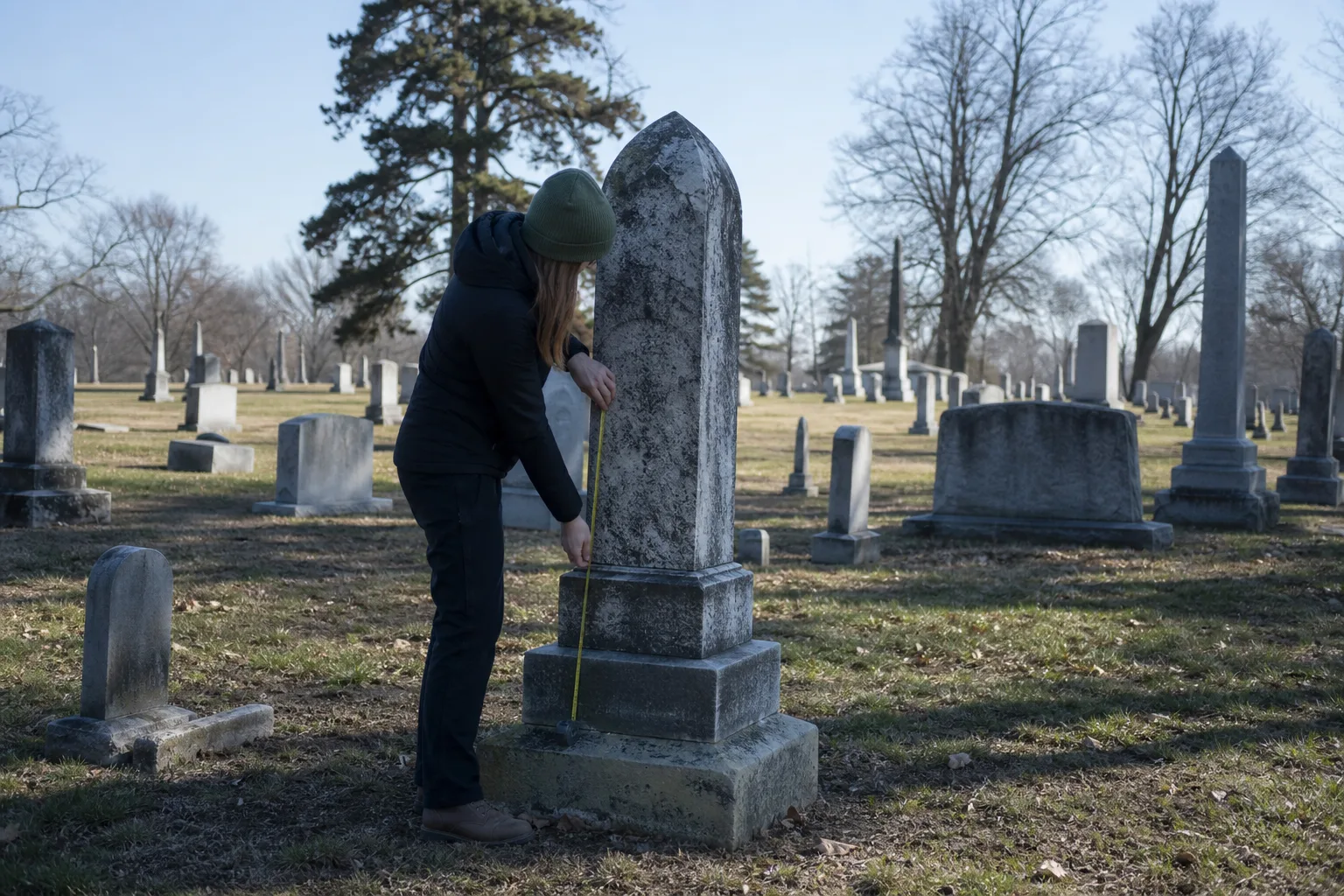
Pay attention to scale in the row, not in isolation. A monument that looked substantial in the shop can read as undersized once it is standing between two neighbors of similar vintage. The opposite happens too. Bring a tape measure and write down the width and height of three stones you like, then hand those numbers to the dealer. Numbers travel better than adjectives.
Photograph the backs. Many families never think about the reverse face until the stone is set, and by then the decision about whether it carries anything at all has been made by default.
The people who actually hold the decisions
A memorial passes through more hands than a first-time buyer expects, and the hands are local. The cemetery sexton or superintendent enforces the section rules: permitted height, whether uprights are allowed at all, base setbacks, vase policy, and often the color palette. The monument dealer draws and orders the stone. A foundation crew, sometimes cemetery staff and sometimes a subcontractor, pours or sets the concrete base and schedules the setting. If a veteran is involved, a federal marker application runs on its own separate track and its own timeline.
Call the cemetery office before you visit the dealer, not after. Ask for the written rules for your specific section, and ask who pours foundations and what the setting fee is. Ask when the ground crew stops setting for the season. In a lot of the country, foundation work pauses through the freeze and resumes in spring, which means an order placed in November may be a stone that stands in April. Knowing that early turns a frustrating delay into a planned one.
On the commercial side, the Federal Trade Commission oversees how funeral goods and services are disclosed and itemized to buyers, which is why you can and should ask for prices in writing, line by line, before you sign anything.
Sort the choices into two piles
Judgment here is mostly the ability to tell reversible from permanent. Make the list explicitly.
Effectively permanent once the stone is cut:
- The granite color and the quarry it came from. Matching it years later is difficult and sometimes impossible.
- Overall size and shape, because the foundation is poured to fit.
- The spelling of every name and the wording of the inscription.
- Any carved or etched artwork.
- How much blank space is left for a second name and a second death date.
Changeable later, at a cost you can plan for:
- Adding a date to space already reserved, done on site by a letter cutter.
- Bronze vases and similar hardware, where the section rules allow them.
- Cleaning and resealing, which is maintenance rather than a design decision.
The item that quietly matters most is blank space. On a companion stone for a surviving spouse, the layout has to leave room for a name that may be added thirty years on. Ask the dealer to show you the rubbing or scaled drawing with both sides filled in, including the future date, so you are looking at the finished object rather than half of it.
Proofread like it is the last time
Ask for a full-size layout, printed at scale, and take it home. Read the names aloud with a second person, one letter at a time for anything unusual: a maiden name, a middle initial, a diacritic, a nickname in quotation marks. Check the dates against the death certificate rather than against memory. Then check them again the next morning, when you are less tired.
Sign the layout once you are satisfied, and keep a copy. The signed drawing is what the shop cuts from, and it is also what settles any question about who approved what. Families who do this rarely have anything to argue about later.
The whole exercise takes a morning in the cemetery, one phone call to the office, and a night to sit with the proof. That is a small amount of time for a decision that stands outdoors, unchanged, for as long as anyone will be there to read it.