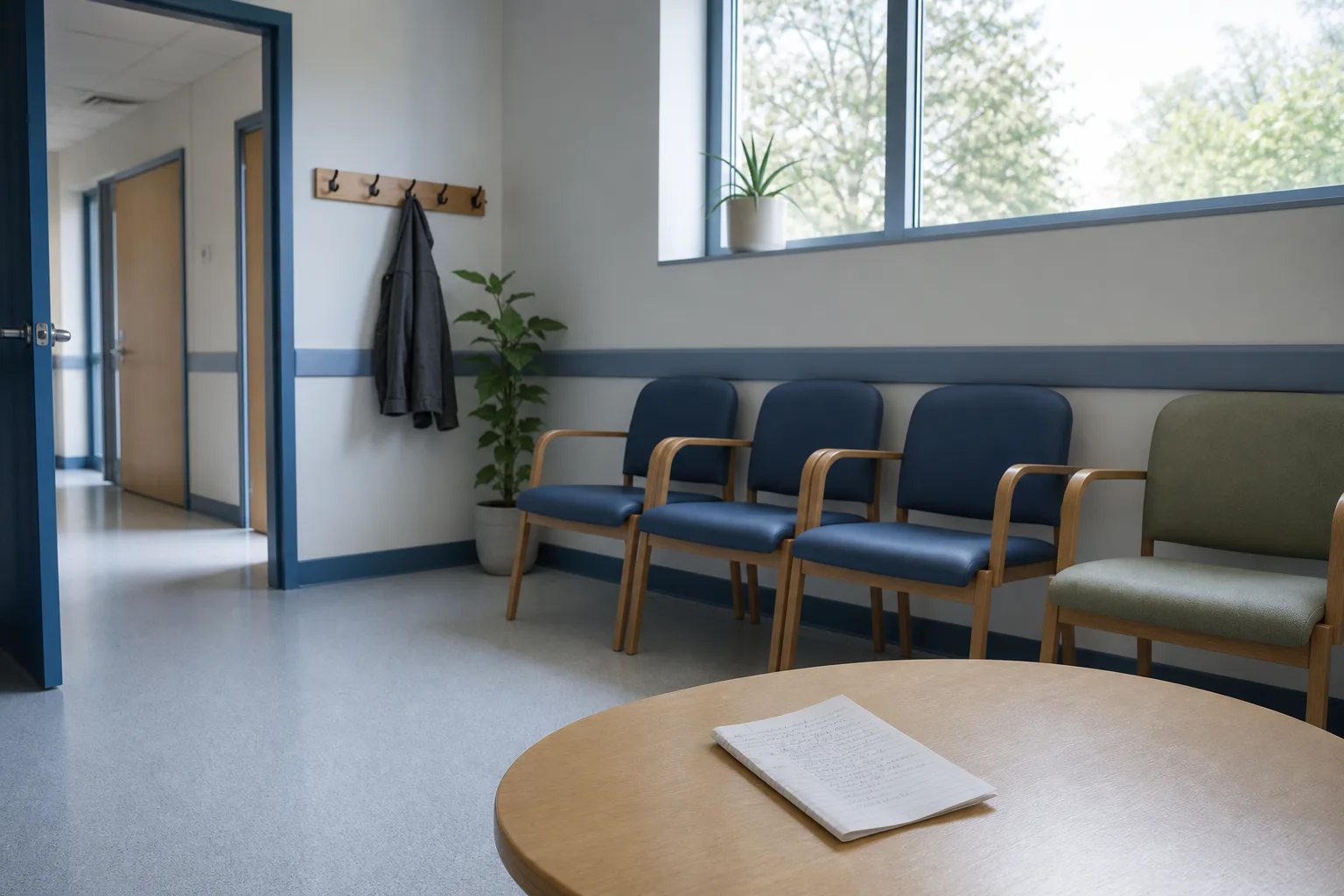
Consider two appointments, composited from the pattern these visits commonly follow rather than drawn from any one person's chart. Same patient, same complaint, same clinician, ten weeks apart, each of them scheduled for the standard slot that a busy practice can offer. The first ended with reassurance and an instruction to come back if things changed. The second ended with a referral, a blood test and a follow up date. Nothing about the underlying problem had shifted much in between. What had changed was that the patient arrived the second time with one page of writing.
Where the First Ten Minutes Actually Went
The first visit spent roughly half its length establishing facts that the patient already knew and had never organized. When did this start, and the answer was a while ago, then a few months, then possibly since the summer. Is it constant or does it come and go, and the answer arrived in three revisions. What makes it worse, and the answer was nothing in particular until a detail surfaced two minutes later that turned out to matter. None of that is anyone's fault, and it is exactly how memory behaves under mild pressure in an unfamiliar room.
By the time the picture was clear the appointment had four or five minutes left in it, which is enough to reassure and not enough to investigate. The clinician did the reasonable thing with the time available, which was to rule out anything urgent, offer a plausible explanation and set a safety net. That is a defensible outcome and a common one, and it is also why the same complaint frequently takes three visits to move forward when it could have taken one.
The Page That Changed the Shape of the Second Visit
The document the patient brought to the second appointment was not sophisticated. It was one side of paper carrying four short blocks: when the symptom began and how it has changed, a list of every medication and supplement with doses, what has been tried and what happened, and three questions in priority order. It took about twenty minutes to write at a kitchen table with the medicine cabinet open, and it was handed over at the start rather than read aloud.
The effect was immediate and slightly unfair to the first appointment. Two minutes of reading replaced five minutes of questioning, and it replaced it with better information, because a list written calmly at home includes the supplement that never gets mentioned and the two week course of something borrowed from a relative. The remaining eight minutes were available for examination and decision rather than for reconstruction, which is a different use of the same slot.
Why a Written Timeline Beats an Accurate Memory
Clinical reasoning runs on pattern and sequence, and the sequence is the part that spoken accounts distort most. People narrate symptoms in order of how much they worry about them rather than in the order they appeared, which inverts precisely the information a clinician needs to separate one explanation from another. A written line saying the dizziness started three weeks after the new medication, with dates attached, does work that no amount of careful questioning can do reliably in the time available.
Medication lists behave the same way. Patients routinely omit anything not prescribed by the person in front of them, including over the counter painkillers taken daily for months, herbal preparations, and eye drops, all of which can matter. A written list removes the recall problem entirely, and it has the useful side effect of showing the household exactly what is being taken, which is often a surprise to the household.
The Questions That Get Asked and the Ones That Do Not
Almost every patient leaves an appointment with an unasked question, and it is usually the one they were most anxious about. It goes unasked because it felt embarrassing, or because the clinician was already writing, or because it surfaced in the corridor afterwards. Writing three questions down in advance and putting the most important one first solves this at close to zero cost, and stating at the start that there are three tends to produce a visit that is paced to answer them.
Bringing somebody else is the other version of the same fix. A second person hears roughly twice as much of what was said, takes notes while the patient is concentrating on the conversation, and reliably remembers the instruction about what to do if things get worse, which is the part most often lost. Neither of these is a criticism of anybody's memory. They are adjustments to a genuinely difficult listening environment.
What the Second Appointment Actually Cost
The patient's preparation took twenty minutes and one evening's attention. It produced a referral that would otherwise have arrived two visits later, which in most systems means several months later, and it removed a round trip that would have consumed another appointment slot in a practice that does not have spare ones. Keeping the page and updating it afterwards with what was decided turned it into a running record, and the Centers for Disease Control and Prevention has for years encouraged households to keep their own immunization histories for exactly this reason, since the personal copy is frequently more complete than any single provider's file.
None of this shifts responsibility onto patients for the length of an appointment, which is a system question rather than a personal one. It simply notices that the ten minutes exist either way and that their contents are partly under the patient's control. Same complaint, same clinician, same slot on the schedule, and a different ending, produced by twenty minutes at a kitchen table with a pen and the contents of a medicine cabinet spread out in front of them.