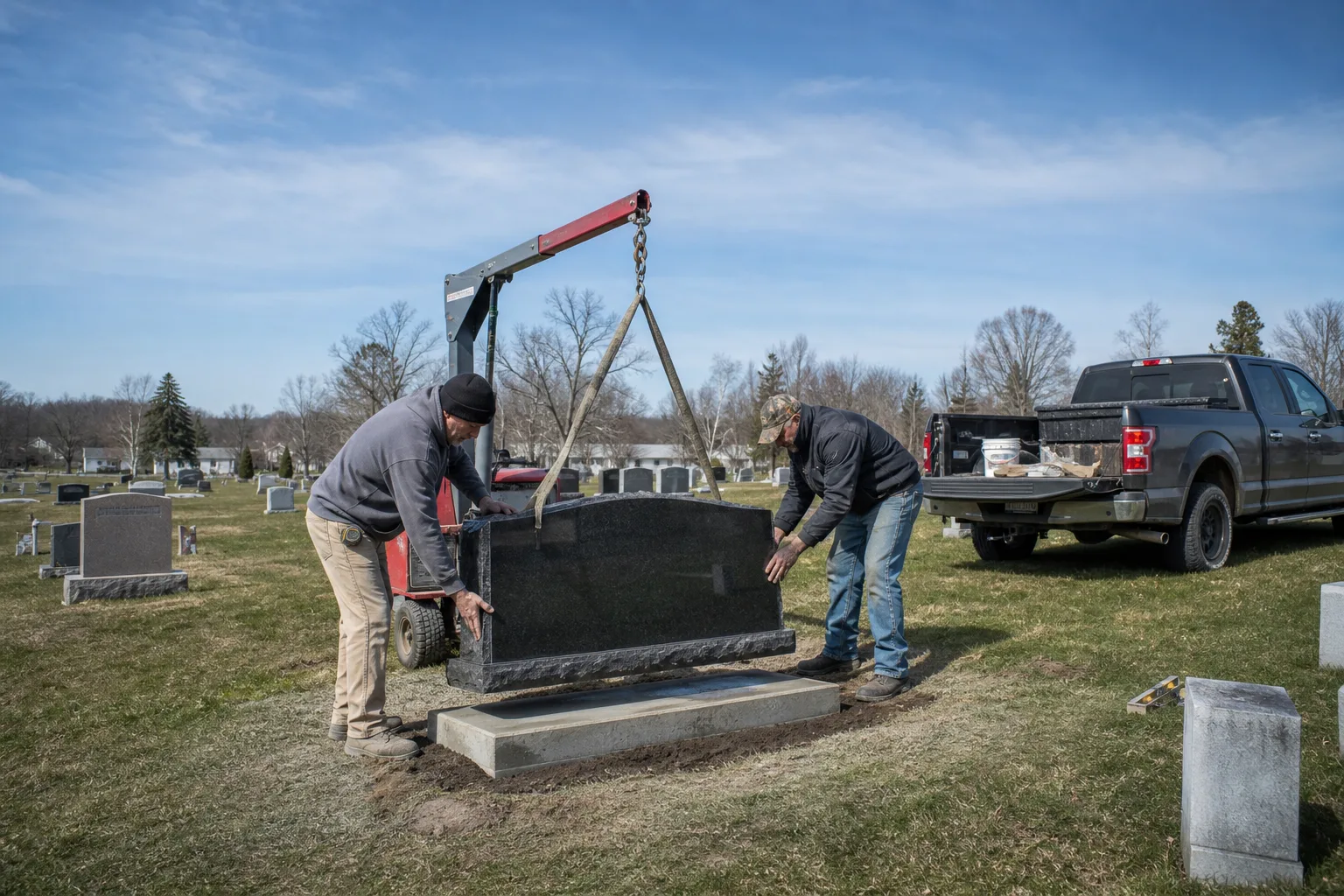
A family in a township cemetery outside a mid-sized county seat ordered a flat granite marker online in March, paid in full, and had it delivered to a relative's garage. It sat there until August. The cemetery required a poured foundation set by an approved installer, the marker was three inches wider than the plot's allowance for flush markers, and the only monument setter working that cemetery had a six-week backlog by the time anyone called him. The granite was fine. The engraving was correct. The transaction was still stuck, because the family had bought a product and skipped the person who installs it.
That gap is the part of this decision that has changed most in ten years, and it is the part nobody shops for.
Three parties, and most families only meet one
A memorial purchase involves a seller, a cemetery, and a setter. The seller has the catalog and the salesperson. The cemetery has the rulebook. The setter has the truck, the concrete, the lift, and the schedule.
Ten years ago these were often the same phone number. A local monument dealer kept a yard, a sandblast room, and two men who did nothing but pour foundations and set stones from April through November. You picked a design in the showroom, and the setting fee was a line on the same invoice. Nobody had to think about sequencing, because one company owned all of it.
The split happened quietly. Online retailers can ship a finished granite marker anywhere in the country for less than many regional yards charge, and the quality of the stone itself is frequently indistinguishable. What does not ship is the labor. So the setter, who used to be an employee of the company you bought from, is now an independent contractor with his own calendar, his own list of cemeteries he is approved to work in, and his own opinion about markers that arrive without a foundation permit.
Call him first. Before the design, before the deposit. He will tell you the plot's actual allowance, whether the cemetery requires a concrete foundation or sets flush markers on a sand base, what the setting fee runs in that specific cemetery, and how far out he is booked. Most sellers will happily build a headstone to whatever dimensions you give them, which is exactly why the dimensions need to come from the person who has to fit it into the ground.
What a decade actually changed
| Element | Roughly ten years ago | Now |
|---|---|---|
| Where you shopped | Local yard, showroom, physical samples | National online sellers, regional yards, funeral home referrals |
| Proof approval | Paper layout, in person, initialed | Emailed digital proof, approved by click |
| Who sets it | Usually the seller's own crew | Often an independent setter you hire separately |
| Cemetery rules | Enforced informally by the sexton | Written specs, approved-installer lists, permit forms |
| What's memorialized | Mostly full burial, upright or flush | More cremation: niche fronts, benches, small companion markers |
| Lead time | Weeks, mostly engraving | Quarry and freight can add months on some colors |
The parts that did not change: granite is still granite, engraving is still permanent, and the cemetery still has the last word on what can be placed over a grave. The Federal Trade Commission oversees pricing disclosure by funeral providers, and that regime has trained families to expect itemized paperwork. Cemeteries and monument dealers do not all sit inside the same rules, so the itemization you get for a memorial can be thinner than the one you got for the funeral. Ask for it in writing anyway. Most will provide it when asked plainly.
Comparing the three routes
The local monument yard
Highest price per stone, usually. You are paying for the showroom, the sandblast equipment, and the fact that the person quoting you has set stones in that cemetery for twenty years and already knows the specs. Foundation and setting are typically bundled. If something is wrong on delivery, one company owns the problem. For a first-time buyer working under time pressure, that single point of accountability is worth real money.
Online seller plus a local setter
Lowest total cost in most markets, and the design tools are better than any paper catalog. The tradeoff is coordination: you confirm the cemetery's dimensional limits, you order to those limits, you hire and schedule the setter, and you make sure the delivery arrives before his window rather than during it. Very workable if you start with the setter's phone call and the cemetery's written specs in hand.
The cemetery's own program
Many cemeteries, and most memorial parks with uniform designs, sell markers directly or through one designated vendor. Choice narrows sharply. Compliance becomes somebody else's job. In cemeteries that only permit flush bronze or a single granite profile, this is often the only route that exists, and it removes the entire class of errors described above.
The choices that close behind you
Some of this decision can be revisited for the cost of a phone call. Some cannot.
- The proof. Once you approve the layout, the spelling, the dates, and the placement, that is the stone. Digital approval feels casual. Print it, read it aloud with a second person, check the middle name and both dates against a document rather than memory.
- The foundation footprint. Poured concrete sized for a specific base. Ordering a wider stone later means breaking out and repouring, on the setter's schedule, at your expense.
- Layout for names not yet needed. A companion marker engraved with one name and one birth year has committed the whole surface. Leaving room for a second name, and deciding now whether a surviving spouse's birth year gets carved in advance, are both irreversible at the moment of approval.
- Material and finish. Color and polish cannot be changed. They can be matched later if you know the granite by name, so write down what you bought.
Get the cemetery's written specifications and the setter's availability before you look at a single design. That one reordering of the sequence resolves nearly every version of the garage-storage problem, and it costs nothing but two calls made in the right order.