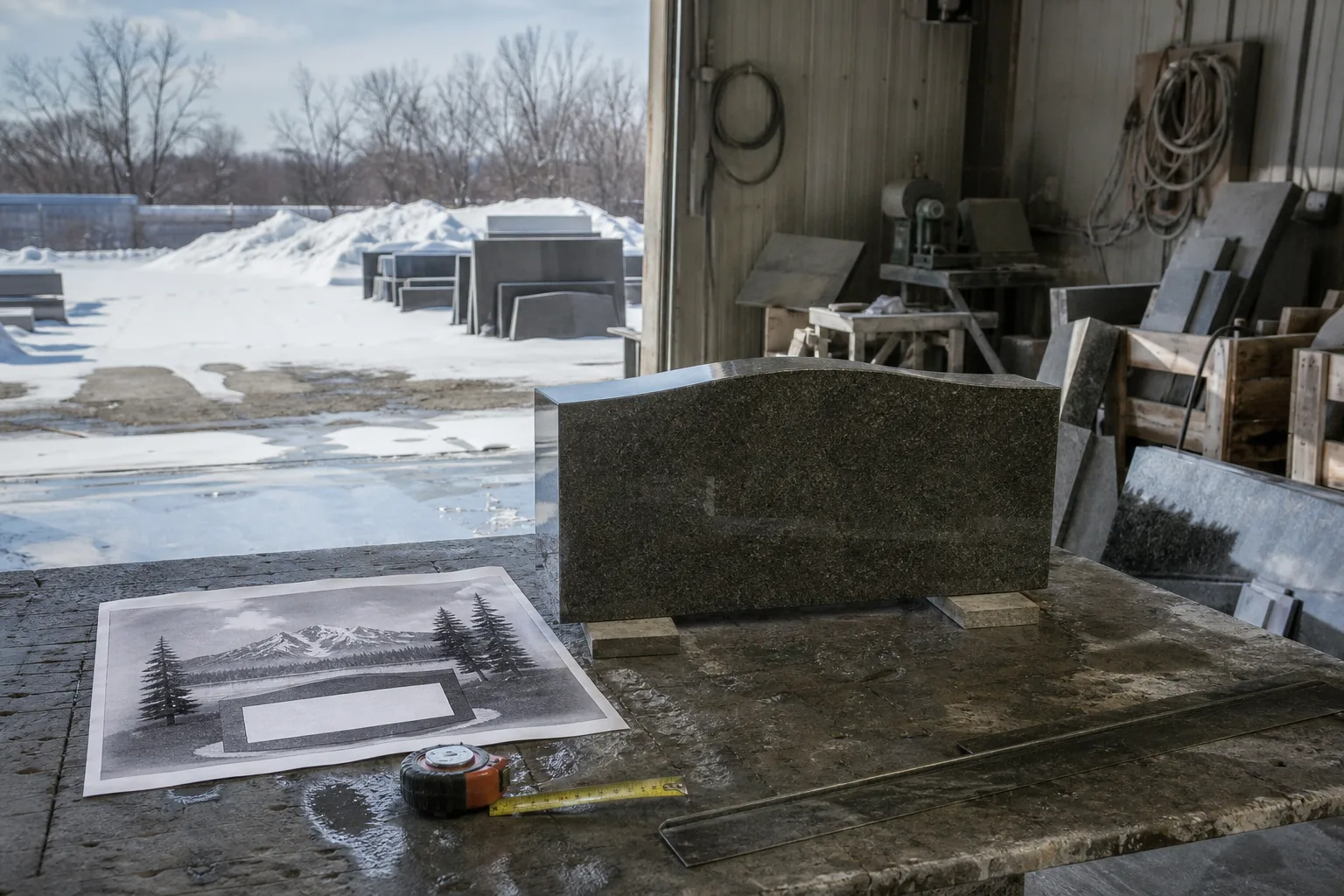
A family orders a granite marker the week after Thanksgiving. They pick the stone, they pick the lettering, they sign, they pay half. Then they ask when it will be in place, and the answer is April. Nobody lied to them. The answer was on page two of the order, in a paragraph about ground conditions that nobody read aloud at the counter.
This is the part of memorial buying that catches first-time buyers hardest, because it is the one decision where the calendar overrides everything else you chose. The stone is a purchase. The setting date is a condition. They are governed by different sentences in the same document, and only one of them is negotiable.
The frost clause, and what it actually commits the dealer to
Most monument purchase agreements in cold-winter states carry a provision limiting foundation work by season. The wording varies by dealer, but the shape is consistent. One common version says installation is scheduled subject to weather and ground conditions, that no foundations are poured while the ground is frozen, and that spring installations proceed in the order received.
Read each of those three parts separately, because they do different work.
Subject to weather and ground conditions means the date you were given verbally is not a promise. If a seller writes a firm date on the order, that is a different contract than the standard one, and it is worth asking for in writing.
No foundations poured while the ground is frozen is the operative restriction. Concrete does not cure reliably against frozen subgrade, and a foundation poured into frost heaves when the ground thaws. A heaved foundation tips the stone. A tipped stone in most cemeteries is the owner's problem, not the cemetery's, and resetting it is a separate charge.
In the order received is the sentence that costs money in a different currency. It means a December order and a February order are both April work, but the December order is ahead in the line. First-time buyers often assume waiting until spring to order avoids the delay. It does the opposite. Ordering in winter buys you a position in a queue that fills before the frost leaves.
Some dealers will set a stone on a temporary base or on an existing foundation during winter, if the cemetery allows it, then return to do permanent work later. That is worth asking about explicitly, because it is rarely offered without a question. The right question is whether the cemetery permits winter setting at all, and the answer to that lives in the cemetery's rules, not the dealer's.
The proof is the point of no return, and it moved online
Ten years ago, a first-time buyer in most markets approved a memorial design by looking at a paper drawing at a counter, or by receiving one in the mail. Some dealers sent a rubbing or a full-size layout on kraft paper so a family could see the lettering at actual scale. Approval meant a pen on a line, in person, on a specific afternoon.
Today the same approval usually arrives as a PDF by email, often with an electronic signature block. The approval language did not soften when the delivery method changed. A standard proof clause reads, in substance, that the purchaser has reviewed all names, dates, spelling and layout, that the design shown is the design to be produced, and that changes requested after approval are subject to additional charge or may not be possible once cutting has begun.
That last phrase is the one that matters. Sandblasting and laser etching both remove material. Granite does not go back. A misspelled name found after the stone is cut is a new stone, and the deposit on the first one is generally not returned.
The practical consequence of the shift to email proofs is that approval now happens fast, often at night, often on a phone screen, often by one family member acting for several. Three habits fix most of it. Print the proof at whatever size your printer allows and read the dates out loud against a document, not from memory. Check the birth year against a birth certificate or the death certificate rather than against what everyone remembers. And send it to the person in the family most likely to notice a wrong middle initial, before you sign, not after.
What ten years actually changed, and what stayed exactly where it was
The catalog side of the decision has moved more than the contract side. Laser etching of photographs onto polished black granite went from a specialty item to something most dealers quote as a matter of course. Design software means a buyer can see a rendering of their own stone in their own cemetery's typical shape within a day or two, instead of choosing from a printed book of stock designs. Several manufacturers now offer scannable plaques or tags that link to an online obituary or photo page.
Cemetery rules have moved less, and that is the gap that surprises people. A first-time buyer who spends an evening on a manufacturer's website designing an upright monument with a vase can arrive at a cemetery office and learn that the section they bought in permits flush bronze markers only, that vases must be flush-mounted or are prohibited, or that maximum dimensions are fixed by section. The rules generally predate the design tools by decades.
Pricing disclosure also sits differently than many buyers expect. The Federal Trade Commission is responsible for the rule requiring funeral providers to give itemized price information for funeral goods and services, and most buyers meet that rule at the funeral home. A monument dealer or a cemetery selling a marker is not always the same kind of seller under that framework. The workable move is to ask for the itemization in writing anyway, because a dealer who will put it in writing is telling you something useful either way.
The four numbers that make up a winter memorial quote
A first-time buyer usually hears one price. There are typically four components behind it, and separating them tells you where a delay or a change order will land.
- The stone and the cutting. Material, size, finish, and the lettering itself. This is the number the catalog quotes.
- The foundation. Often billed by the cemetery, not the dealer, and often on a per-inch or per-square-foot basis. It is the piece most affected by season.
- The setting or installation fee. Sometimes bundled with the foundation, sometimes separate, sometimes charged again if a second trip is required.
- Cemetery permit or inspection charges. Many cemeteries require written approval of the design before the dealer may deliver anything.
Ask which of those four the cemetery collects and which the dealer collects. Ask whether the foundation charge is refundable if the design is rejected at permit review. And ask what happens to your deposit if you cancel before cutting begins, because the answer will be in the agreement, phrased as a percentage or as "non-refundable once production has commenced." Find that phrase before you sign, and ask what event the dealer treats as commencement.
The calendar that works if you are ordering now
Winter buyers who want a stone in place for a spring anniversary or a Memorial Day gathering are working backward from a thaw they cannot schedule. The sequence that holds up is: cemetery rules first, then design, then proof approval, then permit submission, then production, then the foundation once the ground allows. Each step waits on the one before it. Compressing the front of that chain in December and January is what buys the flexibility later.
The design decisions are permanent, and that is the reason to make them slowly. The setting date is temporary, and that is the reason not to let it drive the design. Families who separate those two things tend to end up with the stone they actually meant to order.