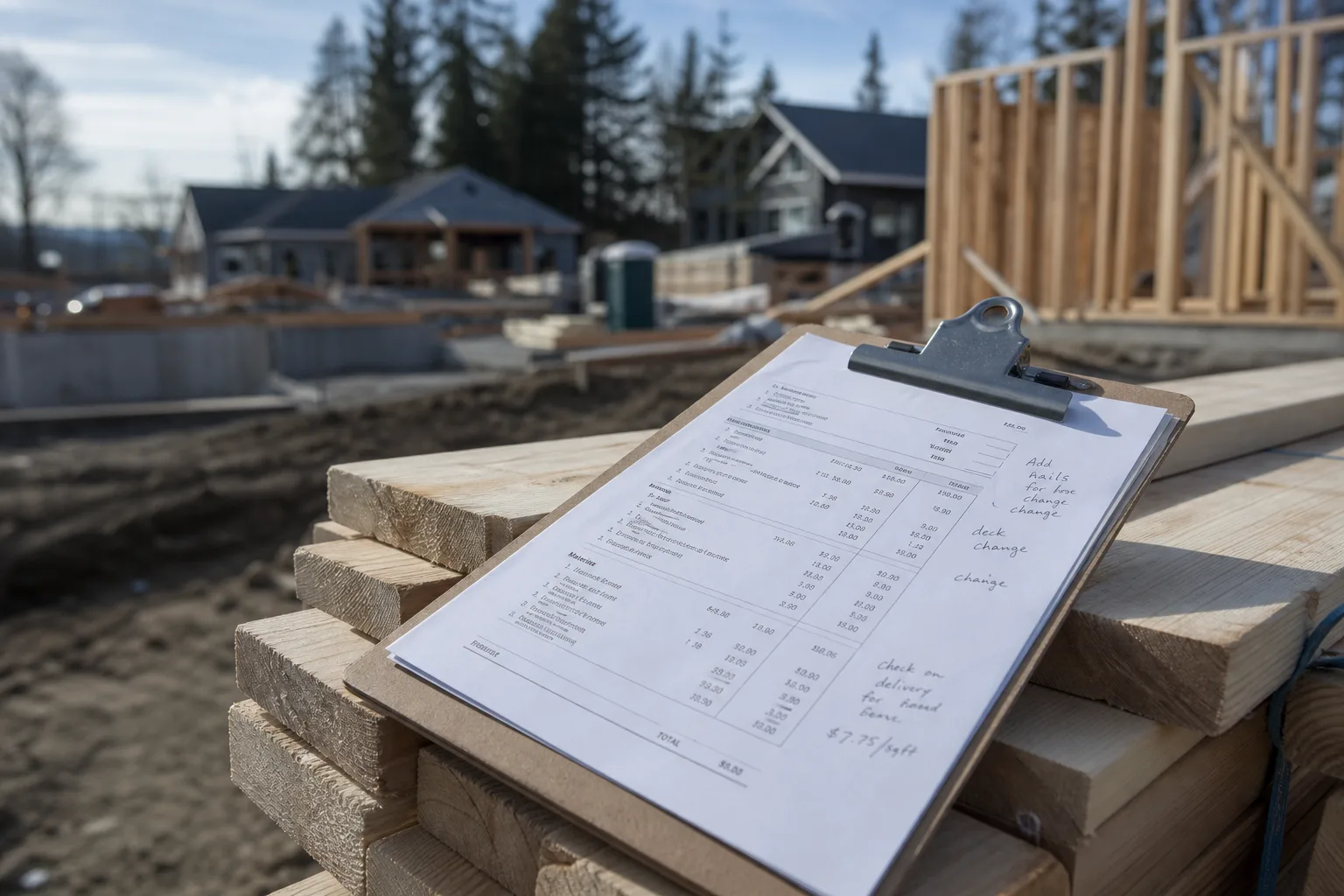
The scene repeats on jobs of every size. Work is going well, the customer is pleased, and somewhere around the middle of it they ask whether while you are here you could also handle a small adjacent thing, which is genuinely small and genuinely adjacent. Somebody says yes. Two more requests follow, the third one is not small, and by the final week the relationship has a note of grievance in it that neither party can quite locate the origin of. It is tempting to read that as a difficult customer. It is almost always a document.
An Estimate That Lists Inclusions Has Not Defined the Job
Most estimates describe what will be done, in a list of positive statements, and stop there. That feels complete and is not, because a job is defined by its boundary rather than by its contents, and a boundary requires saying what is outside as well as what is inside. Two people reading a list of eight tasks will each fill the surrounding space with their own reasonable assumptions, and those assumptions differ in ways neither of them can see until a specific request tests them.
The fix is a short exclusions paragraph written in the customer's language rather than in trade shorthand. Not a legal disclaimer, just four or five plain lines saying what this price does not include: painting after the repair, moving furniture, disposal of the old unit, work in the second bathroom, anything discovered inside the wall. Contractors resist this because it reads as negative and looks like an invitation to argue. It is the opposite, since an argument that happens over an estimate is a conversation and the same argument in week three is a dispute.
The Request Is Usually Reasonable, Which Is the Problem
Very few additional requests are cynical. A customer who can see that the wall is already open, the crew is already on site and the tools are already out is reasoning correctly about marginal cost, and their instinct that this is the cheap moment to do the extra thing is exactly right. What they cannot see is the schedule behind the job, the material that was ordered to a quantity, and the fact that a two hour addition on Tuesday moves a different customer's Thursday.
Which is why the reply that works is not a refusal but a price and a date. Yes, that can be done, it adds a stated amount and a stated number of days, and here it is in writing. That response treats the request as legitimate, keeps the relationship intact, and converts an ambiguous favor into a transaction both parties understand. Saying yes without the price is the move that produces resentment later, and it is almost always done to avoid a moment of mild awkwardness that would have lasted about fifteen seconds.
Change Orders Are Not Bureaucracy at Small Scale
The phrase change order sounds like something from a commercial project with a project manager, and the underlying idea works on a job worth a few thousand dollars just as well. It is one short written record per change: what was asked for, what it costs, how it affects the finish date, and an acknowledgment from the customer. A text message saying that the extra outlet adds a stated amount and half a day, answered with a yes, is a change order in every respect that matters.
What makes it work is doing it every time, including for the changes that cost nothing. A no charge item recorded in writing builds exactly the habit that makes the priced ones unremarkable, and it also creates a record of generosity that would otherwise go entirely unnoticed. Contractors who adopt this consistently report the same thing, which is that the volume of requests falls, not because customers are deterred but because a request with a number attached gets considered rather than floated.
Where the Discovered Work Fits
A separate category deserves its own treatment, and it is the one that generates the sharpest disputes. Some extra work is not requested by anybody; it is found, behind a wall or under a floor, and it has to be dealt with. An estimate that has said nothing about the possibility puts the contractor in the position of delivering unwelcome news that sounds like an attempt to raise the price, which is corrosive even when everybody behaves well.
Naming the possibility in advance defuses it entirely. A line saying that if the subfloor is found to be damaged the repair is priced separately at a stated rate does two things: it warns the customer that the outcome exists, and it fixes the price of it while nobody is under pressure. Photographs at the moment of discovery complete the picture. Customers accept discovered work far more readily than they accept a surprise, and the difference between the two is a sentence written weeks earlier.
The Argument Was Scheduled Before the Job Started
Read that way, the mid job friction stops looking like a clash of personalities and starts looking like a predictable consequence of a document that left too much space. Everything in it was decided at the estimate stage: what was in, what was out, what happens if something is found, and how a change gets priced. The people involved then act reasonably within that space and arrive at a disagreement neither of them chose.
Which means the fix belongs at the beginning and costs about twenty minutes per estimate. A short exclusions list, a named rate for discovered work, and a habit of writing down every change with a number and a date. Nothing about that makes a contractor harder to work with, and customers, who are mostly buying certainty rather than hours, tend to read it as competence. The job that ends without an argument is not the one with the easier customer. It is the one where the boundary was drawn before anybody needed it.