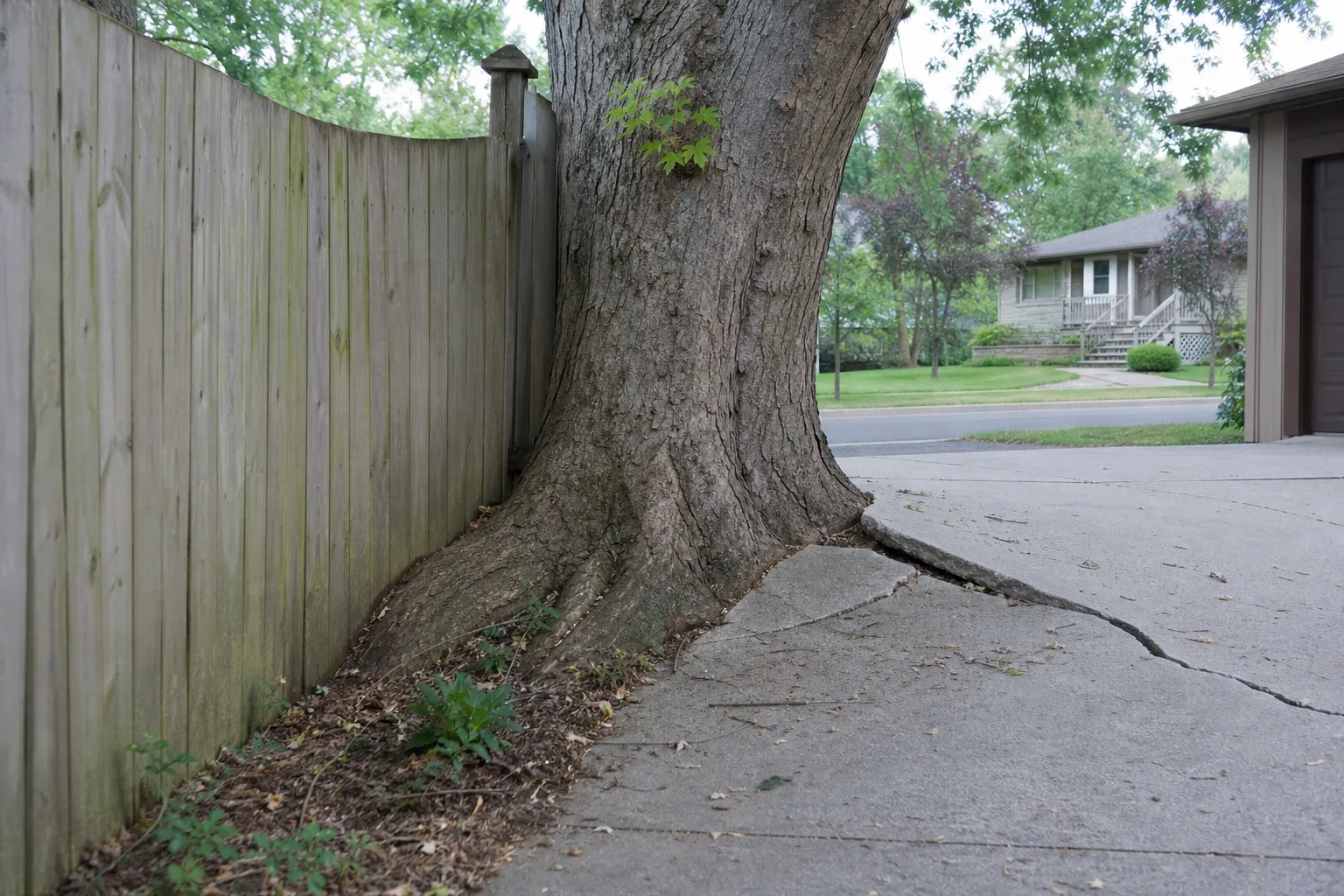
The silver maple stood where two backyards met in an older neighborhood of modest lots, the kind platted before anyone planted anything. Its trunk flared wide at the base and crossed the surveyed line by maybe eight inches. One homeowner wanted it gone because a limb the thickness of her waist hung over her detached garage. The other liked the shade on his patio in August. Between them, six weeks passed before a crew arrived, and almost none of that time was spent waiting on a saw.
What follows is the sequence they actually worked through, in the order the paperwork and the phone calls came. It is not complicated. It is just longer than most people expect, and the parts that cost money are not the parts people brace for.
Who owns a trunk that sits on the line
The first question was not whether the tree was dangerous. It was whose tree it was. In most of the country, a tree whose trunk crosses a boundary belongs to both owners jointly, and neither one can remove it alone without exposure. A tree rooted entirely on one side belongs to that owner, even if two thirds of the canopy hangs over the fence. The difference turns on the trunk at ground level, not the branches, not the roots, and not who rakes the leaves.
Nobody knew where the line was. The fence had been replaced twice and sat at an angle that matched no document. A licensed surveyor came out, set pins, and produced a drawing that put the trunk across the line by a few inches. That drawing cost less than either homeowner expected and settled an argument that had been running, quietly, for about four years. It also changed the project: this was now a joint decision, not a request for permission.
Roots complicated it further. The maple had lifted a section of the neighbor's driveway apron and was working on a sewer lateral. Root damage is one of those everyday consequences people rarely trace back to the tree. They call a concrete contractor about the heaved slab, pay to have it cut out and repoured, and three years later the same corner lifts again. The cause is forty feet away and ninety years old.
What the town wanted before anything came down
The homeowners assumed a tree on private property was nobody's business. In their municipality it was. The code listed protected species by diameter, required a permit application with an arborist's assessment attached, and gave the public works department a window to respond. A certified arborist walked the tree, found included bark in a major union and decay at the base, and wrote two pages explaining why the structure was failing. That document is what the permit reviewer actually reads.
Requirements vary enormously by town, and two adjacent jurisdictions can reach opposite answers on the same tree. Some places require nothing on private land. Some require a replacement planting of a specified caliper within a year. Some treat street trees in the right of way as municipal property regardless of who mows the strip. The only reliable move is to call the building or public works counter and ask by address before scheduling anything. The person who answers is usually the person who will approve it.
The inspector in this case asked for one change: the drop zone had to keep clear of a sidewalk during school hours. That was it. The permit came through in nine days.
Two bids that looked similar and were not
Three companies walked the property. Two bid. The numbers were far apart, and the gap was not markup. The cheaper bid was a straight felling price with the stump left at grade and brush hauled off. The higher one included rigging the limb over the garage down in sections, grinding the stump below the depth where a new footing would sit, and hauling the grindings instead of leaving a mound of chips to settle into a crater over the winter.
That is where most homeowners lose money on tree removal: they compare a total without comparing what each total includes. The questions that separated the two bids were simple. Is the stump ground, and to what depth? Who hauls the debris? Is the crew climbing and rigging, or dropping whole? Is there a traffic control plan for the street? What happens if a limb damages the garage, and who carries that risk?
On the last question, both homeowners asked for a certificate of insurance sent directly from the carrier, naming general liability and workers' compensation, with current dates. A crew without workers' comp can turn an injury on your lot into a claim against your homeowners policy. Tree work is high-hazard labor, and the Occupational Safety and Health Administration is the federal body responsible for workplace safety standards that govern crews working at height with saws. A contractor who cannot produce proof of coverage within a day is telling you something.
The agreement the neighbors wrote themselves
Because the trunk was shared, both signed a one-page letter before the deposit went down. It said who was paying what share, that both consented to full removal, that the stump would be ground, and that the fence section taken out for equipment access would be reset by the contractor at a stated cost. No attorney drafted it. Both kept a copy and emailed one to the tree company.
That page is what kept this from becoming the kind of dispute that runs for months. Boundary tree arguments rarely collapse over the big question. They collapse over who pays for the fence panel, or the ruts in the lawn, or the fact that one party assumed the stump was included. Writing those three lines down took ten minutes.
The crew came on a Tuesday and was gone by two in the afternoon. The patio lost its shade, which the neighbor had already accepted, and gained about five hours of direct sun. He planted a replacement in the fall, set back from the line this time, a species that tops out around thirty feet.
The driveway apron has not moved since.