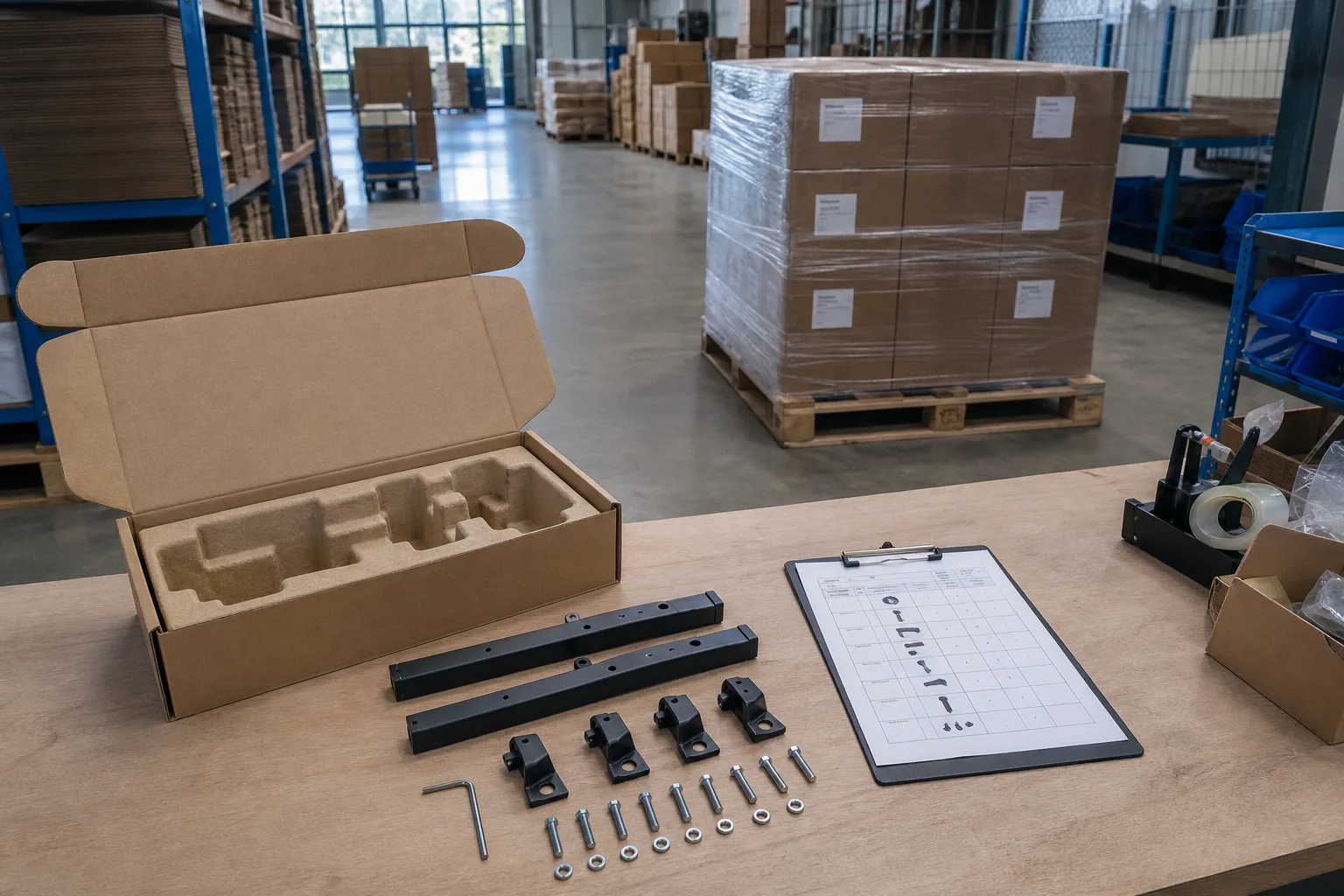
A pallet of retail display kits leaves a warehouse on a Tuesday. Forty-eight cartons, each holding a printed insert, a molded tray, three SKUs and a return label. On Friday the customer emails a photo of one carton with a crushed corner and asks who is paying. Nobody in the chain has a clear answer, and the reason is not that the situation is complicated. The reason is that nobody wrote anything down at the point where writing it down was cheap.
After enough of these, the pattern gets boring. Damage claims are not decided by who was actually careless. They are decided by whose records exist. That is a frustrating thing to accept the first time and a liberating thing to accept the tenth, because records are the part you control.
The pack spec is the whole argument, written in advance
The simplest useful document in this entire process is a one-page packing specification for each item you ship. Not a manual. One page. It names the carton, the interior material, the fill, the seal pattern, the label placement and the maximum stack height. If you kit, it names the assembly order too, because assembly order is what determines whether the heavy part sits on the fragile part.
Why is this so effective? Because every damage dispute eventually reduces to one question: was the goods properly packed for the journey it took? If you can produce a spec, a photo of a packed carton that matches the spec, and evidence the spec was followed on that date, you have answered it. If you cannot, the carrier will say improper packaging and you will have nothing to put against that.
The version of this that people are usually offered is far more elaborate: a packaging engineering study, drop testing to a published protocol, a full test report. That has real value for high-volume, high-value, fragile product, and if you are shipping thousands of units a month of something that breaks, do it. For most shippers, the honest first step is one page per SKU and a tape measure. Start there. Escalate when the claim history tells you to.
Photograph the pack, not the damage
Everybody photographs damage. Very few people photograph the outbound pack, which is the photo that actually wins.
The routine that works, in order:
- Contents laid out flat before packing, so the count is visible.
- The interior packed, before the flaps close.
- The sealed carton with the label readable.
- The finished pallet from two adjacent corners, showing wrap and stack.
- The pallet in the trailer or on the dock, with the seal or trailer number visible if you can get it.
Five photos. Under two minutes per shipment. Tie them to the order number in whatever system you already use, so retrieval takes a minute rather than an afternoon. When a customer sends you a crushed corner three days later, you are not arguing from memory. You are showing the carton leaving intact and the pallet standing square.
Keep them for as long as your claim windows run, and a little longer. Storage is not the constraint it was.
The bill of lading is where liability moves
The bill of lading does three things at once. It is a receipt, it is a contract of carriage, and it is the document on which the driver records the condition of the freight at pickup and the consignee records it at delivery. That third function is the one that gets wasted.
Two habits change outcomes more than anything else at this stage. First, put an accurate piece count and description on the BOL, including the number of cartons and the number of pallets, not just "1 skid." Second, train the receiving side, whether it is your customer or your own store, to write specific exceptions on the delivery receipt before signing. "Carton 12 crushed, top right corner, contents unknown" is a claim. A clean signature is a very hard thing to walk back.
Then there is concealed damage, which is damage found after a clean signature. It is claimable, but the window is short and the burden sits heavier on you. That is exactly the moment your outbound photos start earning their keep.
Interstate motor carriers operate under a federal liability framework, and the Federal Motor Carrier Safety Administration is the agency responsible for regulating them. Two practical consequences follow. Carrier liability is usually limited by weight, and those limits are frequently far below the value of what you shipped. A pallet of small, expensive kits can be worth many times what the tariff will pay on it. If the declared value matters to you, it has to be declared and priced at booking, or you have to insure the cargo separately. Deciding this after the loss is not a decision, it is a hope.
Fewer touches, fewer claims
The quiet truth about transit damage is that a large share of it is not caused in transit. It is caused during handling: repacking at a second location, opening cartons to verify contents, splitting a shipment across two facilities, re-taping a box that was opened for a count.
This is where consolidating assembly and packing under one roof pays for itself in a way that shows up in claim volume rather than in the freight bill. Many third-party warehouses now offer custom kitting services, meaning components arrive from multiple suppliers, get assembled into a finished kit, and get packed once to a fixed spec by people who pack that same kit every day. The shipment that leaves has been touched fewer times, and the pack matches the document.
Ask any provider three questions before you commit. Who writes the pack spec, you or them? Will they photograph the pack as standard, and can you get the images by order number? And what happens to the spec when you change a component, which you will. A provider who has done this a while will have plain answers ready. Vague answers here tend to become vague answers during a claim.
Build the claim file before you need it
Filing a freight claim is mostly assembly work. The file needs the bill of lading, the delivery receipt with the exception noted, photographs of the damaged goods and packaging, the original invoice or a cost breakdown proving value, and a repair-or-replacement figure. Some carriers want the damaged material held for inspection, which means telling your customer not to throw it away, which means telling them that in advance rather than after they already did.
Value is where claims stall. A carrier will pay actual loss, not list price, and if your only document is a customer-facing invoice you will spend weeks substantiating the number. Keep a standing cost sheet per kit: components, packaging, labor, inbound freight. Update it when your costs move. It takes ten minutes a quarter and it turns a contested claim into an arithmetic one.
Set your own internal deadline well inside the carrier's filing window, and put someone's name against it. Claims are rarely lost on the merits. They are lost by sitting in an inbox.
None of this requires a system purchase or a consultant. A one-page spec per item, five photos per shipment, a delivery receipt somebody was trained to annotate, and a cost sheet you keep current. Four documents, and they answer the question of who carries the loss before anyone has to argue about it.