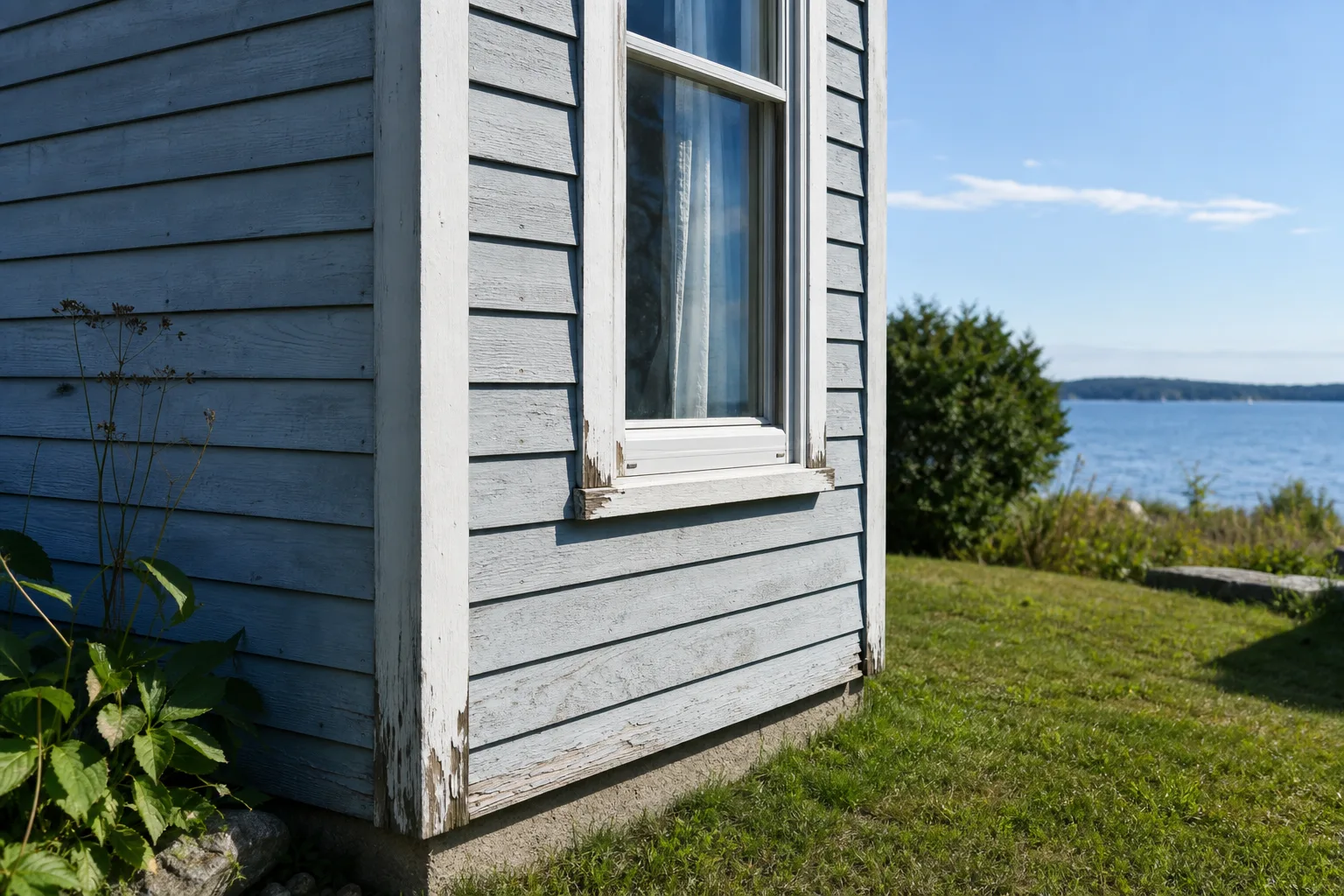
Stand at the southwest corner of an older wood sided house on a bright afternoon and compare two walls that meet at the same corner. The shaded elevation looks tired, with paint that has dulled and chalked but is still continuous. The sunlit one has gone somewhere else entirely: the film has cracked into a fine alligator pattern, curled away along the bottom edges of the clapboards, and opened completely at the window trim, where the wood beneath has gone gray and soft. Both walls were painted on the same day by the same crew.
Why One Elevation Ages at Twice the Rate
Exterior paint fails from ultraviolet exposure and from movement, and a south or west facing wall receives far more of both. The binder holding the pigment together breaks down under sustained sun, which is what chalking is, and the daily cycle of heating and cooling moves the wood beneath it far more than on a shaded elevation, which is what cracks the film. A sunlit wall also dries fast after rain and then bakes, so its coating does several years of work for every year the north side does.
The Moment the Bill Changes Category
As long as the film is continuous, even a dull and unattractive one, the wall is a painting job: wash, scrape the loose material, spot prime, and coat. The cost is labor and access, and it is predictable. Once the film opens, water reaches the wood every time it rains and leaves slowly, and the wood begins to cycle between wet and dry in a way it was never meant to. That cycling raises the grain, opens the joints and eventually softens the fibers, which is the point at which a painter starts using the word carpentry.
The transition is not gradual in cost even though it looks gradual on the wall. Replacing a length of clapboard means matching a profile that may no longer be manufactured, cutting into the courses above and below, and dealing with whatever is behind it, while a window casing rotted at its lower corners usually means pulling trim to find out how far the damage traveled. Two elevations of the same size can differ by a large multiple depending only on which side of that line they fall.
The Places That Fail First and Are Easiest to Watch
Failure is not evenly distributed across a wall, which is why a single repainting schedule for a whole house tends to be wrong in both directions at once, and why knowing where to look turns an annual inspection into a ten minute walk on each elevation in turn. Horizontal surfaces hold water, so the top edge of a window casing, the sill, and the flat of a corner board go first. End grain absorbs water many times faster than face grain, so the cut ends of boards and the mitered corners of trim are the next candidates. Anything within a foot of the ground, or behind a shrub that keeps a wall damp, is on a shorter clock than everything above it.
What the Repair Actually Consists Of
A job that has crossed the line has four parts and only one of them is paint. There is the carpentry, replacing what is beyond saving and splicing in new material. There is the preparation, which on a badly failed wall means scraping back to sound substrate and often takes longer than the painting. There is priming, particularly on bare wood and end grain, where skipping it guarantees a repeat in three years. Then there is the finish coat, which is the part everybody pictured when they asked for a quote.
Houses built before the late 1970s add a further consideration that changes both the method and the price. The Environmental Protection Agency sets the rules for renovation work that disturbs paint in older housing, and a contractor who is certified under them will contain the work area, use specific practices and dispose of debris accordingly. That is a legitimate line on an estimate rather than padding, and an estimate for an older house that shows no sign of accounting for it is worth a question.
Six Years of Savings and What They Bought
The arithmetic on deferral is not complicated once both numbers sit on the table. Repainting an elevation on schedule buys another cycle of protection at a known price. Deferring it saves that price for a few years and then buys the same coating plus whatever carpentry accumulated meanwhile, which does not go away and is not recoverable by painting over it. Wood that has been wet and dry for four winters is not restored by a good primer, and the bill is the same whether the owner chose the delay or never noticed it.
Which is the quiet lesson of that corner where two walls meet. The north side was never the problem and never needed most of the attention it received, while the south side asked for a weekend of scraping and a couple of gallons at year six and, not getting either, submitted a considerably larger invoice at year nine. Paint looks like a decision about appearance, and on a sun exposed elevation it is a decision about how much of the wall you intend to keep.