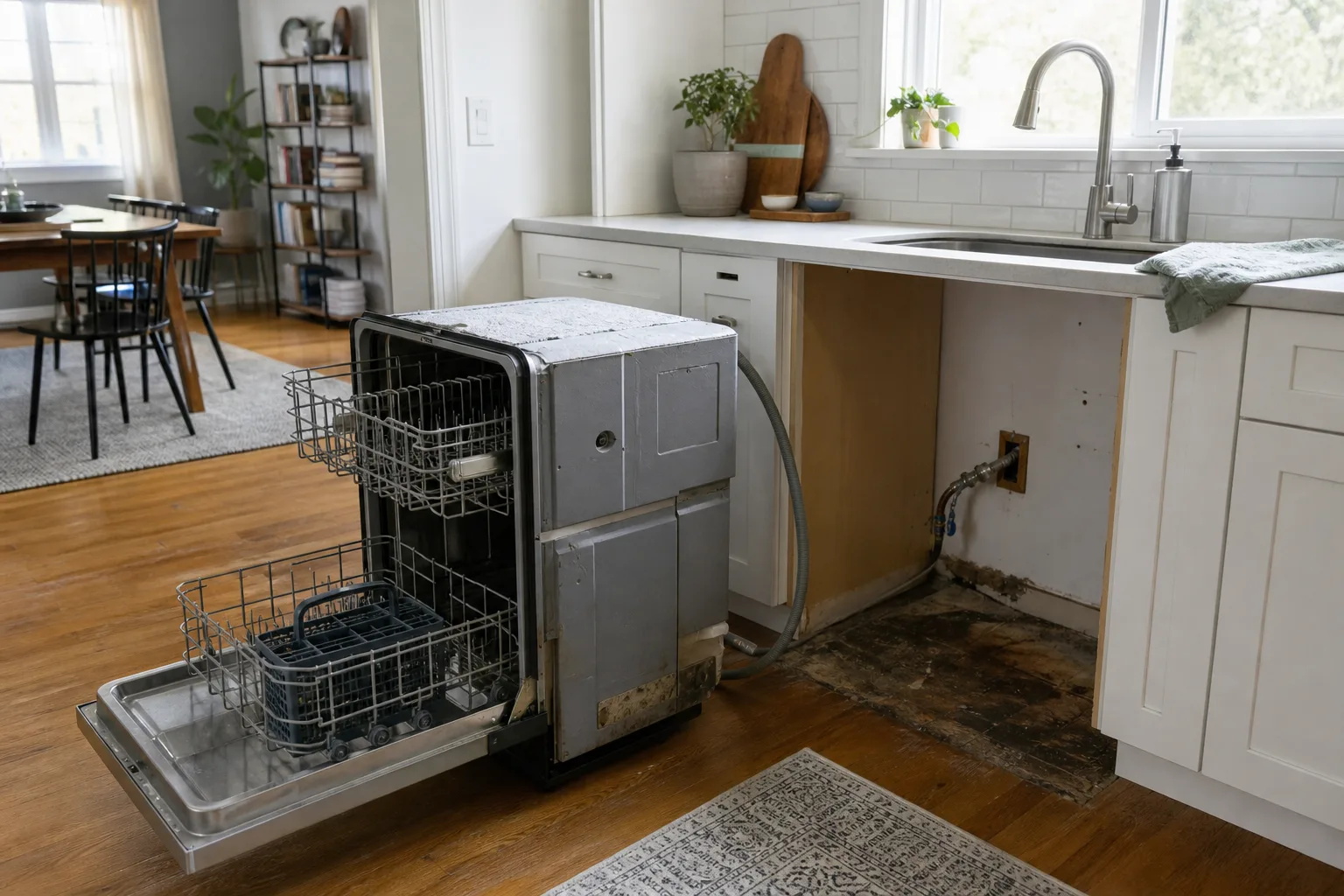
A dishwasher supply fitting weeps a small amount of water, not enough to reach the floor of the kitchen, and it does this for something over a year. The account below is composited from the shape these losses usually take rather than drawn from one household's paperwork. There is no bang, no puddle and no moment anybody could point to afterwards, which is precisely what makes this category expensive. By the time somebody notices a floorboard flexing near the cabinet run, the repair involves three trades, and the insurance answer is one nobody in the household expected.
What a Year of Almost Nothing Actually Does
A slow leak behaves completely differently from a burst line. The volume is small enough that it is absorbed rather than pooled, so it goes into the particleboard base of the cabinet, into the subfloor beneath, and along the joists by capillary action, wetting and partly drying in a cycle that repeats several times a day for months. Materials handle a single soaking far better than they handle that cycle, because each round leaves them slightly weaker and the recovery is never complete.
The visible signs arrive very late and are easy to explain away. A cabinet base that feels soft at the front edge, a section of flooring that has cupped slightly, a smell in the cupboard that seems like something spilled, a faint dark line along a grout joint. Each of these individually looks like ordinary wear in a kitchen that has been used for a decade, which is why the interval between the first sign and anybody investigating is usually measured in months.
The Investigation That Nobody Wants to Start
Finding the extent requires pulling the appliance out and taking up a small area of flooring, and the reluctance to do that is entirely rational because everybody knows the answer will be inconvenient. What was found in this case was the usual pattern: staining on the subfloor spreading well beyond the appliance opening, a joist with a darkened top edge, the base of two cabinets delaminating, and growth on the underside of the floor covering where it had been trapped against damp material.
The Environmental Protection Agency's guidance on indoor moisture draws a practical line at around ten square feet, above which a mold problem is generally treated as a job for somebody with containment equipment rather than a bucket and a spray bottle, and this area was well past that. That threshold is a useful piece of arithmetic for any household staring at a discovery of this kind, because it converts an alarming and open ended question into a fairly concrete one about the size of the affected area.
Three Trades and the Order They Have to Come In
The repair sequence is what makes this kind of loss expensive relative to its drama. The plumber comes first and is the cheapest visit, replacing a fitting that costs almost nothing. Then the remediation work, which involves removing the affected materials under containment, treating what remains and drying the structure properly, and which cannot start until the water source is confirmed fixed. Only after that can the carpentry and finish work begin, because nobody should be installing new cabinetry onto a subfloor that is still holding moisture.
Each handoff introduces a delay, and the delays are what turn a two week job into a six week one. A household without a kitchen for that period is also incurring the ordinary costs of eating differently, which are real and, in a claim of this kind, frequently not recoverable. Scheduling three trades in sequence in the order the building requires, rather than in the order they happen to be available, is the single thing that most improves the experience.
The Insurance Answer Nobody Wanted
This is where a slow leak departs sharply from a burst pipe. Most homeowners policies cover water that escapes suddenly and accidentally and exclude damage caused by seepage or leakage that has continued over a period of weeks or months, and a fitting that wept for a year sits squarely inside the exclusion. The claim in this case was declined for the damage, which is the ordinary outcome and not an aggressive reading of the policy by anybody.
Two things soften that, and both are worth knowing before making the call. Some policies pay for the cost of tearing out and replacing the part of the building necessary to access the failed component, even where the resulting water damage is excluded, which is a narrow but real benefit. And where the failure was genuinely sudden and simply undiscovered for a short period, the distinction between undetected and gradual can matter, which is why a plumber's written description of what was found is worth more than any homeowner's account of when it probably started.
What a Loss Like This Does to a Later Sale
The other consequence surfaces years afterwards, at the point somebody tries to sell the house. Most states require a seller to disclose known material defects and past water damage, and a repair of this kind is exactly the sort of history a disclosure form asks about, so the paperwork produced during the remediation becomes an asset rather than an embarrassment. A household that can hand a buyer a containment report, a set of drying records and invoices from three named trades is describing a problem that was properly resolved.
A household that cannot produce any of that is describing a rumor, and buyers price rumors conservatively. Inspectors find evidence of past moisture readily, through staining on framing visible from a crawlspace or a reading taken at a subfloor, and the difference between a documented repair and an undocumented one shows up directly in the negotiation. Keeping the file is the cheapest step in this entire account and the one most likely to be skipped once the kitchen looks normal again.
What Would Have Caught It, and What It Would Have Cost
The preventive measures here are almost comically cheap against the outcome. A battery powered water alarm sitting on the floor under the sink or behind the dishwasher costs very little, runs for years and will sound at the first cup of water, which is the entire failure mode this loss depends on. Braided stainless supply lines with a stated service life, replaced on schedule rather than when they fail, are the other half of it.
The habit that costs nothing at all is looking. Pulling out the base of a sink cabinet twice a year with a flashlight, running a hand along the connections, and putting a sheet of white paper under a fitting overnight will find a weep long before it finds a floor joist. Households that have been through one of these adopt that habit permanently, which is a reasonable response to a bill that arrived two winters after the actual event and could have been prevented by a five minute inspection at any point in between.