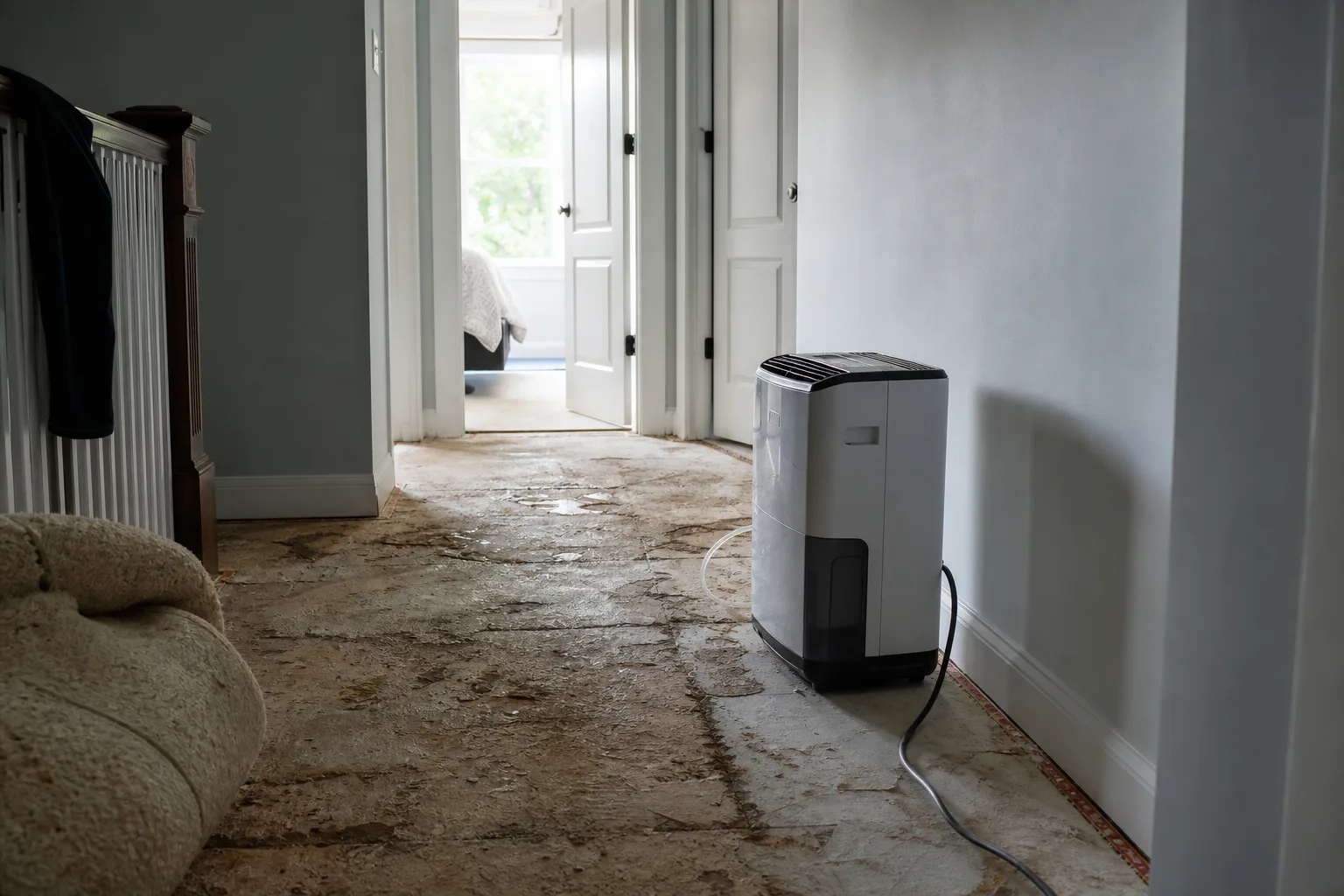
Put the question to anyone who dries buildings for a living and the answer arrives quickly enough to suggest they have given it before: the cost of a water loss is set in the first two days, and almost none of what happens in those two days involves a contractor. It is done by whoever is in the house, usually at an inconvenient hour, usually without any idea that the decisions being made are the expensive ones. What follows afterwards, the estimates and the scheduling and the arguments, is largely a consequence of choices already taken by then.
Stopping the Water Is Only the First Half
Everyone gets the first part right, because a running leak is obvious and the instinct to stop it is correct. What gets missed is that the water already in the building keeps moving after the source is closed, traveling along joists, wicking up drywall, running under flooring and settling into wall cavities that look completely dry from the room. A ceiling stain the size of a dinner plate frequently sits beneath an area of wet insulation many times larger, and the insulation holds the water rather than releasing it.
Which is why the useful first hour is spent finding the edges rather than mopping the middle. Feel the baseboards well beyond the visible damage, check the ceiling in the room below and the closet on the other side of the wall, and look at the underside of the floor if there is a basement or a crawlspace. The point is not to fix anything yet. It is to know how big the wet area actually is, since every later decision depends on that boundary and it is easiest to establish while the water is still fresh.
Air Movement Beats Every Other Response
Materials dry through evaporation, and evaporation needs moving air and somewhere for the moisture to go. A pair of ordinary box fans aimed across a wet floor and a dehumidifier running in a closed room will accomplish more in the first day than any amount of towel work, and the closed room matters, because opening the windows on a humid day imports moisture rather than exporting it. Heat helps too, within reason, so a house that is already warm dries faster than one where somebody turned the furnace down.
Speed matters here in a way that is genuinely non linear. Wet materials handled within roughly the first day usually dry in place and keep their finish, while the same materials left for three or four days begin to swell, delaminate and grow things, at which point they stop being a drying problem and become a demolition problem. Carpet and pad, cabinet toe kicks, engineered flooring and drywall all sit on that clock, and the clock does not pause because it happens to be a weekend.
Which Materials Are Worth Saving and Which Are Not
Some things dry and some things do not, and knowing the difference prevents both wasted effort and false economy. Solid wood, plaster, framing and concrete generally recover if the water leaves quickly enough. Carpet padding, fiberglass insulation soaked through, particleboard and the paper faces of saturated drywall generally do not, and every hour spent trying to save them is an hour the surrounding materials are not drying. Removing four inches of baseboard and drilling small holes behind it is a common professional move precisely because it lets a wall cavity dry without taking the wall apart.
The nature of the water changes the calculation entirely. Clean water from a supply line is a drying problem. Water from a drain, a dishwasher, a washing machine or anything involving sewage is a contamination problem, and porous materials it has touched are generally discarded rather than dried regardless of how quickly anyone acted. That distinction is worth establishing in the first hour, because it determines whether the response is fans and patience or removal and disposal.
Documenting a Room You Are About to Change
Everything done in the first two days alters the evidence, which is unavoidable and is exactly why the photographs come first. Wide shots of each affected room, medium shots of the damage, close shots of anything with a model number or a specification, and a short video walking the space while narrating what is wet. Photograph the source too, and the meter reading if anyone takes one. This takes ten minutes and it is the only record that will exist of what the house looked like before the fans and the demolition changed it.
Keep every receipt from the same period, since the cost of preventing further damage is usually recoverable under the policy and usually only recoverable with paperwork. Note the times as well as the dates. A log showing that the leak was found at nine in the evening, the water shut off at nine fifteen and fans running by eleven is a direct answer to any later suggestion that the damage was allowed to develop, and it costs nothing to write down while it is happening.
Why the Second Day Is the One People Regret
Day one runs on adrenaline and day two runs on fatigue, which is why the second day is where the expensive omissions cluster. The floor looks better, the smell has faded, the fans are noisy and somebody switches them off, and a wall cavity that was two days from dry stays damp inside a closed room for a fortnight. Mold does not require a flood, only sustained moisture and time, and the Environmental Protection Agency's published guidance on indoor moisture keeps returning to the same practical point, which is that drying quickly matters more than any product applied afterwards.
The reasonable standard is not perfection but persistence: keep the air moving until a moisture meter, borrowed or hired for very little, reads the same in the affected material as it does in an unaffected part of the same room. Then leave it running another day. All of which returns to the person standing in a hallway at eleven at night with a towel and a bucket, who has no idea they are the most important contractor on the job. They are, and the two days in front of them are worth more than anything that happens in the six weeks afterwards.