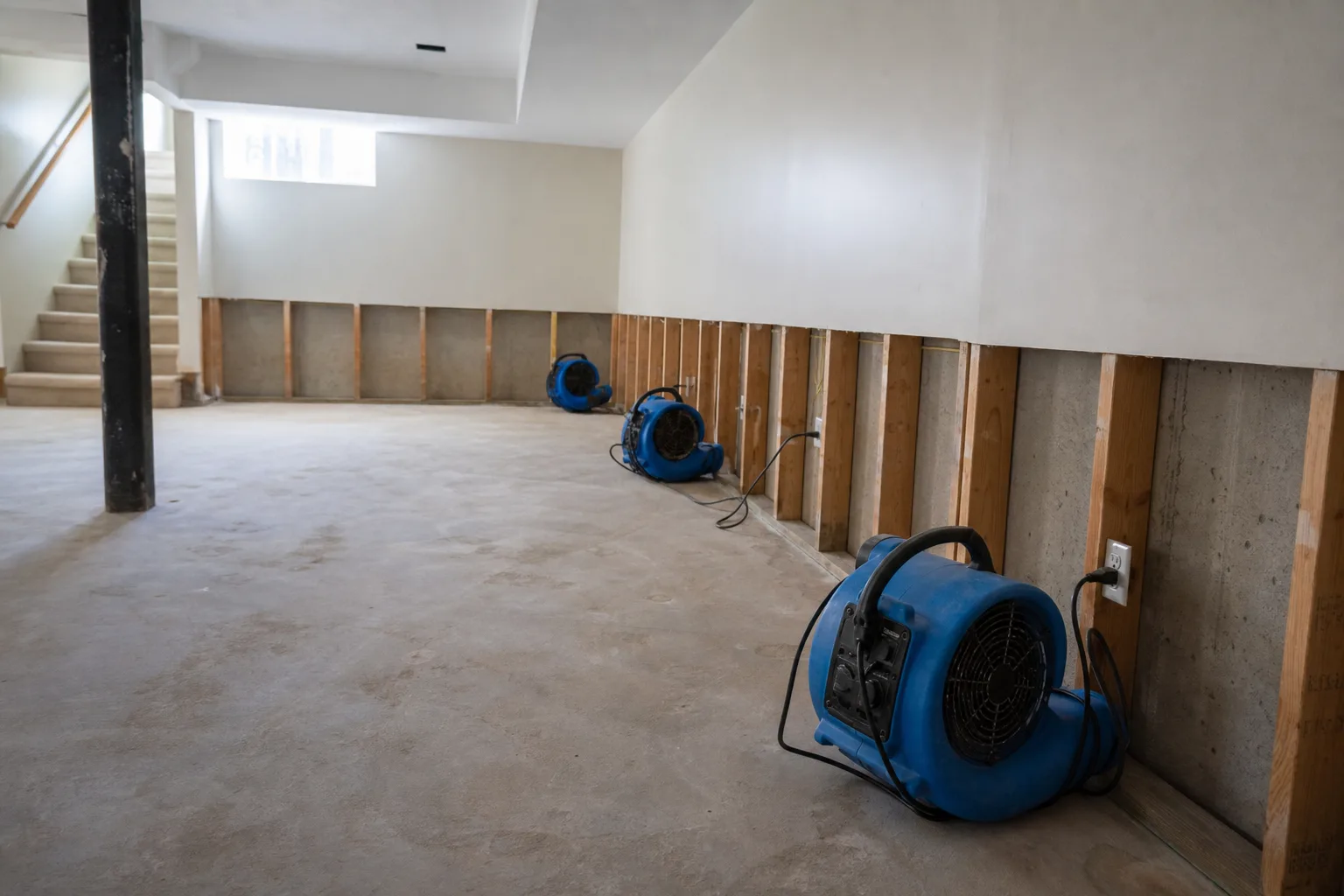
A sump pump stopped during an overnight storm and a finished basement took several inches of water across most of its floor. The account that follows is composited from the pattern these losses ordinarily take rather than taken from one household's file, and the physical repair in it was never really in question: carpet out, drywall cut back, dry the structure, put it back. What took twenty two days and produced a genuine disagreement was the middle step, because two parties looking at the same room reached different conclusions about whether it was finished.
The Night the Pump Stopped and What Was Actually Wet
The failure was mundane. A float switch stuck, the pump did not run, and by the time anybody was awake the water was above the level of the baseboards and had been sitting for several hours. Water at that depth reaches further than it appears to, because drywall wicks upward from its cut edge and carpet pad holds many times its own weight, so the visible tide line on the wall was well below the height the moisture had actually traveled by morning.
The first useful act was mapping rather than mopping. Somebody walked the perimeter with a hand held moisture meter borrowed from a hardware store, marked where readings stopped being elevated, and photographed each wall with the marks visible. That map is what later made the drying plan arguable rather than a matter of opinion, and it took about twenty minutes at a point when everybody wanted to be doing something more obviously useful.
Why the First Two Days Set the Ceiling on the Cost
Extraction happened the same morning, which is the single most consequential timing decision in a loss like this. Standing water removed within hours keeps the problem inside the materials that were directly wet, while standing water left overnight pushes moisture into framing, into the underside of the subfloor above and into anything porous within reach, and the difference between those two outcomes is most of the eventual invoice.
The carpet went out immediately and the pad went out with it, both of which are ordinary practice, because pad is essentially a sponge and carpet that sat in water from a sump basin is not a candidate for salvage regardless of how new it was. Drywall was cut back about two feet, above the highest elevated reading rather than at a standard height, and the insulation behind it came out in the same operation. That decision, driven by the map rather than by convention, is why the wall cavities dried at all.
What Three Weeks of Equipment Actually Does
The drying setup looked excessive and was not. Several air movers were positioned to push air along the wall surfaces rather than at them, which is what lifts the boundary layer of saturated air off a material and allows evaporation to continue, and two dehumidifiers ran continuously with the basement closed off from the rest of the house. Opening a window would have felt intuitive and would have imported humid summer air into a space actively trying to lose moisture.
Containment mattered as much as the machinery. Sealing the stairwell kept the dehumidifiers working on one volume of air rather than on the whole house, which is the difference between equipment that is sized correctly and equipment that is merely present, and it also kept the noise and the warmth in one place. Air movers were repositioned every couple of days rather than left pointing at the same spot for three weeks, since a surface that has already given up its free moisture gains nothing from more air while the wall six feet along is still holding water in its lower third.
Readings were taken daily in the same places, marked on the same map, and written down. That daily record is the part households almost never keep, and it is the difference between knowing that a wall is drying and believing it is. It also revealed the ordinary pattern: rapid improvement for the first several days, then a long flat stretch where very little appears to change and everybody starts to suspect the equipment is not working.
That flat stretch is the reason these jobs run for three weeks rather than one. Free water leaves quickly and bound water leaves slowly, and the last portion of moisture in framing lumber and in the bottom plate resting on a concrete slab takes far longer to release than the first. Slabs themselves hold and give back moisture on a much longer timescale, which is why a basement can read dry on the walls while the floor continues to feed humidity into the room.
The Disagreement About Whether It Was Dry
Around day twelve the room passed every informal test. It smelled normal, the surfaces felt dry, and the visible damage was gone. The contractor wanted to close the walls and get the household's basement back, the household wanted the equipment gone, and the adjuster was being asked to authorize the rebuild. Everyone in that conversation was acting reasonably and two of the three were relying on the sense that a room feels dry, which is not a measurement.
The complication was the bottom plate, the horizontal piece of framing lumber sitting directly on the slab at the base of each wall. It is the last thing to dry in nearly every basement, it is hidden behind whatever gets installed over it, and it is the piece most likely to cause a problem months later if it is closed up while still holding moisture. A meter reading taken at the plate was consistently higher than readings taken a foot above it, and that gap was the whole argument.
What made the disagreement difficult was that nobody had agreed in advance what finished meant. Drying is complete when the affected materials reach the moisture content of comparable unaffected materials in the same building, which is a standard anybody can apply and almost nobody states at the beginning. Without that definition, the discussion becomes a negotiation between a schedule, a rental bill and a household's patience.
The Two Readings That Settled It
The resolution was straightforward once somebody proposed it. Take a reading from the bottom plate in the affected wall and a second reading from the same component in a wall on the far side of the basement that had never been wet, using the same meter on the same setting, and compare the two rather than judging either against an abstract number. That comparison removes every variable that makes a single reading arguable: the species of lumber, the age of the building, the humidity of the season and the calibration of the instrument.
The two readings converged on day twenty two. At that point the case for closing the walls was not an opinion held by a contractor or a doubt held by a homeowner but a comparison anybody in the room could see, and the rebuild started the following morning. The whole dispute had lasted longer than the final stretch of drying it was about, which is the usual proportion in these things.
What the Twenty Two Days Bought
Measured against the alternative, the extra ten days of equipment cost a modest rental figure and prevented the failure mode that makes these losses expensive twice: a wall closed up over damp framing, a smell that develops in the autumn, and a second demolition of a basement that had only just been finished. Nobody ever gets to see the version of the story where that happens, which is precisely why the patience is hard to justify while the fans are still running.
The insurance side of it was less contentious than the drying, largely because the paperwork existed. Sudden discharge from a failed sump is treated differently by different policies, and this household had bought the backup endorsement some years earlier for a small annual sum without ever expecting to use it, which is the only reason the finished basement was covered at all rather than just the structure. The photographs taken on the first morning, the daily readings and the equipment rental invoices went in together, and the file was closed without anybody having to reconstruct anything.
The household changed three things afterwards, all of them small. A battery backup was fitted to the sump so a power failure or a stuck float has a second answer. A water alarm now sits on the basement floor and will wake somebody at three in the morning. And the drying map, the daily readings and the photographs went into the same folder as the policy, because the next time anybody has this argument they will be having it with a record rather than with a memory of a room that felt dry.