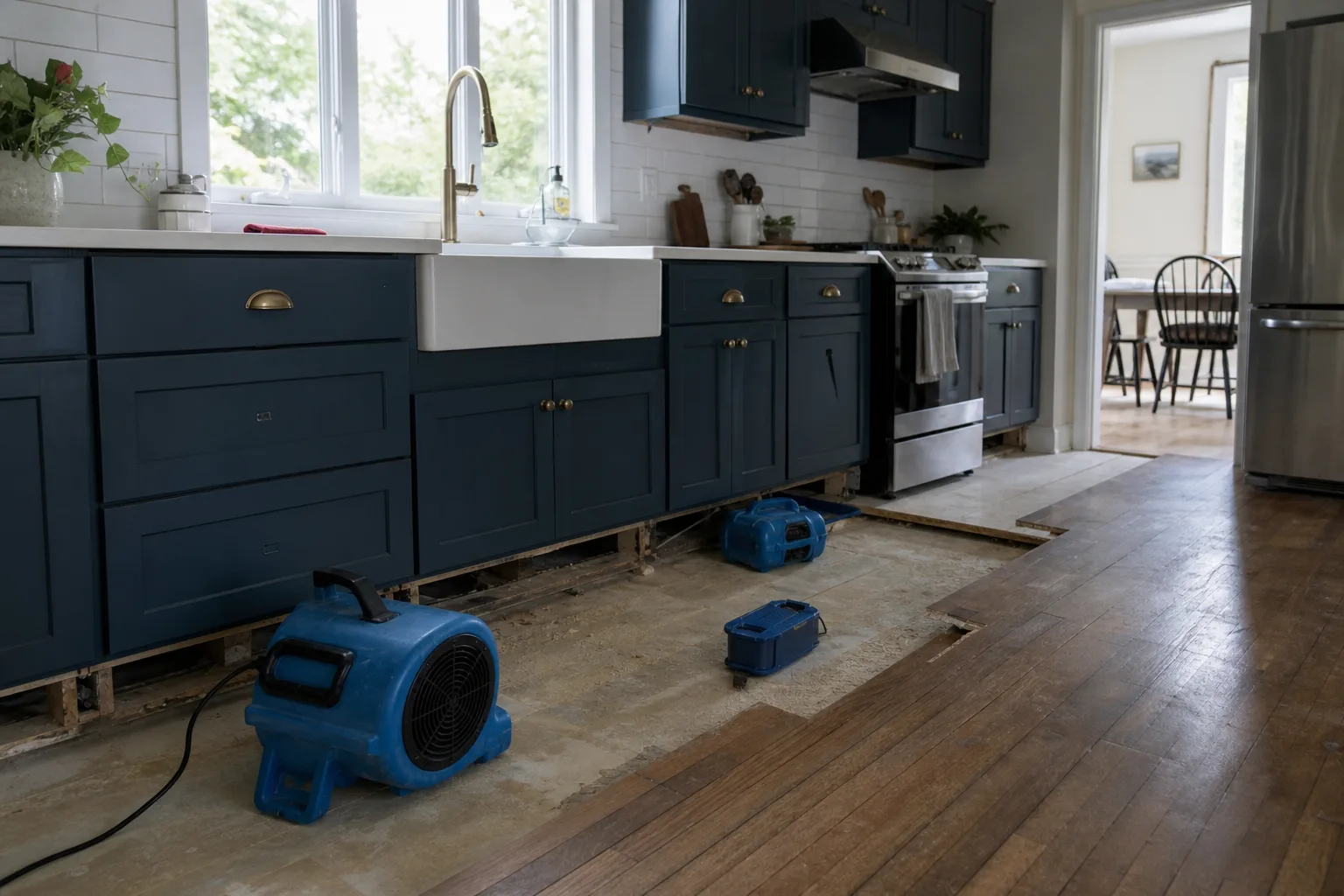
A braided supply line under a kitchen sink lets go on a Wednesday while nobody is home, and by the evening there is water across the kitchen floor, into the adjoining room and through to the ceiling below. The physical event lasts a few hours. The financial one lasts about eighteen months and arrives in roughly a dozen pieces, most of which the household has never heard of on the day it happens. Setting them out in the order they land is the closest thing there is to a map of what the next year and a half will cost.
The Emergency Work Nobody Shops Around For
The first money out is spent at speed and without comparison. Somebody stops the water, which may be a plumber at an evening rate, and somebody extracts the standing water and sets equipment, which is usually a restoration company reached through the insurer or through a search made in a hurry. Neither of those purchases is negotiated, and neither should be, because the alternative is several more hours of water sitting in the building and a materially larger bill afterwards.
What that stage costs depends almost entirely on how long the equipment stays. Air movers and dehumidifiers are priced per unit per day, and a kitchen with cabinetry, a subfloor and a ceiling cavity below routinely runs for a week or more, so a modest daily figure becomes a line worth arguing about by the end. This portion is generally covered, generally paid directly to the vendor, and generally the part a household never sees an itemized copy of unless they ask for one, which they should.
The Demolition That Determines Everything Else
Somewhere in the first week a decision gets made about how much comes out, and it drives most of the remaining cost. Cabinets built from particleboard that have taken water at the toe kick do not dry into serviceable cabinets, and the base run usually leaves. Flooring depends on what it is: sheet vinyl over a wet subfloor comes up, engineered plank frequently swells at the joints, tile may survive while the material under it does not. The ceiling below opens up wherever it was wet, which is nearly always further than the stain suggests.
The awkward part is that demolition is priced modestly and dictates the largest numbers in the file. Removing one run of base cabinets means the countertop above it comes out, and a stone countertop rarely survives removal intact, which turns a cabinet decision into a countertop purchase. Similarly, flooring that runs continuously from the kitchen into two other rooms cannot be replaced in one room without a visible line, which is the single most common flashpoint in the entire settlement.
The Rebuild, Which Is the Part People Expect
Cabinetry, countertop, flooring, drywall, paint, trim and the reinstallation of appliances and plumbing make up the visible repair, and it is the only portion most households picture when they think about the cost. It is also the portion where scope disagreements concentrate, because an insurer's estimate is built from a line item pricing system and a contractor's estimate is built from what they intend to do, and the two describe the same kitchen at different levels of resolution.
Matching is the recurring argument. A discontinued cabinet door, a tile that is no longer made, a floor whose color has been superseded: each of these raises the question of whether the policy pays to replace the damaged portion or the continuous surface it belongs to, and the answer sits in the policy language rather than in anybody's sense of fairness. Reading that language before the argument, rather than during it, is worth a great deal.
The Money the Household Pays Regardless
Three lines come out of the household's own pocket in almost every claim of this kind. The deductible is the obvious one and the only one most people have thought about. The second is depreciation, because policies paying replacement cost typically release the depreciated value first and hold back the remainder until the work is complete and invoiced, which means the household is financing a portion of its own repair for several months and has to produce receipts to recover it.
The third is everything the policy simply does not cover: an upgrade the household chose because the kitchen was open anyway, the difference between a builder grade replacement and what was actually there, and code required work above whatever ordinance and law coverage the policy carries. None of these is a surprise if somebody reads the settlement documents carefully, and all of them are a surprise to the household that assumed a covered loss means a free kitchen.
The Costs That Are Not Building Work at All
Contents are their own claim within the claim: the food that spoiled, the small appliances, the contents of the base cabinets, anything on the floor of the room below. They settle on their own terms, at replacement cost or actual cash value depending on the policy, and they require the inventory that nobody feels like writing in week one and everybody wishes they had by week four.
Loss of use is the other line that goes unclaimed with some regularity. A household without a functioning kitchen for six weeks is spending materially more on food than it usually does, and additional living expenses coverage exists to meet exactly that gap, in the amount by which normal spending increased. It requires receipts and a small amount of bookkeeping, and it is money the policy has already agreed to pay to anybody who bothers to document it.
The Line That Arrives a Year Later
The final piece lands at renewal, long after the kitchen is finished and everybody has stopped thinking about it. A paid water claim generally affects the premium, sometimes for several years, and it sits on the loss history that follows the property rather than only the policyholder, which can matter at the point of sale. That figure is genuinely unpredictable and depends on the carrier, the state and the claim history, but it belongs on the map because it is the reason small claims are frequently not worth making at all.
Which is the useful thing to take from a bill counted this way. The repair everybody pictured is perhaps half of it, and the other half is distributed across an emergency nobody shopped for, a demolition that decided the scope, three lines the household pays itself, two claims that only get paid if somebody documents them, and a renewal notice eighteen months later. A braided line under a sink costs a few dollars and takes fifteen minutes to replace on a schedule, which is a piece of arithmetic worth doing before rather than after.